Love, Acceptance, and Negotiation…turning Me 2 We… The idea is that fighting against yourself or others removes what is necessary to flow through challenging times. The energy of fighting shifts you away from what you need, away from your sensory guidance system; removing fight from your vocabulary helps you to access precisely what you need when you need it, so that you can shift out of any painful situation to find peace, your soul-utions, and balance.
If the challenging situation is an addiction to substances, experiences, or people in an unhealthy way – then these actions help you to remain in recovery. 4simple phrases to return you to balance and remain in recovery. Recovery is a journey rather than a destination.
Step one is to find your way to balance. Step two is returning to balance. The Path to Grace is a journey that cycles between these two steps. Listening to your sensory guidance system, led by your spirit connection. Removing fight from your vocabulary and focusing on love, acceptance, and negotiation helps you return to balance and flow through any difficult situation.
Try these mantras to get you to and keep you on this Path to Grace.
Stop, look, and listen. It is the perfect mantra to create the neutral, present moment, open-minded perspective required for moving through roadblocks. Stop the harmful behavior; look at your thoughts, beliefs, feelings, and actions, to discern what may be underneath your resistance; listen to you heart, tone, whole language to comprehend an underlying covert message.
The attitude of gratitude. Identify the gifts of your history, your drama, and your shift into recovery. Reaffirm your choice for health. Focus on your strengths, reframe your limitations. The attitude of gratitude creates an inner structure of resilient positive self-esteem rooted in a solid foundation.
Focus on what you want rather than what you fear. This mindful mantra directs your attention to precisely where you have power. Things feared tend to be things unknown that are out of your control. An inner locus of control puts the resilience, power to create, and basic capacity to respond to whatever comes your way into your own hands, so that you believe, have faith and have evidence that you can create what you want.
Be the Change You Wish to See in the World. This is a phrase made famous by M. Gandhi. He was interested in major social change, but this phrase is just as useful in small social worlds. Act mindfully, show respect, be loving, and compassionate as a style of being in the world. Live your change in every cell of your being, allowing breath, faith, forgiveness, and lovingkindness to direct your actions and personal relationships, beginning with your relationship with yourself.
Keeping these simple mantras close to your heart and mind will increase your capacity for mindfulness; it will increase your experience of compassion, harmony, and balance in living, and keep you on the recovery Path to Grace.
Relationship change and growth are adventures into your heart and soul.
Relationship styles follow a developmental process from Me-style through I-style to We-style. The Me-style of relating has diffuse and enmeshed boundaries. Which mean the boundaries between Me and You in relationship get blurred. The way in which a participant in a Me-style relationship makes decisions is through a need to agree with, or merge into the other to feel the connection. This is how the co-dependence begins. The individual in a Me-style of relating has difficulty saying No when asked to act or be in a way that is inauthentic, because the driving force is to connect at all costs including loss of self. The picture of this kind of relationship is two halves coming together to make a whole. So there is a lack of boundaries between the two participants. ( )
To move into an I-style of relationship requires closing off the boundaries around yourself. Developing a sense of yourself that is defined from within so that you can guide yourself toward your own goals. You need to develop ways to meet your own needs and to depend on yourself. This is both exhilarating and frightening. Once you do this you are freer to develop into a fuller picture of yourself. Rather than two halves making one whole you are developing a whole picture of yourself so that you can move into and I-style of relationship, two Is walking side-by-side without integration. Connection is through a tally sheet of exchanges. Here competition, defensiveness, and independence drive the relationship so that an individual in an I-style of relating has difficulty saying Yes when asked to create dependence or interdependence. The fear for an individual in an I-style of relating is to become engulfed into the other and lose himself. As with the Me-style of relationship this is a result of an insecure sense of self. Unlike the Me-style of relationship, where the drive to be connected causes enmeshed or a lack of boundaries, in the I-style of relating the fear of enmeshment results in overly rigid boundaries. The picture of this kind of relationship is two Is walking side-by-side, solitary selves walking next to each other without integration. 0 0
You have to develop a solid sense of yourself, deal with adversity against your picture of yourself , and create a personal relationship with yourself, to live in an I-style of relationship. After solidifying this experience and developing a sense of trust that you will not sell yourself out, you can begin to move into a We-style of relationship. An I-style of relationship is a stepping-stone to get to a We-style of relationship. This is because you have to develop boundaries first (I-style) before you can be flexible with your boundaries in a dynamic way (We-style).
The interdependence of a We-style of relationship allows for strength of self and connection to other, simultaneously. The We-style of relationship incorporates support of the individual and collective goals and needs with a dynamic, flux movement between the resources of the relationship toward whatever of these needs attention at any given time. This requires strong boundaries and flexibility in the interdependence of the two individuals and the third aspect, the relationship or partnership. So that rather than ½ + ½ = 1 (me-style) or 1,1 (I-style) you create a situation where 1+1 = 3, or more than the sum of its parts (we-style). The picture of the We-style of relationship includes two wholes and a third aspect, which is the area the two individuals overlap to create the relationship vortex, o()o (view this symbol as two circles overlapping each other to create an inner vortex).
Fear can really be a block to change, embracing the attitude of adventure can reframe your fear into excitement, offering an energy or anticipation to help you to flow with the change rather than block or freeze when faced with change.
This is how boundaries work. Boundaries create a definition. They clarify this is me, and this is you, through defining where you end and another begins. This clarification creates a deeper understanding of each individual and also how couples, partners or groups coexist and share goals. From the defined individual space, the boundary, you can create the space for a sense of oneness and togetherness.
Flowing through the process of change begins with gentleness. Boundaries assist in creating an internal container, so that you can move through a process of change more harmoniously. Creating boundaries comes out of self-love, and love toward your partner. The clearer you are about you and other the better you are about defining what you want and what you can give in relationship. Boundaries increase connection.
See if you can discover in a self-affirming, authentic way the edges of you and how you integrate with your partner this will give you space to discern an interdependency that support you both and your relationship. in love and light, beth
Trusting yourself is not only believing in yourself it is also listening to your intuition and sense impressions and acting with a sense of internal power. A common way you diminish self-trust is when you dismiss your inner knowing and listen to another’s interpretation to get approval. This is a risk in any student role.
In therapy, there is a saying that if you say I already worked that out or I already resolved that conflict you are possibly tricking yourself. It’s a sign of resistance, especially when said adamantly or defensively.
The key is to discern if your resistance to an interpretation is due to a true inner sense of truth or a deflection of the truth.
pay attention to your own charge (degree of intensity) regarding the issue, and level of repulsion to the idea
–> if you speak reactively, in an adamant, dismissive style it is likely that you are hiding the truth
–> if you are responding in a neutral style regarding how it just doesn’t feel right and you evaluate the information, then the other may be projecting onto you something through her interpretation.
listen in an interested, curious, unattached, mindful way to your teacher’s guidance
pay attention to his or her congruence in speech, action, and countenance
Be careful to not give away your power due to the other’s reputation or standing in a group – in other words don’t make your teacher into a guru – we are all walking through life with lessons to learn – when you give your power away to a guru, you interrupt your own energy flow toward your own lessons, gifts and path
I wrote a bit about this last year in this post https://instinctivehealthmedicine.com/2012/04/09/truth-within-inner-guidance-i/. I was reminded of this thesis over the weekend while attending an intensive Yoga workshop. Many of the participants were my teachers, whom I respect deeply. I love Yoga, and although I am a Yoga-neophite, I had decided the best way to learn was to stretch-myself (no pun intended) and do my best. The focus of the first day was to work on inversions and transitions between poses; focusing on the importance of transitioning into a pose not just the pose itself. I loved the idea behind it as it allowed for seeing the divine in the space between, something I am drawn to experience daily. I was grateful to pair up with my favorite teachers and found that my willingness to let go, play with the work, and surrender led me to a powerful shift in my practice.
On the second day, the focus of the work was to elucidate how, when, and where you feel blocked in a yoga pose, to surrender to the block, and allow a break-through. The poses that were being utilized to enlighten each of us were bent inversions so that arching, opening the heart chakra and pelvic space and lengthening the spine were paramount. Flexibility in your hips and shoulders are important to get a good back-bend; they are also the spaces in your body where you collect and hold hidden trauma both physical and emotional. This style of workshop offered a perfect opportunity to work-through an energy-holding leftover from earlier traumas, as long as the guest teacher could also provide a set of tools and a trusting space fo release.
Our guest teacher identified at the beginning of the workshop that she had not previously taught this particular workshop and stated in her opening mantra that it was important to not interfere with another’s lesson by showing them how to work through their blocks. Her remarks were incongruent with the presentation she provided on her website and the description of the class goals. As I sat preparing to risk and surrender to the lesson, two things stood out in my sense impressions: one, she was in a position of guide, yet identified at the onset that she was against guiding through blocks; and two, although she had an excellent reputation, this class was unexplored territory.
We worked through many different exercises to open shoulders and hips – paramount for backbends. The pace was quick and often we broke up into dyad partners to work on our assignments. This increased the opportunity for intimacy yet reduced a chance for clarification and guidance from the guest teacher. We felt at times like the blind leading the blind.
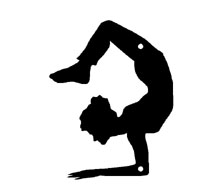
After much headstand and handstand practice, the guest teacher decided to use me as an example of how to assist your partner through what my gymnast-daughter calls a ticktock, and in Yoga is called Scorpion Vchikasana. For non-yogis it’s a handstand and then with great control you bend your legs over your head so your feet touch your crown.
This is a pretty awesome and advanced Yoga position.
I was excited to experience what it felt like to get into the position; I knew that once there I could create a body memory so that when I practiced on my own I could correct it with clarity. I enthusiastically kicked up into a bent arm handstand, anticipating her to catch my leg and move me over into the bent inversion. Instead I heard a laugh among the participants as she grabbed it forcefully and rotated it inward, this jarring maneuver caused me to lose my focus and I fell right back down. My enthusiasm dropped. She said kick up again. I did, albeit more cautiously this time. Hopefully, I waited for her to gently move me over into a backbend, she did not, I held until I couldn’t any longer, fell down and kicked up again, waited, kicked up again, attempting on my own to shift the weight of my hips over my chest, and feeling a bit confused I fell back down. She said kick up again, come on. I stopped and looked up at her. I was confused as to why she was not demonstrating moving me over into the backbend. She looked at me and said what’s ging on? What are you feeling? I said I feel weak. She said well you are stopping yourself and referenced the cause as my inner negative dialogue. She said do it again. I dutifully reset myself and I slowly and perseveringly moved my leg up into a handstand: first one leg and then drawing my other leg to the handstand trying to stack my hips over my ribcage, still expecting her to assist moving me into position, I kept waiting for her to gently move me up into position and then stand in front to move me into the scorpion position….but nothing….dead space, my arms and legs over-worked…I came back down onto my mat, flat.
She moved away to the front of class, never having actually demonstrated moving me into position, and then looked back at me sideways and said, you are strong enough to do it, you are fighting yourself, you need to change your inner dialogue.
I felt a familiar conglomeration of disappointment, vulnerability, defeat, and confusion. Somehow I had been triggered. I felt a combination of having been tricked by her and an inability to stand up for myself and realign internally with my strength. How had I given my power to this guest teacher? I felt shamed by her in front of the class.
This was a powerful moment for me to deduce the etiology of my holding and my fear.
I had not heard any negative self-talk. I searched inside myself, what am I hiding from myself? What I noticed was a defense mechanism of holding and protection that increased the more I interacted with this guest teacher. What was that about? . In my head I was trying to make sense of what had happened and what to do next. Was she doing this on purpose to help me move through my block or was her action more sadistic and so recreating an earlier trauma that my personal intention for the class posed as an opportunity for release?
After reflection, and discussion with other students in the class, some of whom were new to me, my concerns about the negativity of the situation from the guest teacher were corroborated. Their observations were consistent with what I observed and felt. Her actions exacerbated my hold and blocking rather than assisted me to move through the physical block. This is the opposite of how the workshop was billed. I had a funny feeling from her, as if she was not really there, not really centered on the role of being a facilitator but rather focused on being an exhibitionist. Although some of my teacher-friends really liked her others later identified a similar set of concerns.
My holding was indeed an aspect of my trusting myself; my body clearly ‘heard’ that this teacher was not trustworthy, so surrender was unsafe at that time -> this was the me fighting myself –> I was trying and I was stopping myself. My mind was directing the trying and my body was directing the stopping. My ‘block’ or resistance was a holding within my body in response to her passive hostility. This holding did not develop in response to her. It pre-dated the workshop as a survival mechanism from previous trauma; it was indeed the thing I took to the workshop to work-through.
This guest yoga teacher had designed a class to learn how to work-through holding and physical blocks without understanding a fundamental component needed to complete the task; to surrender and allow – Trust is required. In order for a teacher to encourage a shift in holding within her student her presentation has to include a lack of aggressivity, and a consciousness of beneficence; she need not be a cheerleader but rather have an unattached spirit of generosity. This renowned guest yoga teacher gave mixed messages though her words and actions which created a lack of trust needed, thus she had set up a class wherein re-traumatization could and would occur.
The choice to shift and uplevel lies solely in the power of the individual. Trusting yourself, surrendering to your truth includes paying attention to when resistance is beneficial and a positive communication from your personal sensory guidance system. Timing to uplevel matters, allow it to be guided from within(yourself), rather than without (another).
Sheldon Kopp wrote: No meaning that comes from outside of ourselves is real. The Buddhahood of each of us has already been obtained. We need only recognize it – Thus the Zen Master warns his disciple: – If you meet the Buddha on the Road, Kill him! (Kopp, 1976).
Creating a guru of another limits your and his power so that neither of you are allowed to uplevel into your most conscious selves. Namaste, in love and light, bg
Kopp, Sheldon, If you meet the Buddha on the Road,Kill Him. Bantam Books: New york, New York: 1976.
Peace comes from receptivity driving creativity – mind following heart:
11.T’ai. Peace, I Ching.
K’un(receptive) above, ch’ien creative) below
…Great approaches. Good fortune. Success.The image: Heaven and earth unite: the image of PEACE. Thus the ruler divides and completes the course of heaven and earth; he furthers and regulates the gifts of heaven and earth, and so aids the people. Wilhelm/Baynes, 3rd edition (1959, 1967, 1971)
The concept of heart guiding focus is a part of mindfulness, Taoism, Buddhism, and Christianity. The implication of the treatise to do the right thing as guided by god is a part of the Jewish, Islamic and Hindu traditions. The threads of rightness as proclaimed from the unification of earth and heaven, human and spirit, with the guidance of rightness from ones heart (spirit) rather than ones mind allows for ‘peace on earth as it is in heaven’.
Cues to the many threads of agreement are found throughout religious and spiritual texts if your willingness to look for agreement (collaboration and connection) overrides your desire to be right (competition and narcissism).
In order for Peace to be the defining force among humans, the consciousness of rightness must shift out of an adversarial Alpha-style of civilization to a Beta-style of collaboration. This is the effect of Turning Me (driven by competition and narcissism) to We (focused through collaboration and connection); rightness from a dualistic perspective, Kohlberg shifting to rightness from a holistic perspective of inclusion and care, Gilligan.
It is predicted throughout time by philosophers of various beliefs and in varied social-spiritual texts that to unite human and spirit, have the mind create what is known as truth in the heart. Mindful partnering is the way of upleveling consciousness and living in the light of universal spirit on the earth-plane so that all beings are upleveled together. The resultant style of interaction among spirit-humans is Peace.
This heart focused style of relating comes out of connecting and unifying rather than dissecting and dividing. The means of how you get to Peace matters; a means that follows mind without heart, leads to destruction rather than unification of heaven and earth, even if the intent of the actor is that of Peace. This mind separated from heart style is human thinking separated from spiritual truth. Non-violent actions and words lead to the opportunity to create unity, connection and put heart (spirit) in the driving seat. Violent words and actions, even toward an idealized goal or belief system, separate heart and mind and put mind in the driver’s seat.
The way to higher consciousness-living now, follows the I Ching hexagram 11. T’ai – Peace, receptive above and creative below. In every action let your heart lead; let your mind create what your heart (spirit) desires and knows as truth; see the other as yourself and your heart will be your guiding light in action. in love and light, beth
“Be Content with what you have; rejoice in the way things are. When you realize there is nothing lacking, the whole world belongs to you.”
Lao Tzu
I have been working with the energy of time and dimension through my channeling processes and what I have discovered is that everything seen is created by the seer. This is an energetic concept not a concrete one. I see this as a way to assist you in the direction of how you want to be in the world.
Here is my example;
A woman goes into the store. While she is inside a second woman hits her car by accident, but she leaves the scene without leaving a note. A third woman observes the event and makes a decision to report the information to the owner of the car – the woman in the store. The woman exits from the store and finds the person parked behind her waiting.
The first woman goes to the driver and asks – may I help you are you okay? She is endeavoring to assist. The driver who had the information about the hit and run says “no I am here to help you – someone just hit your car and left the scene, I took down her license, make, and model of her car. Here is my information and I will be your witness – please go to the police and report it so that you don’t have to pay for something that is not your fault.” The third woman then leaves.
The owner of the car has a choice in response to her situation A: she can be angry and feel sorry for herself and wonder why is the world so against me, “why does this keep happening to me” in response to the car accident, which would deplete her energy and have it be vibrating at a very low frequency; or B: she can see the way in which she is protected and cared for through the experience of the help from the driver who observed and stopped to help her, “the universe is looking out for me”, which would raise her energy and uplevel it, moving it to be vibrating at a much higher frequency.
Which perception you choose, A or B in this above example, A: anger and negativity or B: gratefulness and positivity, defines for you the world in which you live.
The more you feel that the world is against you the more you feel negative, defeated, lonely, and lost; and the more you feel that light and goodness is all around you, the more you feel the gratefulness and the joy.
Seeing your life from a bird’s eye view is not just seeing the big picture and how things are related, it is also the idea of looking at it with the concept of positivity and spirit, wisdom and an integrated spirit-mind-body knowing.
Eagles and Hawks bring messages from spirit in the Native American traditions. Doves are a sign of Peace and are also considered to carry the presence of the Holy Spirit to a situation. Athena had an owl on her shoulder so that she could see what others were hiding which allowed her to see true wisdom, in the Greek and Roman (Diana) traditions. Birds are connected to spirit.
Seeing from a bird’s eye view offers you a broader and fuller perspective so that you can choose to see the gift being presented to you in your situation.
The world you live in is based in the how you perceive events. And you perceive events based on your paradigm.
Connect to and choose the paradigm that love, peace, joy, gratefulness, and compassion are everywhere and that you are intimately connected to the universe in a powerfully spiritual way. Do this and you will see and experience a real change and uplevel in consciousness everywhere you look. Just like when you learn a new word and all of a sudden you see and hear it being used everywhere.
Shift your perspective to a bird’s eye view and sees through spirit’s eyes. You, me, and the world are truly beautiful from that perspective. in love and light, beth
Hello, yesterday this blog hit the number, 19000 hits. I feel grateful to my friends and their friends who have come to check out what’s happening here. Thank you all, in love and light, bg
So today I want to share about two proverbs.
One is Taoist: Let Go or Be dragged.
It is the way. Life is dynamically changing. Sometimes the time comes to shift a situation. You see this often in relationship. The relationship has come to a place where a shift is required for it to continue in a healthy manner, but the individuals don’t want to let go of the habitual way they had interacted.
Releasing each other from the habitual or routinized interaction allows for the two individuals to float up and flow with the wave of change, perhaps coming back together in a better more healthful fashion; perhaps moving away from each other and into a healthier relationship with themselves, leaving space to create a new relationship.
Holding on can result in a spinning inward of negativity that ultimately drags down the energy of the relationship until it implodes. This is just one description of the proverb, but the idea is to go with the flow, allow the flow of the universe to guide you and to release yourself from holding on to something that does not serve you.
The other proverb is the donkey in the well fable.
One day a farmer’s donkey fell down into a well. The animal cried and struggled to get out but the sides of the well were too deep and too smooth for the donkey to exit. For hours the farmer tried to figure out what to do. He could not figure out a way to help the donkey escape. Finally, thinking the animal was old, and the well needed to be covered up anyway. Rather than retrieve the donkey he decided to cover up the donkey and fill the well with dirt.
At first, when the donkey realized what was happening he cried horribly. Then, he quieted down and let out some happy brays. A few shovel loads later, the farmer looked down the well to see what was happening and was astonished at what he saw. With every shovel of dirt that hit his back, the donkey was shaking it off and taking a step up.
As the farmer continued to shovel dirt on top of the animal, the donkey continued to shake it off and take a step up. Pretty soon, the donkey stepped up over the edge of the well and trotted off!
The moral to the fable is this: Life is going to shovel dirt on you. The trick to getting out of the hole you are in is to shake it off and take a step up. Every adversity can be turned into a stepping stone. The way to get out of the deepest well is by never giving up but by shaking yourself off, and taking a step up. To do this you need to change your inner perspective, your inner attitude, your interpretation of what is and what is not. This allows you to see your situation from a differently and allows you to find solutions and take actions that help yourself.
More than anything in life, what happens to you isn’t what matters,
What matters is how you choose to respond to what happens to you.
Your life is what you make it. Your paradigm defines what you see and what power you perceive you have, even what power you perceive others have over you. The donkey could have lived (and died) in the paradigm he began with in his journey into the well; but in the fable he used his observation skills and thinking to shift his perspective and paradigm to change his circumstances by using the tools given to him – the rising dirt.
Both of these parables can be interpreted in a physical way, but they are equally as applicable to psycho-emotional and spiritual circumstances that require a shift in perspective.
In the donkey circumstance the shift from victim to thriver, creating his own way to safety was a physical, psycho-emotional and spiritual shift. This is also true when faced with a circumstance where let go or be dragged applies.
Own your life.
Wake each day renewed in your belief in your self, belief in the world around you and in the people in your life that matter. In this way you can be centered in your attention your unexpected and habitual experiences that require a shift.
Recognize that letting go is sometimes the most loving thing you can do even if the other is unaware of the gift.
And hold true to your inner strength even when those you believe in have let you down.
Thrive.
Model thriving. Have your thriving rub off on those around you so that the world around you, and the people around you can all shift perspective in unison to walk out of the well they have fallen into.
I have been doing some research on Taoist principles for a new book and I have found some amazing, powerfully enlightening information.
Taoism perceives that the originators of civilization itself are people of higher knowledge attained through extradimensional awareness … all successful original cultures are initiated and guided by people in contact with the Tao or Universal law. Thomas Cleary
It is Cleary’s contention that from this Taoist vision, “Taoism is not, as usually thought, a product of Chinese civilization. Rather it is the other way about – Chinese civilization was originally the product of Taoism in the sense that like all successful original cultures it was initiated and guided by people in contact with the Tao or universal law.“(The Book of Balance and Harmony, Cleary, 1989) What a powerful concept and a perfect focus for renewal and transformation.
Thomas Cleary in his book of the translation of The Book of Balance and Harmony (1989) identifies that the Taoist movement called the Complete Reality movement was created to distinguish a practical understanding of Taoism as it had been lost over time. Cleary writes that ” ironically, one of the most comprehensive descriptions of Taoism … can be found in a Buddhist text, the Avatamsaka-sutra or Flower Ornament Scripture,” which he said is “held to contain the totality of all religion:”
The various methods and techniques of the enlightened adept to worldly conditions in order to liberate people. The enlightened provoke deep faith by being in the world yet unaffected by it, just as the lotus grows in water yet water does not adhere to the lotus.
With extraordinary thoughts and profound talent, as cultural leaders, like magicians the enlightened manifest all the various arts and crafts of the world, like song and dance, and conversation admired by the people.
Some become grandees, city elders; some become merchants, caravan leaders. Some become physicians and scientists, some become kings and officials….. All-sided goodness abides by reality, not in a country. Cleary, The Flower Ornament Scripture
What I love about this is how it gives a prescription for how to live in these times.
It is about how to trust your inner knowing, your internal guidance sensory system and connect to a higher wisdom and light so that you can identify and act from a universal law or truth rather than propaganda or third dimensional pulls toward power over others to feel successful.
The ebb and flow of nature and the return to balance is the way. Living in that way, guiding your actions to be in connection to that is the highest form of instinctive medicine, balance, and harmony.
Focus on what is and the light allows that to be what is produced or created, rather than a disconnection from self, an embracement of self in harmony.
One way to find your way back to balance is to pay attention to where you feel discomfort and that can give you a clue to where you are out of balance.
You may also feel, hear as another speaks or the world shifts to attend to a lack of congruence or harmony. This is the best way to avoid following propaganda rather than the truth.
Trusting yourself, your internal sensory guidance system includes intuition and connection to extradimensional experience through mediation, visualization, and dreamwork.
Let love and your heart center be your primary, strongest guide. Through this pathway you may find renewal and transformation in this new time of higher light and higher consciousness.in love and light bg
Forgiveness is required to release anger and move through any difficult situation. The energy of forgiveness comes from a balanced mindful perspective that is heart centered. Practicing mindfulness increases your openness and your awareness allowing your mind to hear the calling of your heart.
When you are stuck in your thinking process you may find that you get into a loop about the different aspects of a problem or conflict. This loop is driven by the left brain analytical aspect of your brain. The right brain aspect of your brain receives information in wholes, it gets imprints of information – spirit mind and body integrated.
Both aspects of your brain are beneficial in sorting through problems. The left brain, verbal and analytical aspect that separates and evaluates in a more tangible fashion is necessary for movement through complex problems and conflicts. It gets to the figure issue of the problem. The Right brain, image, whole, and energy evaluator is necessary for getting to the background and interconnections that can allow for transition or transformation.
The key is to allow for your understanding, empathy, and big picture connection to inform your analytical specificity evaluator. This directs you to see through a mindful, compassionate, integrated perspective so that you can release the dualistic right/wrong style of consciousness. This shifts the power of the injury or anger and helps you align with your internal sensory guidance system.
Three steps move you through to forgiveness.
Allow the fullness of the pain and injury, anger and trauma to be experienced. Do not skip to forgiveness, feel the pain. Do not stuff down the pain or the shock. This release is important and necessary. Make this a finite thing, not something that goes on and on or becomes a way of life. Utilize writing, talking, and creative artistic measures to get to the injury and clarify your experience. Note what verbal and cognitive equations that begin to develop, ie: a sense that you will never trust again, never love again, never have another child, never go through this again. This will give you a clue as to what habit reaction pattern you may be setting up and a direction about what you need to forgive. the issue is usually very subtle, not the whole injury just some piece that shocked your system.
Create a space to dialogue (if this is possible) with the injurer. Identify how you participated in the conflict so that you can shift yourself and your action in the future. Look at the situation from a larger view and from the perspective of the other person – notice if he was operating under a different paradigm than you and if you can shift the misunderstanding through dialogue or negotiation. If the injury is without another side or perspective look for what good, light, beautiful outcomes came out of the situation; this is most difficult when there is a loss of someone you love through no fault of your own or his. Still focus on the light will help to move you through to forgiveness and the uplevel your consciousness. This is where allowing your heart to lead and connecting with your right brain imprint, memories, and wholes to help you to have access to the light. you can do this through creative maneuvers, painting, drawing, music, building – these are all powerful tools to get to your inner healing and inner knowing.
Set a time to let go of the injury. Also use this third step to identify a holistic,. balanced picture of you without the injury and moving joyously through life. Do this is a concrete way. You can use writing or a picture. Take the information in a tangible form and release it through burning it. Do this in a safe and contained way. Then allow yourself to take the created future that you identified and burn that into existence. You may find you want to create a structure or an image of what you are releasing and what you are bringing in to remind you to remain in forgiveness. You can use these a cues to remind you to live in the now and the light.
Forgiveness is essential for health. Holding onto an injury distorts your perspective, skews the energy in your integrated spirit, mind, body field and can over time create stagnation, disruption and disease. Letting go, releasing the injury or anger and incorporating a higher consciousness understanding regarding the situation heals and rights your imbalance. This can reset your energy field so that you promote health rather than stagnation and misdirection.
Joy. Light. Love. These are the tools of your heart and lead the way to uplevel your consciousness, integrate you spirit, mind, and body and through these tools you can change the world around you through changing the world within you. in love and light, bg
When I was a young Psychiatric Aide on a Locked Psychiatric unit in Albuquerque, New Mexico, I had a very good friend, also a Psychiatric Aide, who was a master at the practice of the Japanese Martial Art of Aikido. He was superb at handling any physical attack, without injury to himself and with the least degree of injury to others.
Here is an example:
A young man who had stopped taking his antipsychotic medicine began to lose control of his thinking and behavior, his touch with reality was slipping away and he thought he was being attacked. My friend asked him to go into the quiet room (a padded room that protects the individual from hurting himself and others when out of control). The patient felt attacked by my gentle friend’s request, he became enraged and began to throw at my friend any thing that his hand touched – chairs, tables, lamps – my friend simply and easily shifted the energy of each piece of furniture and dropped it beside him, protecting the other patients and deflecting the negative energy, lightly and firmly moving toward the out of control young man. His movements were gentle, clarified, and precise – lightly deflecting the energy while deftly responding to the needs of the entire room. Once he entered the physical space of the out of control young man he quickly and without harm immobilized his flailing arms, and with kindness and gentleness he walked him to the quiet room.
His precision at shifting the energy of the flying furniture had the effect of de-escalating the damage in the situation to himself, the out of control patient, and the other patients. It created a sense of calm and control that was soothing. It brought everything to a neutral space so that injury was avoided.
The art of verbal Aikido is a metaphor for utilizing the same strategies in handling verbal attack. The majority of miscommunication and arguments are a result of charged interpretation of other’s dialogue, where another person interprets your statements as barbs thrown and so reacts defensively, or vice versa.
Responding to another’s attack via mindfulness increases your neutrality and clarity in what underlies the negative communication. Simply deflecting the negative statement and deflating the negative energy to shift the interaction.
Practicing the Art of Verbal Aikido has three steps:
First, deflect the negative tone, and tenor, by simply responding to the actual content with neutral responsive content.
Second, deflate the negativity by reiterating your intended meaning through clarification and compassionate interest in how your communication was interpreted. Then clarify the intended meaning and take responsibility for not being more clear in your first communication.
Third, if the communication escalates, continue with steps 2, and 3, with a gentle, kind, precise and light manner – avoid sarcasm, condescension and a down-putting tone.
Then you are free to find a solution or agree to disagree without malice or charge.
You only have power over your own actions. You cannot change another person’s attitude, position or behavior, you can only offer a space for another to shift his perspective on his own. You have control over your own actions, behaviors and attitudes, responses. If the other person chooses to find you offensive and react defensively, you have power to maintain your mindfulness.
The most mindful and loving response in a situation where another is angry is to not take on his anger, not react to it and join-in, on the negative interpretation, the fighting back or proving argumentative tone or attitude.
Create a visual image of yourself lightly deflecting the flying furniture and placing it on the ground; or an image of another’s charged words as sufficiently solid that you can observe yourself deflecting them or moving your energy so you are not hit by the negative barb in the words. Think of a Jackie Chan movie, see yourself in slow motion deftly avoiding what is thrown your way, while simultaneously smiling and gently reaching out an olive branch toward connection and understanding.
This is the practice of verbal Aikido and it will increase the level of peace you experience in your relationships.
It is the most healing response to conflicting perspectives and offers a direct pathway to uplevel consciousness. in love and light,bg
If you want to find the secrets of the universe think in terms of energy, frequency, and vibration – Nikola Tesla
Hello friends
The miracle of healing is at your fingertips. It is simply a matter of seeing, listening and responding to your senses, energy, frequency and vibration.
I see immediate and complete transformation in my practice, relationships, and life every day!
The corresponding elements that allow for this are a matter of knowing, belief, and sight. It is through this knowing belief and seeing that the miracle presents itself. It is greater than a course in miracles. It is an instantaneous truth seen through your eyes when you are completely connected to your sensory guidance system and the healing knowledge of sight and action.
Your sight must be aligned with the frequency, energy, and vibration of health, light, and spiritual knowing. From this wavelength and universe all things are possible.
This allows for the immediate perception of a miracle.
Three steps will help you to see the miracle.
First, use your inner sightconnected to your inner knowing. So that you are open to how the fabric of your life can shift to create, offer the miracle – this results in seeing the miracle.
Second, accept that choice is the ultimate foundation for each soul on the planet. And you do not have the power to change another person’s choice for his or her life.
Third, see the miracle in each event…even when your first reaction is to say that no miracle exists. Pay attention to the energy of the event and within you the intensity of your reaction. Vibration and frequency are also useful in assisting you to discern the message therein… once you have aligned yourself with the miracle you can bring forth a healing either in spirit, cognition/thinking or the body/physically.
The universe is always offering a gift to move you toward your soul’s path.How – that is true is the tricky part. Seeing the miracle requires integrating spirit, mind, and body knowings as well as energy, frequency, and vibration. Use paradigm shifting through compassionate sight and inversions to see the balance in the universe. Use a long, broad view to understand what the universe is presenting as a miracle.
A fourth step helps to align with the miracle and integrate the lesson.
Embrace even those events that are painful and look for the healing lesson within – you will know when you have found that lesson when you find yourself, smiling, looking lovingly on another or a new perception of the event, and feeling a release of anger and fear.
Miracles are the norm in your life…. as you train your internal dialogue and sight to attend to your sensory guidance system you will experience them in every step of your life. The natural outcome to this state is love, peace, upleveling consciousness, collaboration, acceptance, and success in all of your endeavors.
This is a quantum shift in experience and knowing; a quantum shift in energy, frequency and vibration. Once you allow yourself to see differently you will act and be different, immediately, in a quantum and whole way. Paradigm recognition, shifting,integration and creation in the moment. in love and light, bg

 InstinctiveHealthParenting4U