InstinctiveHealthParenting4U

Change your Attitude, Heal your Soul, Balance your Life. Uplevel YOUR consciousness. Find your way HOME through MAAPS.


2 Comments

Using humor to shift paradigms

Hello

Humor is the most useful tool in your bag of tricks when it comes to paradigm shifting.  It allows for the shift to be non-threatening.  It has the same energy as an epiphany but less drama.

Humor creates a conduit for the perception to be seen and released simultaneously.  This is especially true if you are attempting to assist someone, or yourself, in seeing an over-reaction.  Humor can help you see silliness in your thinking or behaving, without negative judgment.

I use humor all the time to shift energy.  It is the perfect response when I want to  lighten a situation that is getting too serious.  The seriousness can create a block to the needed shift.  It’s really helpful with children when you want to side-step a negative interaction that is steamrolling down a course to opposition and  a flat-out stalemate.  Using humor can result in an instantaneous shift in energy, especially if you choose just the right maneuver.

Laughing at ourselves when we need to lighten up is an important part of de-stressing, and it helps us get into a mindful state; it’s like a mini-paradigm shift into the humorous nature of events, that opens the doorway into real insight and epiphany.

The mindfulness component to humor is especially evident when used to deal with resistance.  Resistance can look like a NO or just a distraction; it can be really strong and obvious or just dawdling and delaying.  All of these actions can be a form of resistance and can interfere with the smooth flow of events.  Often resistance is actually a cover for something else that is underlying the situation.  This could be a way of dealing with unwanted pressure, or expectation, or structure that feels stifling, like our time schedules or an event we are required to attend.  By bringing humor into the equation you can uncover the cause of the resistance without getting into a power struggle with your child or the other person.  If it is your own resistance with which you are dealing than humor makes it more tolerable to look at yourself and your actions.

Humor lightens.  It makes the change feel less heavy or more obvious and it allows the shift to be embraced without negativity.  Lightening both the weighty-ness of making choices, decisions, and change as well as lightening with respect to increasing the degree of mirth, spirit, and luminosity involved in living and evaluating.

When my daughter was just working on moving from pre-team to team in gymnastics her energy changed.  Rather than being relaxed, attentive, self-confident, and strong, her intensity shifted; she started to be a little uptight and anxious about who was going to move up and where she was in the line-up of her peers in skill and talent.  She began to get discouraged and this affected her capacity to do the work.  She tried harder but it had the effect of making her too conscious so that she was pushing rather than allowing her skill to shine through. It resulted in her getting stuck.

I tried having a serious, mindful discussion about how her attitude was getting in the way, but she became adamant that she just couldn’t do it; “I can’t” she said.  I calmly and lovingly talked with her about how she needed to say “I can” because her words had power.  She said they only had power in one way if she said I can’t then she couldn’t but when she said I can it didn’t change the outcome.  She was trying to tell me how discouraged she was, but I wasn’t listening with my third ear (my inner mindfulness and attention), I just  kept on with my efforts to shift her perspective, describing how the “I can” made it a neutral space so her mind/body could work together to go through the motion of the skill with ease that she had been practicing.  I was talking to her rather than listening to her and responding, even though I thought I was being reasonable my efforts helped to create a block and she dug in her heels because she felt unheard and invalidated.  The more I tried to be calm, and mindful, and clarifying the more adamant, angry, and resistant she became, until we were at a block, a NO, a lost opportunity for learning.

Then I decided to explain how it worked by acting as her confused muscle that she was sending two messages to, one message of I want to do it, and the other message of I can’t. The result was a jerkiness that depicted her muscle trying to respond to both an action of follow through on the skill and an action of miss the skill.  When there are two opposing messages the wires get crossed and there isn’t any clarity about what action to take.  The inner confusion would assuredly result in a mis-step and diluted action/skill.   As I was describing this, in simpler terms, I acted it out,  with silly facial gestures and a crazy looking jerkiness of my arm.  It was so silly she spontaneously laughed out loud; I looked so silly that her first most natural reaction was to laugh and that broke up the energy so that she could both feel heard and listen to my explanation.

Through the use of humor, the words got in, then she had an opportunity to integrate the concepts.   The humorous picture also became a visual mantra/or visual imprint she could use to re-focus herself in the future, so that she could find her own neutral place and shift the energy when she felt discouraged.

It lightened everything.  It allowed for a paradigm shift, and it was a strong image that was beneficial in the future.  The next practice she moved with ease and self-confidence, she got her skill; and in her being was the memory of how funny her mom looked and the information behind the humorous action connected to it that you have to give one clear message and allow you natural ease to flow through.

So mindfulness needs a little mirth sometimes to get the job done.

Humor is a little tricky, it can really backfire when used incorrectly or at the wrong time.  This is especially true with certain ages that have a hypersensitivity to being laughed at.  In these circumstances it’s most useful to allow yourself to be the canvas or conduit for looking silly, allowing your child to laugh at you and through that, to see their own silliness, on their own and in their own time.  If you make the connection too quickly and they are not ready then you may find that you worsen the situation.

It takes a feel to know when to use humor and how, that ability to listen with your third (inner paying mindful attention) ear, in conjunction with knowing your child and what actions are covered messages.  When used efficiently humor is the most effective tool in your toolbox for shifting paradigms and getting to aha experiences.

Next time you feel your blood pressure beginning to rise, or you feel stuck in your interactions, apply a funny, humorous face to the situation.  See if you can create your own paradigm shift with humor.  The lightening up of the situation goes far to instill the needed information, and it does so with fun, ease, and efficiency.

See you tomorrow.

Beth

1 Comment

Thriver vs Survivor attitude

Hello

Habit reaction patterns define how we relate in the world.  They do so without our attention to them.  They pull us into ways of behaving like a rut pulls us around a circle.  The groove, furrow, or automatic routine of it takes us out into the behavior Habit like any reaction in an automatic, non-present-moment-thinking-way (unconscious).

This is not intuition.  This is the opposite of mindfulness behavior, which requires a present moment centeredness where information is experienced and processed in a thorough centered and multi-dimensional fashion.

Survivor scenarios are habit reaction patterns.  They are ways of being in the world where a trigger acts like the groove that pulls a person into a set of interpretations and actions (reactions) to survive.

This mechanism built into our style of being in the world is highly efficient in a dangerous environment; having the ability to automatically react in a split second fashion could save your life.  However, when these are applied to everyday choices in relationships and interactions that are perceived by way of the trigger as dangerous but are indeed not life-threatening, they form a set of behaviors that actually serve to negatively affect the individual engaging in them.

Survivor scenarios actually take on a number of forms depending on the function that set up the original scenario, the how mechanism to survive or what style developed to survive.  Protector, survivor, victim, persecutor are all forms of survivor scenarios.  They share the need for the other to define the self.  In order for an individual to define herself as a survivor she must continually create (by way of interpretation and attribution of specific intent) situations she must survive.  Thereby actually keeping herself caught in the web of the scenario.  This is true for each form of the scenarios.

In order to get out of the rut, groove, automatic routine, or habit reaction one has to invoke two things, a sense of present moment empowerment and mindfulness.  This is an attitude of a Thriver.

Thriving is doing more than surviving.  Surviving is good, as the alternative is not surviving, which is bad.  Thriving is even better – it is developing and focusing your life, actions, interactions, creations, and living toward your best potential and capabilities.

Where surviving is a function of creating the best situation possible out of a negative set of circumstances, thriving is a function of creating what you want.  Creating what you want out of all the possibilities in the universe, not just your current circumstances.

Being a survivor may be the best thing you ever did, and so it may be difficult for you to let it go.  You may feel like it is the thing that sets you apart from your peers.  The problem is it sets up an attachment to that style of being in the world, such that situations to which you are drawn will be primarily difficult and challenging, allowing you to continually, automatically, invoke the survivor mechanism to make lemonade out of lemons.

Being a thriver increases your actual responsibility to create what you want.  In order to do so you have to be willing to risk defining what you want and then creating the avenue to make that happen.  It sets you into an active rather than reactive mode.  Saying I want to make this happen in my life, rather than I can make this situation work to the best form.

Certainly having the skill to make a bad situation work until you can create a better one is laudable and to be maintained as a positive skill; however, it is not proactive unless connected with an attitude of focusing your efforts on creating a life that is thriving and reaching your best potential.

Here’s how to decipher if you are in a habit reaction pattern or survivor scenario.

Check in with your senses and intuition.  If you feel that the experience is familiar or a pattern then you may be participating in  a habit reaction scenario.  If you feel that you have trouble trusting that things can/will go well for you, then you may have a history of having to survive that is coloring your current day choices/actions.

If you have an immediate feeling of anger, like someone has crossed a boundary and your feeling is charged in that the level of emotion (intensity) doesn’t match the situation or boundary crossing, this is a sign that you have been triggered.

In this instance, proceed in your actions (re-action) with caution and by caution I am suggesting to invoke mindfulness and centered, present moment attention to the situation, to literally work against the pull of the groove into the habit reaction pattern.

This is how you can engage the thriver attitude.

Focus is the key.  If you are in danger, utilizing your survivor skills to get out of the situation is paramount.  If you are not in danger but rather caught in a survivor scenario then focusing your attention on what you want rather than what you fear is the best response.

Using mindfulness to re-view the circumstances in relation to your emotion will help you identify whether this is danger or not.  In example, if a stranger is doing something that feels dangerous allow your survivor reactions to move at lightning pace.  If however, the situation is with a loving partner, or friend – you need to view your emotion within the context of the relationship in present-time and with clarity and genuineness.

Here’s how you can develop a thriver attitude.

It requires a focus on what you want.

It requires a re-view of yourself through a centered, mindful attention to yourself, your skills and limitations, what brings you joy and centers you in your best self.

This focus allows the possibility of creating what you want from all the possible choices available to you.  This is a difficult concept to grock for a person who has defined herself as a survivor.

This paradigm shift allows for a relaxation of the struggle to survive or fight and a gentle movement into the mindful, balanced living of life.

May you Thrive!

See you tomorrow.

Beth


Leave a comment

Balance of spirit, mind, and body – the Tree of Life

Hello

Instinctive knowing incorporates spirit, mind, and body awareness and experiences, with attention centered along the space-time continuum, in the present moment; Intuition and sensing, together in balance, centered in time.

In studying the  Kabbala I have found something congruent with this idea and clarifying the issue of knowledge and instinctive knowing as integrated and guided by spirit at it’s core.

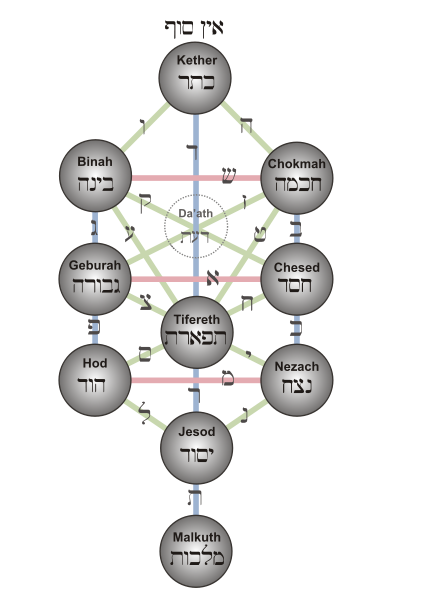
The Kabbala (Kabbalah, Qabbalah, Qabala) is a set of esoteric teachings.  It is a set of writings and texts that exist outside the traditional Jewish scriptures, but it is attributed to be a part of the Jewish religious tradition.  The Kabbala is represented by a set of branches sephirot, drawn as circles connected by lines in a specific order. This symbol is referred to as The Tree of Life.  

The texts seek to define the nature of the universe and the human being, the nature and purpose of existence, and various other ontological questions. It also presents methods to aid understanding of these concepts and to thereby attain spiritual realization.

Altogether 11 sephirot are named. However Keter and Da’at are unconscious and conscious dimensions of one principle, conserving 10 forces. Presented here are the names of the Sephirot in descending order:

(Think of these as going from most insubstantial in energy to most substantial.)

  • Keter (crown, representing above-conscious will)
  • Chochmah (The highest potential of thought – intuition)
  • Binah (the understanding of the potential – knowledge)
  • Da’at (intellect  or cystalization of knowledge – instinctive knowing)
  • Chesed (sometimes referred to as Gedolah-greatness) (loving-kindness)
  • Gevruah (sometimes referred to as Din-justice or Pachad-fear) (severity/strength)
  • Rachamim or Tiphareth (Mercy – Love, acceptance)
  • Netzach (victory/eternity)
  • Hod (glory/splendour)
  • Yesod (foundation)
  • Malkuth (kingdom)

These ten (11) sephirot can be viewed as a process of ethics.  Studying the sephirot will allow the individual to increase BOTH his spiritual consciousness and his spiritually ethical action in the physical plane.

It is viewed that Divine creation by means of the Ten Sefirot is an ethical process. The sephirot represent the different aspects of Morality and they hold within them the opportunity for both the virtue as well as the vice attributed to each branch.

Balance is the key.  Utilizing intuition and sensation knowledge, and centered in time, one can develop a balanced experience and knowledge of these branches.

In example, Loving-Kindness is a possible moral justification found in Chesed, and Gevurah is the Moral Justification of Justice and both are mediated by Mercy which is Rachamim. However, these pillars of morality become immoral once they become extremes. Lovingkindness is the Virtue.  When Loving-Kindness become extreme it can lead to sexual depravity and lack of Justice to the wicked, the vice.  When Justice becomes extreme, it can lead to torture and the murder of innocents and unfair punishment.

In the Kabbalistic view, “Righteous” humans (Tzadikim) ascend these ethical qualities of the Ten Sefirot by doing righteous actions. If there were no “Righteous” humans, the blessings of God would become completely hidden, and creation would cease to exist. While real human actions are the Foundation (Yesod) of this universe – kingdom (Malhut), these actions must accompany the conscious intention of compassion.

Compassionate actions are often impossible without Faith (Emunah), meaning to trust  that Source always supports compassionate actions. Ultimately, it is necessary to show compassion toward oneself too in order to share compassion toward others. When one empowers oneself through this development to assist others, one is following an important aspect of Restriction, and this is considered a kind of Golden Mean in Kabbala, corresponding to the Sefirah of Adornment (Tiferet) and being part of the Middle Column.

In the Kabbala there are different branches for understanding, knowledge, awareness, and knowing.  These culminate in the explanation of the sefirah of Da’at. Da’at can be viewed as the crystallization of awareness.

In the Kabbalistic Tree of Life, when counting the 10 sefirot, Da’at is the tangible form of Keter,and so can be counted with Keter.

Keter is the crown, knowledge as an emanation from Source, and Da’at is the experience of man – specifically experienced knowledge – knowledge from the point of view of the human being and his or her accumulated experiences.

Chochmah is intuition and Binah is understanding or the ability to grasp concepts, and Da’at is knowledge, the accumulation of experience.  In other words there are three ways in which a person knows the function of the mind or of consciousness:  1/through the intuitive grasp of Chochmah, through, 2/ through the analytical powers of Binah, and 3/through the accumulation of ones experiences, known as ones Da’at.

Da’at is sometimes drawn with a dotted-line underneath the crown Keter, somewhat in between Chochmah and Binah.  Keter, as the emanation of knowing, is the most insubstantial.  For our purposes, Chochmah – intuition, Binah – 5 senses, body and mind, and Da’at – the accumulation of experiences – time, offer together an experience of instinctive knowing, balancing spirit, mind, and body.

How these are translated into our ethical actions in the physical plane is how we enact our spiritual consciousness balancing spirit, mind, and body knowing and awareness.  It can be a product of studying and understanding the various consciousness of the sephirot of the Kabbalistic Tree of Life.  However this is not the only Way.

Living mindfully is a great resevoir for development of your higher consciousness, your true self and The Way.

May you find your Way and be in Joy.

See you tomorrow.

Beth


3 Comments

Seeing in 4-D

Hello

Working with the idea of 4th dimension, space and time, is a way of thinking about what happens when you are shifting paradigms.

Immanuel Kant in his Critique of Pure Reason developed a concept of transcendental philosophy.  In Kant’s view, a priori intuitions and concepts provide us with some a priori knowledge which also provides the framework for our a posterior knowledge.  His theory about space-time is fascinating as to how it relates to the 4th dimension.  Space and time for Kant are a form of perceiving, together, and causality is a form of knowing.  From his perspective both space and time and our conceptual principles and processes pre-structure our experience.

This develops the idea that paradigms and paradigm shifting are a product of perceiving and then introspectively knowing.

For Kant things as they are in themselves are unknowable.  In his view for something to become an object of knowledge, it must be experienced, and experience is structured by our minds – both space and time being the forms of our intuition, or perception, and the unifying, structuring activity of our concepts.  These aspects of mind turn things in themselves into the world of experience – so that they can be known.

For me, seeing in 4-d is viewing with your five senses plus intuition, and the concept of time as represented by the now, past, and future; 2/  recognizing how interpretations in time affect the future; and 3/  noting how changing those interpretations actually CHANGES reality.

Mindfulness increases ones capacity to see in 4-D.  I think of mindfulness as a concept that includes spirit, mind, and body responses integrated with information to guide our actions and cognitions, in the space-time continuum of the NOW.

Our minds are full with a focus on perception, attention, perspective, intention, and time.  These are the foci that allow us to see in 4-d – giving space for figure/ground perspective and paradigm shifting.

For me, intuition provides a blink response, as described by Malcolm Gladwell in this book by the same name. A cue that there is something wrong or right.  It allows for us to integrate our observations of our sensing system with our knowledge to guide us.  The blink quality may allow for this integration to come to us as a whole (what Fritz Perls defined as a Gestalt) and in an instant.

Emotions are not knowings in and of themselves, they are triggers, or responses – it may be a trigger to alert us that there is someone crossing our boundaries like an internal sensing alarm system, or they may be emotional triggers to survivor scenarios, or responses as a posterior knowledge.

Viewing emotions as experiences but not knowings assists one in determining how to respond to an emotion.  A good example is Feeling sorry for oneself it can erode at our being in an insidious way but is not always rooted in a reality.  Recognizing that perceptions and experiences can be temporal but not necessarily real or factual can assist one in seeing in 4-D and remaining centered in ones life.

If you find yourself feeling defensive, angry or feeling poor me, assess whether the feeling is part of a habit reaction pattern or a trigger OR an accurate assessment of something happening in the present moment.  Sometimes these feelings are cues about how what is happening now is akin to something historical that needs to be addressed.  When the feeling is nagging and bothersome rather than intense and loud then it may be indicative of a problem if it feels reactive and loud then it may be more of a habit reaction pattern or trigger.  This is counterintuitive.   You can make a comparison of history event and the now event, to discern which is in play.

Mindfulness is a concept of utilizing one’s emotional sensory guidance system, and physical sensing system and the Fullcapacity of our cognitive and problem solving skills to evaluate situations and experiences in order to create and guide our way.  This is seeing in 4-D and allows for a unifying and flexible style of relating in the world.

Seeing in 4-D increases one’s capacity for centeredness and groundedness with flexibility and strength.

See you tomorrow.

Beth


Leave a comment

Waiting and patience

Hello

Have you ever had to wait for something you really wanted?  Okay, everyone has.

It’s hard.  It takes all your internal energy to remain excited but calm, available but not pushy, energetic but not anxious.

It’s especially hard when it is something that you have attached a lot of meaning to – like being asked to marry – you want it SO bad and yet you have to wait, and trust and allow – it’s challenging.

Well for children almost anything they want has this energy.  Playing Wii or Xbox, watching their favorite TV show, playing their favorite game or getting a special toy, it all feels this intensely attractive and pressing.  As parents and teachers we sometimes miss the intensity of our children’ and students’ experiences.

Teaching patience requires looking for the positives in waiting.

This can be challenging if you go about it in the typical fashion of costs and benefits, especially if you are dealing with a person who doesn’t naturally have a tendency to delay gratification.  But if you can be creative and even change your perspective this can shift the energy to identify some beneficial aspects of waiting or delays.

Certainly the better we model it, the more likely we will be able to transmit the gift of patience.

I think some people’s brains are hard-wired for delayed gratification.  They have little trouble with waiting and developing patience.  These individuals can hang out, re-focus and set aside, that internal nagging feeling of I Want It NOW.

They create a hierarchy of goals.  They break up the main issue into smaller more easily attainable goals so that they don’t actually feel like they are waiting – they are just moving along the path.

If you are one of these people, you do not have to continue reading, unless you are raising someone who is the opposite of you, then you should continue.

The people whose brains are hard-wired for impatience, they just can’t let it go.  They are like little ever-ready-bunnies moving in circles of thought – I want it now, unable to still their thoughts and beings.

Waiting for this population is excruciating.  Even when they make an effort to exert patience they cannot last for very long.  Their experience of time is more intense than the individuals who are hard-wired for delayed gratification.

Okay so here are some of the tricks for helping these individuals.

Don’t offer a reward of something they really want, for good behavior.  They’ll be unable to hold it together long enough to get the reward, because they get stuck thinking about the reward rather than the action required to get the reward.  They want it so bad they can’t think of anything else, so you will get the opposite of what you are trying to create.

These children are better to be rewarded when acting properly rather than offered a carrot.

Building structure for your child, and connecting behavior and outcome, increases a person’s ability for patience, waiting, and delayed gratification.  The structure identification helps the child center himself in his world so that the intensity of waiting can be neutralized.

Set up a simple structure make it into a rhyme or into a song they already know so that it can be recalled effortlessly and quickly.  This way they can begin to develop an inner structure that is accessible to them.  ie:  for an elementary school child, put your name and the date on your paper and read the instructions before you begin – in a tempo that is already in their mind.

Say it over and over until it is second nature to think of at the beginning of homework.

If your child has difficulty with overstimulation in stores, wanting everything that strikes his fancy, the best way to avoid trouble is to set up what is expected and what consequences will happen if expectations are not met.

“I know you can be overstimulated by all the toys and fun things in the store.  Today we are not buying any new items for you.  If you see something you can point it out to me, or write it down for a future shopping trip when we are purchasing toys.”  Or you can say “today we are buying one item for you in the store for this amount of money.”  Then you can add the above about how to deal with wanting of several things and how to create a structure about this.

Continue with your set up to identify what will happen if your child continues to ask for a toy or more items than you have agreed to purchase – “no toy/item will be purchased if you continue to ask for something or ask for more”.  In some cases you may say that you will immediately leave the store if your child cannot control his impulses.

Think about this as to whether this more negatively affects you or your child and do not set this up if it interferes with your needs in the store – ie:  you are buying necessary groceries.

After setting up the expectations for behavior and the consequences, ask your child to repeat to you his understanding of these.  Then as you go through the store provide positive reinforcement as your child is correctly following the expectations.  “I notice how well you are behaving in the store.”  “Do you need some paper and a pencil to write down your ideas?”  “You are doing a good job.”

Re-direct your child and remind him of the expectations and consequences when he begins to lose focus.  Repeat the plan enough times that it becomes something that he can complete on his own when he is re-directed by you.

This will allow him to develop an inner structure, connecting his behavior with the outcome.  This results in a sense of empowerment and that has the effect of neutralizing the intensity of wanting and waiting.

Additionally if you have set up that he will get a toy/item at a future visit, try to connect that visit to the previous work by for example bringing the paper with the identified items so that he can choose something from it, or from a new visit.

If you are setting up a set of consequences use this rhyming or song template.  ie:  I make a request nice the first time, sternly the second time and I get angry and take away a toy the third time.

Say it a number of times without consequence.  This gives the child a practice time where no toy is removed but the information is repeated at the second request.  After awhile the child knows the third step and can redirect his behavior himself at step two before there is a complete breakdown.

This is teaching him how to see the future, connect his behavior with outcomes, and develop a sense of empowerment because he can avert the consequence.  Structure and empowerment together are the key.

Try these simple strategies to help to create structure and support in waiting.  Patience and delay gratification will follow.

See you tomorrow.

Beth


Leave a comment

Shifting disappointment to courage

Hello

How you choose to deal with disappointment is a cross-point in life.  Whether you can apply mindfulness or get lost in a maze of discouragement effectuates which path you take.

The natural pull is toward sadness and despair.  Unfortunately, that force can get you caught in a loop of insecurity that pulls you down and diminishes your sense of self, your sense of power, and your courage.

Life is full of disappointment.  In races there can be only one winner.  In contests, again one first choice (unless there’s a tie – but that number is equally as small and finite).  So many will receive the experience of disappointment.

In order to promote joy and inclusion and a sense of individual strength without getting lost in the competitive nature of me against you, one has to focus on his own strength and limitation and choose goals in alignment with these.  I don’t think the answer is to give out ribbons to everyone for participation, this diminishes the accomplishment of the winner and serves to diminish motivation, and perseverance.  The answer isn’t to dilute the accomplishment of winning, but to use the disappointment to encourage, shift and grow so that the next time an individual may be sitting in the winner circle, whether the winner circle is in that same event or another.

The best, most encouraging response to disappointment is mindfulness.

Mindfulness in evaluating the entire situation looking at it within a three-dimensional context.  Applying compassionate evaluation of the other players, ones own preparation and readiness, other factors not directly assigned to the event, the expectations, limitations, and strengths brought to fore and then re-setting, re-forming how to proceed toward the goal, even re-forming the goal.

Mindfulness may proffer information that the goal was unreasonable, or the timing was incorrect for a win because of what came with it ie:  your environment doesn’t support the expectations of the win.  Maybe the inner strength, resilience  and courage was not sufficient and the disappointment served to strengthen these, by creating an opportunity to re-evaluate and then re-commit to the goal with renewed energy.

Often in retrospect one is able to view the disappointment in the center of ones world and see the way in which that disappointment served to strengthen and encourage the individual.  Looking at it in the present moment in the center of your life, mindful introspection, can give you the insight or knowing that you can use now rather than get as a result of retrospection.

Mindful introspection moves you further along your path.  It defines and clarifies the path and your inner self within the context of who you are.

Despair in response to disappointment creates a tear in you center and moves you into a loop of depressed thinking that result in circling in a maze without forward movement.  It’s like an involution onto oneself and results in depressive thinking and incorrect attachment of meaning and  experiences to each other.  It creates a stuckness and a stagnation, or worse the involution can result in self-destructive behavior.

Shifting disappointment to courage is a mindful act that results in positive, self-affirming growth and behavior.

Using mindful meditation is a way of moving out of despair and into encouragement.  It happens as a response to your neutrality in viewing the situation.

If you have applied for a job and you did not get it, using mindful meditation to look neutrally at the situation may provide you with a knowing, understanding or insight about the job in connection with your self, which might clarify how this disappointment was actually a good response.  Perhaps you are better working as an entrepreneur and the loss of the job can propel you into creating the right, perfect job for yourself.

This action is transforming the energy of the disappointment into the energy of change and growth forward.

If you have trained for a race and someone else won, using mindful meditation to evaluate what you need to do to increase you abilities and capabilities could give you renewed vigor to create exactly what you desire.

If you have tried to become pregnant and you have had another miscarriage, again mindful mediation applied toward your sadness and outcome can help you to evaluate what you want, and where your power is, and what you can do about it.  In this instance there may be less power in creating the change of getting pregnant, but you may discover that your true desire is to parent and you may find a way to adopt a child that is yours in your true love of him.

Viewing each situation with a neutral, compassionate perspective allows the facts and information most important to you to rise to the fore of your vision so that your perspective shifts and clarity is the result.

Your goal in life is to be fulfilled and successful and joyous.  How to create that comes from a strengthened courageous perspective within you.  The characteristics and qualities that defines that path for you is unique.

If you have chosen an unattainable goal you will be disappointed.  If you apply a mindful eye to the goal and situation then you can be encouraged and renewed.

Shifting disappointment to courage allows for us all to get exactly what we want.

This attitude is one that allows for all beings to succeed.  This is the way to move through competition and find yourself collaborating.  This is what moves everyone up and allows for ever-expansion because it is totally individual and group minded at once.  Your focus is on being your best and true self and allowing others to do the same – this moves everyone toward their successful selves.

Applying mindfulness accepts the differences between us without judgement.

So that one who is a strong runner can win without beating out the one who is a weaker runner.  Applying mindfulness allows for our limitations and our strengths, and each of us then aligns our goals with those things that enhance our strengths, so that we are in the exact place we need to be to succeed in our goals.

Mindfulness with neutrality, perspective, acceptance, understanding, and compassion allows for each individual to choose best for himself.  And when he hasn’t, it allows for the fine-tuning and adjustment needed to shift disappointment to courage.

The next time you are faced with disappointment apply mindfulness to your circumstance and see if you can shift disappointment to courage.  This will strengthen you and it will focus your energies and goals on those attributes, and experiences that best support who you are and your path.

The trick is the attitude of gratitude, remembering all that is positive in your life along with the disappointment, this allows for a centering of you within your full space.  From there, what matters can inform your goals and your actions and your successes.

Courage is a result of feeling strong enough to face the challenge not lack of fear but rather an inner strength in the face of fear and disappointment.

See you tomorrow.

Beth


Leave a comment

Sabbatical

Hello

There is a tradition in some professions to take a year off from one’s regular work to  study something of your choosing called a Sabbatical. The idea is a great one!  Focus on what you want, right?  The theory is that one will return from Sabbatical refreshed and with renewed vigor and inspiration.

Why not institute that in your everyday life, regardless of your profession?

What an idea.  To allow yourself to study intensely and intimately something that truly interests you.

I believe if we did this we would go far to really model a LOVE of learning and model the importance of renewal.

I have some friends that were put on a forced Sabbatical.  They have used the time to renew their relationship, focus on what they REALLY want, where they want to live, who they really are, and what they want to do.   And as a result of this forced Sabbatical, something they experienced as a painful change of events, they have developed a better, more fulfilling relationship with each other, their family, and life.  You can see it in their eyes, their kindness toward each other, and their general demeanor.

How joyous to observe such a profound transformation.

It got me thinking: what impedes one to create this renewal and bring this spark and peace back into ones life?  And how that space to transform be created?

From Wikipedia:  In recent times, “sabbatical” has come to mean any extended absence in the career of an individual in order to achieve something. In the modern sense, one takes sabbatical typically to fulfill some goal, e.g., writing a book, traveling extensively for research. Some universities and other institutional employers of scientists, physicians, and/or academics offer the opportunity to qualify for paid sabbatical as an employee benefit, called sabbatical leave. Some companies offer unpaid sabbatical for people wanting to take career breaks.  Sabbatical typically follows at seven-year intervals of full-time employment. The most common arrangement is for a half-year at full pay, or a full year at half-pay.

Okay so many of us don’t fall into categories that allow for a Sabbatical under these qualifications, but the idea of taking a time-out, a space for reviewing or re-evaluating or just a space to study, or create something different is something that may be very useful.

From a religious perspective, the sabbath is a time-out from work, to consider and connect with spiritual practices.

Creating a space for viewing, and reviewing your life is a way to enact mindfulness into you’re everyday life so that you can really effect change and maintain health, balance, and innovation.

The attraction of the idea of a Sabbatical is that it encourages a change in your thinking, being, and experiencing.  It is like a cognitive head stand.

Engaging in mindful review of your beliefs, paradigms, goals, and relationships/agreements on a daily basis is like creating a sabbatical space incrementally.

For those of us not as fortunate as my friends and their forced Sabbatical or those who can simply create with their contract the space to re-view, focus, and investigate new vistas in an extended way, mindfulness and the sabbath may be our best shot at creating a space for this kind of activity.

If you allow yourself this incremental process you may find you too can find the rejuvenation that comes with a breather and adventure.  Mindfully review and evaluate your way of being in the world.  Create a cognitive head stand; feel all that blood rushing to your head – that could be a renewal and shifting experience that you could take back to refresh your everyday life and work experience.

See you tomorrow.

Beth


1 Comment

Being real is the best defense

Hello

Being real, and allowing yourself to be seen and fully present in your interactions, is both desired and avoided in society.

To be nobody but yourself in a world which is doing its best day and night to make you like everybody else means to fight the hardest battle which any human being can fight and never stop fighting. e e Cummings (1894 – 1962)

Socializing groups is a way of transmitting values and beliefs.  This is an important aspect of living in groups.  But what about when this transmission of how to be in the world is so strong it strangles individuality and unique styles.  This is when the power of the group overtakes the empowerment of the individual.

Hermann Hesse (1877 -1962) wrote a number of powerful novels about authenticity, spirituality, and search for self.  These had themes focusing on the issue of group versus individuality, Demian, Siddhartha, Kingsor’s Last Summer, Narcissus and Goldmund, and Journey to the East.  His final book Magister Ludi, also known as the Glass Bead Game, struggled directly with this issue.

When do the needs of the group overtake the needs of the individual and visa versa?

This is an important question for us as a society and as individuals.

Bullying is a form of socialization.

When focused from an individual power issue, it has to do with a power hierarchy.  We see this in the animal world and we see it among young children of both genders in elementary through high school.  The individual is working to deal with his individual power position within the group.

When it is in a system or group environment, the group is attempting to enforce conformity.

When faced with a bullying situation it is important to identify which is happening  – is it the group  forcing conformity or is it an individual power issue.  The answer to this will inform you as to how you can best help the individual faced with the bullying situation.

In the school environment this can also help you to redirect the “bully’s” aggression and power issues.  In a group environment individual development will determine the best course of action for the identified “victim”.

I have put “victim” and “bully” in quotation marks because they need each other to exist; these are survivor/victim/perpetrator scenarios.  Only by assisting both parties to see their distortion regarding the power issue can real change and peace be accomplished.

In Bullies to Buddies Izzy Kalman writes that we need to not react like a victim to the truth or to lies by giving away our power.  He says when victims stop being victims, bullies stop bullying, or at least it diminishes their power to bully.

His theory informs us that knowing yourself, being real, and acting from your center, is the best way to escape the negative effects of being bullied.

This concept of truth, or reality, as what we allow to have power over us in our inner picture of ourselves and our outer actions is found in many philosophical traditions.

However, sometimes information from our enemies is of much better use than information from our friends.  Our enemies don’t buy our story, and as a result they can see what we may be trying to hide and they can use it against us.  Inside those treacherous acts are gifts of gold and healing IF we can get through the pain of hearing the truth without the takeover.  This is underlying the anecdote of keep your friends close and your enemies closer.

The idea of sifting through painful criticism or observation to find the kernel of truth can help you use your limitations or failings to your benefit.

Our mistakes, when seen as missed takes or missed steps, can help us to understand both ourselves and others more holistically.  Learning from our mistakes allows for a re-take, a shift in our perspective and our actions.

It is in this perspective, where the idea of attachment is pronounced.

If you have an attachment to what something should look like or how you should be (insert a need for something to look a certain way or you to be perfect) than a mistake feels insurmountable.  The attachment keeps you stuck, unable to re-take and shift your perspective, or paradigm.

Attachment interferes with your ability to engage mindfulness and centeredness in your internal review of the situation and disallows your ability to place the mistake within context, with a realistic degree of meaning.

Attachments can take all forms.  They are a way of viewing the world and your actions so that you are compelled to act in a certain way and can feel unable to be who you really are.

Creating an accurate and empowering internal self-picture requires a willingness to see yourself with neutrality and compassion.  Compassion allows for passion rather than attachments to guide your actions.  Here I am using the word passion as spirit, an inner push to create and act from your true self.

Marlo Thomas wrote a children’s book in 1974 called Free to Be You and Me. The book was designed to assist children in opening their horizons and discovering their true inner nature and acting from that space in creating their identity and career paths.

The idea of free here is to be free of attachments and limiting paradigms of what or who  you can be.  It encouraged allowing your inner passion to guide you in determining who you are from the perspective of how you wanted to be in the world.

This idea of freedom is about being real, free of unwanted enforced conformity, or phony facade dictated from the social environment.

Evaluate what aspects of how you see the world are transmitted from your personal culture and in what ways these may be holding you back from your true self-expression.

Allow yourself to be comfortable with real-ity so that you can model this comfort, acceptance, and compassion for your children.  This allows them to embrace those values that are truly of value to you in their internal self-development.

This is an empowering attitude to transmit to your children.

It is the best vaccine for bullying and for insecurity.

It teaches them to seek guidance from within to determine who they are and how they want to be in the world.  In this way they will be able to bend but not break under the pressure of conformity.  This results in self-love, positive self-esteem and self-confidence, and a true inner light to guide them through the world.

See you tomorrow.

Beth


Leave a comment

Clarity in knowing

Hello

When you know something is right it moves you closer to creating exactly what you want.

This doesn’t work as perfectly when you are working with another person in relationship because creating requires both people being in the same right place of knowing.  That doesn’t happen that often but when it does things transform immediately.

This knowing also helps to get you through difficult times.  If you know it’s all going to work out then you can tolerate when it is falling apart in front of you because you know it will all go back together in a perfect way.

For me, I have had several experiences of the heart with a clarity in knowing that have served me to act in exactly the right fashion to achieve a sublime result.

When I met the individual who would ultimately become my husband, I had a premonition – a flash of seeing into the future and the past, simultaneously threading past, present, and future together in a beautiful weaving of connection.  I felt that he was the one, not in that high-school-girlish-crush-way rather,  in this deep knowing that was at the core of my being.  It was a peaceful, calm, enlightening experience.  I felt solid not fragile.

This clarity in knowing was very useful as our relationship took a bunch of twists, turns, patience, and working through to result in what is currently quite lovely.  An example when one party has the clarity in knowing and the other doesn’t at first.

An example of when both parties had a clarity in knowing was my first interaction with his son, who has joined my family tree in a grafted on limb of love and connection.  He felt like the son I always wanted and I, to him, felt like the mother-connection he desired.  It was a separate and complete connection.  We turned all those step-mother fairy tales on their heads.  We have a strong, loving bond that has served us well over the years to create a supportive and affirming relationship.

When I met my sweet dog, Joxer, standing in the animal shelter, there was an instantaneous connection between us.  It was like reconnecting with an old friend.  He and I went on to have a companion connection that was extraordinary by anyone’s standards.  And later when I met my next canine companion I could feel him from across the state, just waiting to find his way to us.

With my sweet, lovely daughter, I knew her before she ever began to grow in my belly.  I knew she was coming and that she would be the most amazing being.  Our connection is powerful and enlightening in many good ways.

Now reading this you may say but this is how everyone feels.  Perhaps that is true.  What I see as a clarity of knowing, and the difference from other relationships for me, is the lack of internal conflict in each of these identified relationships.

There were negative comments, disagreements, and dissuasion from the outside about these relationships.  But from within there was a singular knowledge that each of these interactions and relationships were meant to be; and therefore a singular presence in how I acted within them.

This clarity in knowing allowed me to set aside the outside chatter and dissention and focus on the internal knowing and relationship building process.  I was not pulled out of my center by the fears and negativity of the outside environment, or even the difficulties present within the relationship at times, because of the clarity in knowing within my being.

This is a powerful experience and a powerful way of being in the world. To know, and then act on that knowing, focuses all your energy rather than separating off parts of yourself to protect yourself from what you don’t know or what you fear.  Acting from a clarity in knowing space harnesses all your energy to create.

Now this is different from a distorted knowing that is actually a need for completion or control that you find with a stalker.  I am describing an experience that is accepting, peaceful, and centered which allows the other to also have a free choice in the relationship.

How do you know you are not tricking yourself and it’s real.  It’s something you feel in your heart.  It may not be something you fully understand but it is something you know in your heart.

This clarity in knowing is what pushes us forward in times of trouble and it helps us to discern if the trouble is a cue to get out or remain, and work it through.

Having a clarity in knowing is empowering and allows us to act from our strongest and most balanced center.

It includes having an understanding that the other may not choose what you know to be true. So that although you feel certain about the relationship, it may end if the other doesn’t have the same internal experience.  When this happens it is not a result of your clarity in knowing being wrong but rather a result of the free will of  each of us to move forward in our lives on our own determined course.

Having a clarity in knowing is empowering.  It is not a fear, or a need, or a co-dependence. It has a fullness and a peacefulness to it.  With it you act compassionately toward yourself and the other as you each move forward in the relationship and make your choices.  You feel acceptance and love regardless of the outcome.

If you feel the other has let you down or broken an agreement because she does not choose to embrace your clarity in knowing, then you have misappropriated the feeling and misidentified it.  These feelings are not part of a clarity in knowing they belong to some other attachment or linking in relationship.

Clarity in knowing can be applied to what career or field of study best supports who you are.  It can apply to everyday decisions.

To increase your capacity for a clarity in knowing you can develop your mindfulness skills.

Use mindfulness meditation to develop that inner peaceful, centered, balanced, unattached and compassionate state.

The more you live in the present, in empowerment and balance, with compassion, inner strength, confidence, and acceptance, the more available you are to you inner instinctive knowing.

Develop these skills and apply the peaceful attention to your decisions and relationships.  You can increase your clarity in knowing and harness your full energy on whatever you desire to create.

See you tomorrow.

Beth


Leave a comment

What if that funky mood is telling you something

Hello

I wrote a blog  funky to joyous, how to shift the energy, posted january 28, 2011, with great ideas about how to shift yourself out of a funky mood.

But what if that funky mood was itself the cue that there was an underlying problem but it’s too vague to figure out?

When things just don’t feel right it may be that you are out of sync or you have taken a wrong turn.  Sometimes feeling off, or in a funky mood is just the cue to get you back on track if you use your mindfulness, observation skills, and pay attention.

Instinctive knowing is more of a bothering rather than a loud shout that there’s a problem.

A funky mood can be like a bothering, a nagging, sense that something is out-of-place.  So you can view it as a cue that you need to go within, get centered and listen, or mindfully look at what is bothering you.

I find this is especially true when the funky mood seems out-of-place.  You can follow the thread back to when you began the funky mood and see what happened just before your mood shifted into being funky.  Often through this process you can use your observation and investigation skills to see the precursor to the funky mood, and that will give you information about the problem with which you are bothered.

The funky mood is your instinctive knowing informing you that something is awry.

This tends to be an insidious experience; in a subtle, pernicious fashion things begin to go awry and the funky mood develops in response to this shifting.

When you use you attention to look at the circumstances leading up to the shift in energy you can see the precise moment the shift occurred.  It is often a word or statement from another or a set of interactions that are linked in some way to an attachment or expectation or agreement you hold about yourself, others in relationship with you, or a group.

First you use you attention to discern whence the funky mood originated, and then you use your intention to bring into light that which is bothering you.  Once you can identify the problem then you can clarify and choose to respond to it with your whole self, in a mindful and centered way.

Our natural state is to be in balance, easily connecting and interacting with those in our environment who matter to us.

A funky mood could be a sign that you are out of balance.  Using it as a cue you can engage your mindfulness and paradigm shifting skills to center yourself into your life and respond from within that center and feel a return to balance.

When the issue is an attachment then the shift may be to unlink the should of how things should be.  This is to say you have to evaluate if you have an attachment about emotion and action or an unexpressed linking of your behavior to another’s behavior in response.  ie:  I make everything ok and you owe me.

When the issue is an expectation then the shift may be to clarify, re-evaluate, and re-negotiate the arrangement that corresponds to the expectation.  Sometimes expectations are unacknowledged and there isn’t agreement among parties.  In this situation the resolution may be to create a space so that the expectation is identified and shared with all parties involved.  Sometimes the expectation is inappropriate and the shift is to let it go.

Expectations are often unexpressed agreements that are part of one parties’ belief system (or habit reaction pattern), but not part of another parties’ belief system.  This leads to resentment, conflicts, and funky moods.

When the issue is an agreement it is important to bring to light whatever aspects of the agreement that has either 1/ not been fully identified and expressed or 2/when the aspects of the agreement have changed.  You see this a lot with partnerships or love relationships ie:  with monogamy or loyalties – if the parties have different belief systems or when feelings have changed, what one party thinks is an agreement may not be held by the other party.

Agreements, expectations, and attachments are a normal part of relationship however they are dynamic.  This ever-changing aspect is the source of much conflict, discomfort, and miscommunication.

I have found that both expectations and attachments tend to result in dissonance and an imbalance moving people out of their center.  This is especially true when they  are unexpressed or unidentified until they go unmet.

It is wise to make an effort to evaluate these in your relationships on an ongoing basis.

You funky mood can be seen as an early warning system.

Paying attention to it allows you to adjust your focus and use your mindfulness to increase your alignment of your agreements, expectations, and attachments with your centered, balanced true-self in your relationships and your interactions.  You may find a cleaner, less funky relationship ensues, resulting in a more balanced present (available), happy, secure (confident), mood.

See you tomorrow.

Beth