InstinctiveHealthParenting4U

Change your Attitude, Heal your Soul, Balance your Life. Uplevel YOUR consciousness. Find your way HOME through MAAPS.


Leave a comment

Compassion

Hello

Compassion is a powerful word.  It is active.  It is a way of being in the world.

It can bring others together to create peace.  Peace in relationships.  Peace in families, betweeen children and parents.  Peace between countries.  Peace in the world.

In order for compassion’s healing power to work those engaged in relationship and dialogue have to be in  a mindful state.

A mindful state, not a righteous state.  A mindful state is a listening state not a teaching state.  It’s having your senses on receive and integrate, not send and conquer.

Compassion requires the ability to see figure and ground simultaneously and to shift paradigms with flexibility; it requires congruency between one’s words and one’s actions.

Peace isn’t going to present itself between parties that are each sending their righteous verbiage toward each other, or through proving your point.

Peace comes from fully understanding the other person’s point, and fully understanding your own, and then mindfully looking for connection points, where those two points connect. 

It requires an earnest communcation, asking questions, delving further, all the while with a suspended sense of belief, and a focus on understanding. 

To get to understanding one must make efforts to explain meaning and not assume that a word has the same meaning for both parties.  Inflection, and non-verbal statements too, must be fully evaluated and understood.

It requires the listening and understanding part happen first, then the focus on connecting. 

Denying the other person’s perspective and jumping to let’s just see where we agree is not peacemaking; it doesn’t result from understanding.  It’s a false form of looking for agreement, and an actual form of ignoring another person’s position, concerns.

Compassion is a two-way street, it’s a way of being in the world – an attention that you put to every thing in your life – yourself, your child, your partner, your teacher, your guide, your leader – all need compassion.

Apply a compassionate attention to interactions and relationships and see if you have a clearer, fuller understanding of them and yourself. 

It may allow for more of what you want to happen, not less.  The energy of all working together, unified as one, is powerful. 

Compassion, mindfulness, and seeking understanding increase connecting points so there can be unification, not as clones but as a transformed, thoughtful, mindful, responseable group.

See you tomorrow.

Beth


Leave a comment

Mindfulness in everyday life

Hello

How you do One thing is how you do Everything.

In Buddhist philosophy, chop wood and carry water refers to finding enlightenment in everyday mundane tasks.

Additionally it has been interpreted as How you do one thing is how you do everything. Personally this has profound meaning due to my affinity for congruency.

If you live everyday life being mindful in the moment. Then there is much to be gained through quiet, solitary tasks.

My personal favorites are doing the dishes, sweeping, and working in the garden.  I find myself in a meditative state, with the water running and the steam coming off the soapy water, or methodically moving the dirt across my floor in neatly lined sweeps.  I learned this early in my life that being fully in the moment with these mundane tasks seemed to create a sense of peace and connection to my inner being.

I love standing in the middle of the river with the water rushing by me on either side, casting my fly rod into the water.  The rushing water, in the center of the river, looks like white birds flying off the water toward me, and has a sound-deafening quality; the sound so loud it is silent.  It is the most peaceful and meditative experience.

Last week my family took a walk in the falling snow; big, fresh, snowflakes attaching to our hats and clothes.  The air was heavy and there was a hush.  It was magnificent, just walking among the trees in the foothills, feeling the true beauty of our sweet life.

For Japanese zen meditation these actions are like the state of za-zen.  It’s a concept of complete mindfulness and attention in the moment that offers a sense of oneness with the act, or the environment, that allows for enlightenment.

You can find inner peace through the most mundane tasks. Your life doesn’t change once you become enlightened, only your perception of life changes. You will still need to chop wood and carry water but these chores will take on deeper purpose, and eventually you will find even the mundane tasks as spiritual in nature.

In Judaism one of the most sacred holidays is the Sabbath, Shabbat.  It is the most mundane and the most sacred.

Being mindful is not relegated to situations that are of significance but also those mundane, repetitive tasks that make up our everyday life.

Rather than rushing through the monotonous chores, mindfully focus on the action, meditatively being one with it.

If you can bring mindfulness to these everyday acts and chores then you will be able to bring mindfulness to the more penetrating concerns in your life and relationships.  Your state of being in the current moment is composed of whatever you do, big or small. Think about congruence; try to give the same degree of attention and mindfulness to all your activities.

You may find it increases your connection to enlightenment.

See you tomorrow.

Beth


Leave a comment

The Path to Grace

Hello

In the early nineties I began to write about something I call The Path to Grace.

The components of this had to do with survivor scenarios and ways to return to balance or Grace.  I remember talking with a renowned author and lecturer in the counseling field about my ideas and him saying that the word grace was too religious and would not be greeted positively by the general public.

Recently I have noticed that the word Grace has found it’s way into our everyday dialogue.  Especially, as the concept of spirit, mind, and body being interconnected is more consistently identified when discussing health.

Ken Wilber, in 1991, called his book about his wife’s battle with cancer, Grace and Grit:  Spirituality and Healing in the Life and Death of Treya Killam Wilber; so I guess I was on the right track.

I have studied the I Ching for over twenty years.  This is a profound, philosophical book.  Both Confucianism and Taoism have their common roots in it.  I prefer the translation by Richard Wilhelm, with a foreword by Carl Jung.  The Book of Changes identifies hexagrams that indicate the ebb and flow of energy, and power.

The I Ching hexagram 22 called Pi / Grace states the following:

The most perfect grace consists not in external ornamentation but in allowing the original material to stand forth, beautified by being given form.  …The inner structure of the hexagram shows harmonious equalization of the movement, giving no excess of energies to the one side or the other. … This is the form of heaven.  Having form, clear and still:  this is the form of men.  If the form of heaven is contemplated, the changes of time can be discovered.  If the forms of men are contemplated, one can shape the world. …The  form of human life results from the clearly defined (Li) and firmly established (Ken) rules of conduct, within which love (light principle) and justice (dark principle) build up the combinations of content and form.  Here too Love is the content and justice the form.  …. Here we have a standstill (Ken) outside and a clarity (Li) inside….  p494-496 Wilhelm’s  I Ching

Grace is the form where Light, shows the authentic truth of an individual.

The state of Grace allows for the opportunity for one to let go of their habit reaction patterns, survival strategies or scenarios and let their true, authentic self show through.

It’s through compassion, mindfulness, and paradigm shifting that you can reveal your authenticity and thrive in the present moment.  This, to me, is the path to Grace.

Think about how you can  be still, with clarity, and respond in the moment to your situation mindfully.  The path to grace is mindful interaction with compassion and responsibility.

See you tomorrow.

Beth


1 Comment

Soulutions

Hello

I call myself a solutions focused therapist – but I think I’m really a Soulutions focused therapist, because I think that spirit is the critical component of health.

Spirit, Mind, and Body are inter-related, the leader is the most insubstantial component, spirit.  Shifts in spirit spin out the relationship and result in disordered thinking and ultimately, physical disorders.

Grief and loss are perfect examples of this.  When someone you love dies it is as if the invisible tethers that connect you are ripped from you.

The individual remaining on the planet feels as if they are walking around with a big hole in their energy field.  You begin to see depression, anxiety, and fatigue set in and in some cases the individual can not seem to direct their lives with any sense of strength or focus.  The emotional pain is so great that some take many years to recover and some would say that they were forever changed by the experience.

Sometimes the lack of will results in a cessation of doing things that one loves or for which one has real passion because the person is disconnected from themselves – the loss can be very destabilizing.  Sometimes there is an increase in self-medication through alcohol or drugs or food.  Sometimes there is a perseveration on the loss – an inability to move from the position of loss

I have had this experience a number of times and can feel the shift in energy.  Recently my dear girlfriend died of cancer.  I knew she was leaving so I could prepare myself, and yet even with that I could feel the cords being ripped from me when it was her actual death time.  I fell to the ground it was so destabilizing.  Perhaps because I was more prepared for this event I was able to recover more quickly than in earlier events of loss, but it still took time to reintegrate the loss into my field of energy.

My college boyfriend died 28 years ago today – and still, every year, no matter how beautiful the day, no matter how perfectly fulfilled I feel in my life, no matter how much love I feel from my husband and children, I feel it and remember that it is the day, March 21, on the day.

We have an energetic memory of intense, positive, loving, connections.  The ripping experience can heal, but there is always scar tissue of a sort and that reminds us on the day of the tragedy of our loss.

We are spirit, matter, energy beings;  not just flesh and blood also spirit and energy make up our beings, and that which affects our spirit is powerful both positively and negatively.

This is also the reason that drugs, even the most benign recreational drugs and alcohol, are so debilitating.  I know it isn’t popular to say this but these substances really do muck up our energy and physical fields.

Other intense, emotional experiences also leave their mark on our energy fields.  This is what we see with the habit reaction patterns and triggering experiences of post traumatic stress reactions.

These are soul, or spirit, traumas as well as physical and emotional.  Healing the spirit is paramount for actual healing to take place.

The most healing action is forgiveness.

Forgiveness is a difficult concept for many because they connect to it cognitively, or from a logic perspective; as such they feel forgiving means allowing others to act badly, or in the event of the loss – denying the importance of the lost one.

Forgiveness means letting go of the pain of the act or pain of the loss; it’s an un-linking of the effects on your spirit so that you are again free to be wholly in the world.

Forgiveness allows you to return to balance of spirit, mind and body; return to what I call neutral, so that the injury is not spinning you out into dis-ease.

Review your stance and being in the world, is there something to which you are giving energy that is a soul loss that is spinning you out of balance in your focus and actions in your life?

If it is a loss of a loved one, all you can do is to gently try to reconnect with yourself, while bringing your relationship with that person forward in your life simultaneously trying to forgive the loss.

If it is a traumatic action then using some of the mindful techniques previously discussed to un-link the action and who you are, will allow for a letting go of the negative effects and a reconnection to your full self.

See you tomorrow.

Beth


Leave a comment

responsibility for and responsibility to

Hello

It’s important to distinguish between responsibility for and responsibility to.  Two small prepositions, one big difference.

Worry is one of the most debilitating elements of stress in our country.  It seems so innocuous but it is really damaging. 

Worry does little to change a situation and it does a lot to negatively affect one’s physical and emotional system.  It can affect one’s digestive system, cardiovascular system, and emotional sensing system.  It can even result in a  pain disorder which has no direct connection to any specific system and create a feeling of fatigue and lack of will.  Worry interferes with our capacity to be present to intuition.

Meditation and mindfulness have a positive effect on all of these systems and can counteract the debilitating effects of worry.

This is where the twelve step phrase helps to begin to distinguish between what requires action or attention and what is out of one’s sphere of control.  The serenity prayer:  God grant me the serenity to accept the things I can not change, the courage to change the things I can and the wisdom to know the difference between the two.

Mindfulness and paradigm shifting are ways to increase your ability to remove your energy from that over which you have no control, and place your attention onto those things where you can effect change.

Staying empowered and mindful also helps to distinguish for which people and things you are responsible and to which people and things you are responsible. 

I have noticed a degree of confusion on this subject.  We are not actually responsible for making other people’s lives work or for their happiness, we are responsible to them, to do the things we have agreed to do.  In fact this is where there have been some missteps in the rights and responsibilities relationship. 

Responsiblity for is a co-dependent concept when attributed to relationships other than young children.  Co-dependent relationships impede our ability to connect to our own personal power.  

Co-dependency is where two people come together to make one – not in the universal we are all one theory but in a reductionist philosophy – they are two halves alone and only make one together.

We are responsible to each other; healthy relationships are interdependent.   Interdependency is where two whole beings come together and make something that is more than one through their interdependent relationship.  They are not reduced by their separation and they are increased by their connection.

Responsiblity to has to do with being reliable, having integrity, mindfulness, and balance of self and other needs and expectations; it is an increasing type of expansion through connection that is not reductive.  It is a very important component of having healthy,  positively functioning relationships.

So over the course of the next few days notice when you begin to worry and apply the serenity prayer to see if you are funneling energy away from yourself. 

Also look at your relationships and see if you’re giving away something to be in them – try to mindfully evaluate if they are interdependent or co-dependent. 

If you find that you are participating in worry, or relationships that zap your energy rather than increase you, see how you can restructure those situations and/or relationships so that you are responsible to, interdependent, and positively functioning interactively.

See you tomorrow.

Beth


Leave a comment

Mindfulness and balance

Hello

So one of the most difficult lessons to teach when parenting teenagers is the lesson that rights and responsibilities are connected.  In the United States adolescence is a time of many rights with few responsibilities – in order to transition an adolescent to adulthood one has to start in early childhood connecting rights and responsibilities.

Mindfulness, and balance of self-needs and group needs are important ways to identify and teach this relationship.  A basic component of this is empathy.

In order to prepare a child for moral development, the components of empathy and rights/responsibilities relationship should be presented in early childhood.  Skills development requires the elements of those skills be taught in small parts earlier.  Think about how we teach reading, writing, and mathematics.

When we have rights without the connection to responsibilities then we don’t see how what we do affects our sense of personal power or the rights of others.  There is a disconnect between individual and community.  We need to teach a direct connection to one’s own power, growth, and how we utilize resources.

It’s like the fable Give a man a fish and you feed him for one night – Teach a man to fish and you feed him for a lifetime…..Teaching our children to be nice to get what they want is insufficient we need to teach them empathy and moral reasoning.

Understanding the relationship between individual rights and responsibilities requires the development of empathy.  Empathy is an important quality required for healthy relationships.  When a person is focused solely on his own rights and needs, he has little empathy; this is understood  within its relationship to narcissism.

Lack of empathy is not just undesirable it is one of the qualities looked for when evaluating a person’s degree of sociopathy.  Sociopathy is both innate or genetic and learned or developed.  Some studies indicate that a sociopath is nearly untreatable by age 13 years old, so waiting to address these issues makes it nearly impossible to turn around the habit development aspect of sociopathy.

Teaching our children empathy and to understand how they are connected to others, to groups and, to some degree, community is one of the habits that helps to defuse sociopathic development.

This skill set is problematic if we err in either direction.

Children need to learn about their connection in groups, and they need to learn they have responsibilities to the group as well as themselves.  Too obedient and they cannot stand out on their own – too self-absorbed or willful and they can’t connect and work in groups or teams.

There is a funny little movie called Ella Enchanted about a girl who has a gift – and the gift is of obedience – but what it really meant was that she was imprisoned by her compulsion to do exactly what she was told to do, even against her own will or inner sense of what was right.

In a way over emphasis on teaching our children obedience does this; it teaches them to be pushovers or followers and if we want to teach them to develop their leadership skills they have to be aware of how they fit into the group while simultaneously able to break away from the needs of the other, or group, when it doesn’t serve them or the expectation of obedience is unreasonable.

These are difficult, complex concepts.  Various philosophical theories take us down the rights, or the responsibilities, paths.  The balance of these is what is really needed to have a  healthy individual at her best potential within a healthy group.  Teaching about rights and responsibilities and the relationship between the two must start in early childhood.

Mindfulness and balance are integral components of the healthy relationship of rights and responsibilities.  These are great tools to utilize to develop empathy.

So how to work this into your life if you are parenting, begin an ongoing discussion of these ideas with your children.  Focus this on your family constellation first.   Make sure your children have age appropriate responsibilities in your family.  Chores and expectations that are not just personally focused but also family or group focused.

You can also try to address interaction issues from an empathic developmental perspective.  Babies will cry if they hear another child crying so there is an archaic form of empathy to encourage and develop.

Second, have them be involved in giving back to their community in whatever way you do this, like through charity, cleaning up the environment, recycling or some other way that hi-lights a connection to the community at large.

Have this be a normal, maintenance part of your everyday lives so it is incorporated into their internal structure as a way of life.

See you tomorrow.

Beth


2 Comments

Attitude of Gratitude

Hello

Have you ever walked around all day in the attitude of gratitude?

It’s kind of a weird thing to do.  I have done this to increase my mindfulness.  For me it looked like this – something frustrating would happen and then I would try to be grateful for that thing.   I had to look at how the frustrating thing was a gift.

It was stilted and foreign but I made it through the day.  The interesting thing I got out of it was to focus on how negative things can be beneficial.  Which is paradigm shifting.  Sometimes it was an issue of increasing my understanding of another person or myself, and sometimes it really increased my availability to patience.

It definitely allowed for me to re-frame situations and choose to respond to the situation and people differently.

The most revealing aspect of this was in my relationship to myself and those really close to me.  I found that I actually felt happier with my place in the world and how I went about my days – and I found that it really strengthened my relationships because I was not just pointing out what wasn’t working but I was aligning with, and identifying, and really acknowledging what was really fantastic about what was working.

This gave me a background of gratitude and connection for the foreground or figure of what wasn’t working.  It allowed a space for the not-working thing to be addressed within a more positive context.

I think, through this action, more collaborative work can be accomplished because people don’t feel defensive, they feel connected.

In order to help in re-framing your world, part of what you have to do is stay cognizant of what is working.

One of the things I’ve noticed is that people have a tendency to focus on what isn’t working rather than what is.  I think that has something to do with wanting to catch things before they get out of balance.  And it is good to be vigilant about such things, but what helps us maintain balance is being aware of both at once in their proper perspective.

This is especially true in parenting.  We need to be pointing out what our children need to work on so that they can be more successful in their lives – BUT we also need to be vigilant at pointing out what they are doing well.

This is essential to keep their self-esteem strong, to teach perseverance, and to help them see the whole picture, their strengths and their limitations.

Too much praise and not enough critical direction and they are selfish, egotistical, unable to tolerate any normal defeat, and unwilling to work hard for success.  Too much critical direction and not enough praise and they have problems believing in their skills and will give up easily, and not be able to stick to things through defeat.  Erring on either side is problematic.

Practice having the attitude of gratitude; and see what you learn about how much you really do have going for you.  Teach it to your kids it helps to normalize their everyday trials and tribulations.

Start out by just noticing everything in your work, life, family, and children that is working, that is right, or that you are grateful for being/having that way.

And then, comment out loud about how grateful you are about those positive things.  It’s also a good place to begin to build or re-build connections.

Try it for a whole day.

See you tomorrow.

Beth


Leave a comment

A little more patience, please

Hello

What happens when you need more patience?

This is a crisis situation in relationships and parenting.  It’s Not a life or death kind of crisis, but it is a potential reaction habit patterns and un-mindful choices kind of crisis.

This kind of crisis event is such a great opportunity for changing your patterns and for creating innovation, if you can just stop and not react.

Practicing mindfulness activities everyday will help to give you think time to not react.  Remember what they are?  Yoga, meditation, focused breathing, and slowing down communication so that it’s not jumping from habit reaction to habit reaction.

But then once you can stop yourself from reacting the next step is to figure out what the best action is for the situation.  This requires figure-ground understanding of the whole picture and a degree of paradigm shifting to create an innovative change in action or behavior.

I have been talking about de-stressing how you live which includes nutrition, exercise, hydration, and sleep.  I think it’s hard to wrap your brain around how these obviously physical issues de-stress your thinking because they don’t logically seem connected.  Our logic tends to compartmentalize things into groups; and body-needs and thinking-needs don’t get sorted into the same group.

Spirit, mind and body are interconnected.  Being rundown physically can exacerbate an already difficult situation.  Just as feeling burned out can make a person feel lethargic and fatigued.

When you are stressed cognitively and/or physically is when you need more patience but have less; laughter and singing or just changing the mood of a situation increases your access to breath and then because of your mindfulness can really increase your own availability to patience.  And, having a mindful routine in your life helps to keep your body de-stressed and increases the level of patience available to you.

How to change the mood when you are at the end of your rope requires a deep level of mindfulness; an ability to actually see the figure ground from inside.  That’s one of the hardest perspectives.  It requires a kind of 3-D perspective from the inside out and an ability to step outside yourself while containing what’s going on inside yourself.

This is an internal paradigm shift that allows for a personal re-balancing.  Once you have done this, then you can see more clearly a path to the best action to the situation.

You have to personally re-balance before you can see and do that.  So patience is an outcome to all these actions.  It’s not that you need patience to get to mindfulness – it’s that you need mindfulness to get to patience.

Seeing more clearly allows the best course of action to present itself.

Try catching yourself in the act of needing more patience and see how you can both align with your frustration while turning that frustration on its head through a 180 degree shift in perspective.  If you know you are physically stressed – Just stop – See if you can get some food, water, sleep, exercise on board before you take an action.

You’ aren’t denying the situation you’re trying to view it differently.  It’s the adage of getting the same result when you do the same thing – to get a different result you can describe the thing differently therefore redefining it, or you can do a different thing to get a different result.  Mindfulness, figure-ground, paradigm shifting are required for both of these.

Try to catch yourself before you react and if you have the presence of mind just laugh and see if that doesn’t shift the situation.  (A great hint that you may be out of balance is if you have lost your sense of humor!)

See you tomorrow.

Beth


4 Comments

Energy, Breath, and Balance

Ever enter a space and all of a sudden feel angry or sad?

Or have you noticed that when you are feeling depressed you start to feel physically sick?

In Chinese Medicine Qi (chi) follows Shen.   Qi is vital life force energy in Chinese Medicine.  Shen is the most insubstantial of energies and represents the energy of spirit. Shen is an energy that is more insubstantial than Qi.

If Shen – spirit goes out of balance it follows that Qi will go out of balance and this can then lead to physical disease.  Emotional instability can lead to an imbalance in the movement of Qi which may result in some physical disturbance.

As an example, what happens while in-utero can have effects on the development of a child in his early years.  Medically we know that early nutritional issues or the introduction of drugs in-utero can affect the child’s emotional and physical development.

I have seen an effect on the child due to emotionally significant events occurring in-utero as well; mostly as a result of my work in adoption.  Over a 5 year period I worked with several hundred birthmothers who were considering placing their children for adoption.  For some of those babies that were placed with adoptive families, as well as some that remained with their birthmothers, I was able to observe the children as they matured through various developmental stages.

One of the anecdotal themes that I noticed concerned those children whose birthmother made a loving connection to their children.  The birthmothers who communicated that they were giving their children to an adoptive mother to raise because they perceived this as an act of mothering love, to best serve their children, made a real connection.  They said hello and goodbye to their children.  The children from those situations seemed to have less adjustment issues in their adoptive homes and through their developmental growth stages than those where this did not occur.

I think this is directly connected to the idea that energy is dynamic and has some degree of substance.

Intense fear emotions affect energy and can create internal should equations that can lead to habitual reaction patterns.

Strong emotional outbursts can leave leftover energy in a space.

If you go outside after having an argument with someone, you seem to have a better sense of yourself and may be able to even think more clearly.  When you return to the space where the argument happened you may find that the energy of the argument spins that cleared mindspace away, and you may feel a sense of resentment you didn’t have when you were outside.

Why is that?

The leftover negative energy has charged the space in some way.

If you are sensitive you may actually feel the change and be able to identify it.  This will allow you to get mindful and make a choice to follow though with your positive reconciliation with the person.

When you pay attention to habitual reaction patterns, you can use our mindfulness skills to

  • get into the moment,
  • be mindful,
  • and focus on the figure and  ground perspective to see the whole picture.
  • Then you can use this information to help you shift out of these patterns and act mindfully in the present moment.

The issue with energy breath and balance is to use your breath and mindfulness to reset the way energy flows through your body.  This is the philosophy behind acupuncture to reset the balance of the channels and the levels within your multi-level spirit, mind, body (shen, Qi, and xue).

From a therapeutic perspective I have observed how the energy of the original situation, (the story, beliefs, and thinkings behind why you act in these habit reaction patterns) that developed the coping strategy holds the reaction patterns into place.  Much like the way a muscle can hold a trigger point.  Being mindful is a way of seeing more clearly, just as changing your environment changes your mindspace.

Cranial sacral energy-work actually works with energy that may be holding a person physically in a certain pattern; it’s like bringing the concept of mindfulness to the muscle and energy system so it can let go of the held pattern.  It’s really interesting to witness, and experience, such a release.

Breathing through these experiences helps to release and move the stuck or held energy.

Qi follows Breath.

In fact, breath has a unifying quality for spirit, mind, and body.   That’s the great thing about meditation, yoga and other forms of focused breathing.  Because Spirit, Mind, and Body are interconnected, Breath has the ability to shift the flow of energy and bring balance to these energies.

Sound is another great container energy releaser, especially in spaces like your home or office.  That’s one of the reasons that practitioners of Feng Shui, a Chinese art of creating balanced energy in spaces, use wind chimes to shift and keep energy moving.  I use bells, toning bowls, and chimes to clear the field of my clients as well as my office and home.  It has an immediate effect to clear-out negative, stuck energy.  It is a great way to clear out negative energy after disagreements.

You can set this up in your own environment as an effective clearing ritual.

Smell is another way to shift the energy of a space.  Rose, lavender, and chamomile have wonderful calming, centering, and clearing actions to bring a person into their own center and release left over, negative energy.  Frankincense, sandalwood and myrrh help with painful emotions  and various citrus essences help clear away anger.

This is my daughter’s favorite ritual at night to bring balanced energy to her room so she can have sweet dreams.  Sometimes after a disagreement she will request to ring the bells and spray her special spray to clear out the bad energy.

Singing is another wonderful way to shift energy in one’s personal energy field.  This is a function of the words of the song in some instances, however, the sound of the notes can have a healing effect on our chakra system, clearing out stuck energies and assisting you to align yourself energetically with strength.

So breath, sound, smell, and mindfulness are wonderful sensing rituals to bring you to neutral, offering a feeling of reset so that you can relate in a mindful, present moment, balanced way to your environment.

See if you can create rituals to help you with clearing out the negative energy and bringing balance to your life.  Remember to use your senses to guide you. in love and light, bg

(reblogged from 3.11.2010, on june 22, 2014)

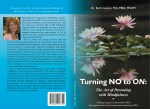
You can find out more at http://www.bethgineris.com.  Even More outlined in Beth’s upcoming book, 6 steps to transcending conflict and elevating consciousness, due out in 2014.  You may participate in seminars to learn these techniques through her website.  This book is the HOW TO companion book to Turning Me to WE: The Art of Partnering with Mindfulness(2013).front cover.me2we Discover where you are in the Temperament and  the MAAPS section.  You can see how you see the world, and whether you have an attachment that is creating problems in your relationships.  MAAPS will help you to discern your insecurities and understand how and what underlies how you developed your insecurity driver (Money,  Achievement,  Attachment, Power,  Structure). You can find ways to simply connect to yourself in a loving forgiving way through theTurning No to ON: The Art of Parenting with Mindfulness Book (2011). beth's book No to ONIf you want to change your life, see how you can bring mindfulness to your parenting and relationships.  One being at a time you can elevate the way in which you treat one another and elevate the consciousness on the planet so that equality, balance, and freedom BEcome the norm for all.  in love and light, bg

2 Comments

Don’t let your garden go fallow

Hello

Several years ago when I worked in an Eating Disorder Day Treatment Program one of my co-workers used the phrase Don’t let your garden go fallow as a way to redirect individuals to focus on their own work.  She told a story about the importance of having a balanced relationship toward helping or you may forget to focus on your own garden.  Without proper attention and nurturing a garden will go to seed and die.

It was a metaphor; it isn’t always that a person doesn’t have the skills to succeed but sometimes it is a matter of improper focus.

I have this friend.  She is smart, and talented.  She is supportive of her friends, and partners, and is great at seeing ways to help them move forward in their lives, while she seems stuck in hers.  Even when she wants to make a change she always ties the change to someone else as if she can’t tolerate the role of standing on her own.  And yet she has always been strong; weathering difficult times alone.

It isn’t that she hasn’t created success, she has; it’s that she hasn’t created her own happiness.

I think it’s because she is caught in one of my identified survivor scenarios.  She helps others as a way to survive and so doesn’t put energy into her own real life.

In fact I see this with a number of women; they connect their success with that of another.  They give support with an unspoken understanding that the other will return the gift in the future but often they end up catapulting the other into success and that other does not return the favor or give credit to them.

No it’s a survivor mentality – life requires this action or imminent death is the feared result. But how does an internal should action, an unconscious habit reaction pattern, get set up in an individual?

For the most part we act in ways to best support ourselves unless we have some sort of psychological illness that interferes with us doing so.  That is human nature.  Therefore individuals who are not ill, act in this way to benefit themselves.

These survivor scenarios are set up early in individuals as coping strategies, that’s why I choose to call them survivor rather than victim scenarios because for the most part they are coping strategies that really do help the individual survive a difficult event.

But the event gets survived and the pattern remains. It’s a short-circuit in our internal structure because it is so closely tied to a fear of death.

I am not suggesting that someone is threatening to kill all these individuals in their early childhood.  I am suggesting that events are interpreted such to directly tie the success of the other to their own life and in response their first goal was to harness their forces to support that individual above their own self-needs.

The development of the coping strategy is a mindful present moment response to their environment which is healthy.  The continued unconscious habit reaction pattern after the event has passed, is no longer a present moment mindful response; it is unhealthy.

Since it is unlikely that any of us have made it through to adulthood without some degree of adverse events, it is likely that we all have developed some unconscious habit reaction pattern, some internal should action equation that no longer serves us.

Figuring out what it is, how it served you and how it no longer serves you so that you can be free to act differently and create your own happiness is a great focus of internal work.  My example above is more typical of women but men have these too and they have the same basic components of giving up self for survival.

Here’s how to begin the process. Be mindful.  Use your senses to guide you.  Use your feelings especially those of anger, defensiveness, depression, or an internal pressure to act in a certain way to help you focus in on the potential strategy that you developed that may no longer be of service to you.

One thing I have noticed is that when it’s happening I actually see myself doing things, or divulging information, or acting in ways that I feel pressured to do and say and I feel sick to my stomach afterward or really angry.  Another thing to look for is an indecisiveness regarding what to do or trying to take back what you did do.

Once you increase your awareness and mindfulness regarding this you will begin to get an outline on what strategy you may want to change, let go and transform.

See you tomorrow.

Beth