InstinctiveHealthParenting4U

Change your Attitude, Heal your Soul, Balance your Life. Uplevel YOUR consciousness. Find your way HOME through MAAPS.


1 Comment

reading signs

Hello

Reading signs is an art and a skill; it’s pattern recognition and figure/ground shifting.

You know the experience when you learn a new word and all of a sudden you see it everywhere.  Or when you are working on a problem and it seems the movies, tv shows, books and news are all discussing aspects of the same problem – even if they are calling it something else.  You are making connections between what is on your mind and what you see in your environment.

The information to solve the problem begins to present itself in all sorts of different ways and places if you can just pay attention and recognize the pattern(s).

If you use it to guide you in your life choices then it requires an ability to recognize when you are faced with divine  guidance and when you are tricking yourself, and it has a playful quality to it.

I used to think everyone saw information in patterns; then I discovered it wasn’t as common as I thought.  It seems it has some instinctive qualities to it but it also can be developed.

I remember when I was a child and my Mom would put me down for a nap, that I was not going to take, I would pass the time staring at the ceiling – there were some truly amazing images there.  Shapes and squiggles make patterns that are recognizable to me.  It’s like laying on grass and looking at clouds – images develop and then shift and then transform into something else.  It has some relationship to what is on your mind and it has some concrete aspects too.

It’s quite meditative and develops the creative aspect of your brain.

I think this past time developed my skills at reading signs, drawing, diagnosing problems, and finding creative, innovative solutions because it developed my perception at pattern recognition as well as my skill at shifting between figure and ground.

It’s a type of Gestalt paradigm shifting; allowing the ground or pattern to develop into a figure, interacting with it and the pattern recognition program in your brain.

This talent is useful for developing mindfulness, problem solving, and focusing life choice transitions because it helps to open your horizons and encourages thinking outside the box.  It uses your internal sense awareness system and increases your connection points or threads to the environment around you.

In the latter situation it works a bit like  free association in psychoanalytic theory, because it helps you ascertain what is in your subconscious, especially that which may be enough under the surface that you miss it when thinking in a formal way.

The theory is that our subconscious has information to share with our conscious mind but that we have stuffed it down under for various reasons.

In example, you love music and love to sing but you had a parent who wanted you to study a science because that was real education and music was folly – so you stuffed your love of music into your shadow or your subconscious.  You may have allowed yourself to follow music and buy music and participate in music in a number of ways but not as a career.

Then you come to a crossroads in your life and you are thinking about what you want to do as a change in career.  When this happens your subconscious wants to get your attention so music, singing, and themes or signs of this nature would begin to present themselves to you in your environment.  Your subconscious isn’t affecting your environment by changing what is there,  it is affecting what you perceive – it is affecting to what you put your attention.

In free association, the rule is to say the first word that comes to your mind without censorship, this is giving you a glimpse into your own subconscious pattern recognition and what associations you have of which you are unaware.

The experience I described above about learning a new word and then seeing it everywhere is another example of seeing due to an increased awareness.

This idea of reading signs can be taken too far, wherein a person must wait for a sign to take an action.  I am not suggesting this, nor do I think this is an empowered way to move through life.

I am suggesting that having the capacity to lightly and playfully notice to what you are attracted or what seems to keep presenting itself to you when you are working through a problem may be an innovative and whole-istic way to guide you in problem solving.

This can be developed through figure ground perception, perspective shifting, and awareness development along with pattern recognition to discover new connections and innovative solutions to bothersome problems.

One way to increase your availability to this phenomenon is to start out by focusing in on a problem you would like to solve – perhaps something that you have tried to resolve through other more formal paths.  Once you have a sense of it – then write it down on a piece of paper and leave it next to your bed.  Look at the information on the paper and think of your question about the problem, and ask for guidance with it as you fall asleep.

You may find you have dreams that give you information about what to do.  Also, pay attention to what patterns are presenting themselves to you as you go through your day.  Jot these down with the question or problem on the piece of paper next to your bed.

Do this for a few days, then look at what information you have gathered and see if you can identify a pattern or answer to your conflict.

I hope you find this to be a fun and informative exercise.

See you tomorrow.

Beth

2 Comments

perception of time and mindfulness

Hello

Feeling like you need more time to get things done?

What about those amazing stories of how a person seems to have split-second responses in times of crisis?

What these two things share is our experience or perception of time.

I think there are ways to shift our experience of time.  One way is to see in 3 dimensions, 3-d, through different levels at once.  Another is a concept of bending time.  It’s like experiencing time moving in slow motion when you need more time to respond to a crisis.

Mindfulness can affect the perception of time.

When we are doing a task mindfully the experience of time is stretched, like there is just enough time to finish the task.  This also increases ones sense of pleasantness to the task.

Think of a time when you felt that time went by faster or slower.  The most common experience of this is when we are doing a task that we do not want to do, or is boring, it feels at these times as if time passes drags by or when we are doing something we love, the opposite is experienced, it goes by fast.

Have you ever experienced an event in slow motion?

It’s a bit surreal, your inner perception, thoughts and awareness of events seems to be heightened and happening rapidly while events you are observing are slowed down in comparison, appearing to unfold in slow motion.  I have had this experience a number of times.

When I was in college I fell 15 feet through a hole in a roof.  It seemed to take forever for me to hit the ground.  I was intensely aware of time passing very slowly.  The event took less than a minute, but felt like minutes in slow motion for me.

In my work on a crisis response team, as the team captain, I experienced a number of events where the crisis event unfolded in slow motion as my internal sensory awareness of the possible actions available to resolve the crisis sped by in my mind, until I decided upon and took the best action.  What felt like plenty of time to resolve the situation internally was observed to those around me as happening in seconds.  That is a type of seeing in 3-d and bending time, and it is a function of utilizing mindfulness.

This experience of events happening in slow motion, happens infrequently and has something to do with a heightened level of attention/awareness in concert with some degree of risk or need for heightened awareness.  In example, when you see someone about to enter an intersection where they will be confronted by an oncoming vehicle.  The event slows externally in your perception as you internally increase or speed up your awareness of everything around you to see if you can act quickly to save the person or avert the accident.

This experience in real life is similar to what the cameras depict in movies where the action is slowing down and the awareness is overly heightened allowing for a protagonist to do exactly what is needed to resolve a dangerous or risky situation.  There is in general a heightened risk that requires split second response.

Having a capacity to change your perception of time, or bend time, allows for what appears to be super human skills when responding to emergency situations.  Having spent many years in a role of responding to emergency situations, I think it is a gift that also requires development.

The key is mindfulness and a long history in meditation and paradigm assessment and shifting.  These activities develop the skill at bending or perceiving time at different speeds or maybe it’s perceiving events at different time speeds.

Practicing meditation and Mindfulness are the best ways to develop your super human skills in response time and time perception.  These activities also increase you experience of tasks and events as pleasant and worthwhile.

One interesting fact about time is that from a mathematical perspective, time feels faster and slower in different times of the calendar year.  This has to do with the movement of planets and the sun and earth.  The equation of time varies over the course of a year, in a way that is almost exactly reproduced from one year to the next. Apparent time, and the sundial, can be ahead (fast) by as much as 16 min 33 s (around 3 November), or behind (slow) by as much as 14 min 6 s (around 12 February).Wikipedia, equation of time.

This is a very comforting piece of information for me since I find that the concept that time is a linear and an exact thing does not fit into my experience of time at all.

Meditation and Mindfulness increase your capacity to see in 3 dimensions and enhance your internal sensory awareness perceptions. It also increases your capacity to assess your environment and shifting paradigm perceptions.

See you tomorrow, which you may perceive as happening slower or faster …..

Beth


Leave a comment

The Solution is present within the dilemma

Hello

The solution to a dilemma is found within – Not just within yourself but also, within the dilemma.  It’s all in how you look at the problem, your perspective,  and what assumptions you have accepted that may need to be re-evaluated, your paradigms and beliefs.

Re-evaluated through a new perspective provides fresh insights into the problem and its underlying components, agreements, and belief systems.

You have to be focused and clarifying.  Objective rather than subjective n your evaluation.

In psychology we talk about an observing ego.

The underlying aspect of an observing ego is an unattached perspective of yourself – observing and evaluating your behavior from a slight distance without subjectivity.  It’s an aspect of yourself that is more neutral and observant.  It provides information about reality testing and whether your paradigms are fully informed.  From a psychological perspective developing your mindfulness will develop your observing ego resulting in an internal system for paradigm identification and shifting.

Perspective alteration leads to paradigm shifting, especially when done in a neutral unattached mindful way.

Usually a person evaluates a chronic or bothersome problem as if running on a track, and with each repeat of the course of thinking he creates a rut in thinking, so that he is unable to see other perspectives, interpretations, or outcomes.  This creates a feeling of being stuck, constriction, and powerlessness.

Sometimes this worsens over time as each course chooses a subjective negative perspective leading to a downward spiral – this is depressive thinking.

The more one repeats runs around the thinking track the more one feels stuck.  This deep and constant feeling of discouragement decreases a persons capacity  to see from a whol-istic, mindful perspective.  And this makes the solution that is present invisible to the person. This results in internalized frustration that then pervasively affects other aspects of his life, and life choices.

The solution is present in the interpretation of the components of the problem.  Looking at a problem from various perspectives shifts the rut in thinking, or offers a new visual or sensory perception of the problem.

Changing your perspective is like changing the lens of a camera it shifts the image, it allows one to see various details of the image differently.  This is true about a problem too – shifting your perspective allows details to be viewed differently, some become more clear others obscured – like zooming in or out.  It allows for a shifting between figure and ground or paradigm perspectives.

Through this review one is able to see what assumptions, paradigms, internalized or introjected belief systems are informing one’s thinking regarding a problem.

Here is an example of a relationship problem.

A person is in a relationship that does not serve her.  She feels obligated to her partner but doesn’t feel fulfilled; these feelings are at cross purposes.  She has a belief system that requires she stay in the relationship.  She tells herself she must deal with it and suppress or “get over” what she is feeling.  This requires a denial of who she is at a core level.

If she is successful at this then she splits away from herself and feels alone and disconnected.

If this is not successful then she feels incompetent and develops poor self-esteem.

At various intervals she feels stuck – neither option of staying or going feels like a solution because she has set up a complicated bind of agreements, beliefs, and expectations that together are incapacitating.  Therefore, she feels stuck and powerless in her life.

The solution is present within the dilemma but she will have to look at each of the agreements, interpretations and expectations that make up the problem to determine which are inaccurate or untenable.  Then she will have to re-choose how she wants to act in the relationship.

First she has to center herself on what she wants and believes and then the action or solution to the problem will present itself.  If her wants and beliefs are at cross purposes then she will be stuck in her thinking and be unable to act.

This is mindful paradigm perspective shifting and I call it Soul-utions focused re-working or working through.

Why Soul-utions ?  The soul or heart is whence she needs to be evaluating her situation – not the mind/thinking alone.  Think of mindfulness as the mind filled with the guidance of the heart. The mind is directed by core instinctive knowings which are deeper and more personal than the social mores that are laid over our internal sense of self.  These are more personal but not more subjective, so that connecting to the core of yourself allows you to be more objective in your analysis of a situation.

Since we are social beings it is difficult at times to separate what is truly our center – our instinctive knowing – and what is a social or group expectation overlay.  Coming from our heart helps us make this distinction.

The more one practices mindfulness and meditation and breathing, the more one has access to his or her internal, centered, perspective of the world.

As you look through this mindful, internal, centered lens you are able to see the solution to whatever dilemma you are facing; it is within you (from your center) and within the components of the problem.

A good way to start this process is to remind yourself  to go within, stay centered and re-view what paradigms or perspectives make up the choices that make up the problem.  Some people find getting to a heart centered perspective requires a spiritual connection or praying – these modes can be helpful.  I find meditation useful.

You will find that mindfully looking at the problem from different angles will be beneficial.

See you tomorrow.

Beth


Leave a comment

Moving through, the use of mindfulness to see the way

Hello

Whenever you find yourself at a crossroads or blocked by an obstacle, the first, best action is non-action.

Stop, and be still.

This action allows for all the information to settle and catch up to you and where you are.

Action before you know what is best, is reaction, and is usually part of a Habit Reaction Pattern. This will generally get you more stuck or going down the wrong path.

Some people instinctively know and can see the multilevel aspect of circumstances and therefore can act quickly in emergency situations – this is not reaction but instinctive knowing action.

An Instinctive Knowing Action and a Habit Reaction are different from each other. The former feels right, but doesn’t have any fearful or emotional charge to it, the latter is emotion-laden and can feel automatic (reactive) and be linked to historical experiences.

The Instinctive knowing action feels calm and has a degree of unattached certainty; the thing that needs to be done now.

The habit reaction pattern feels like a repeat of a previous experience and the person is generally not feeling calm when they are participating in it.

The process of mindfulness actually increases the ability to instinctively know, and with practice can expand the needed space for being still while condensing the needed time for instinctive knowing action.  Mindfulness increases instinctive knowing through paradigm shifting and understanding, the aha experience where everything fits into place

The more your habit is mindfulness, the greater and swifter your capacity to evaluate all the information and act instinctively.

Moving through an obstacle, an obstructive cycle or a stuck place requires the following steps.

First, stop and be still. Breathe.  Center yourself, get into the present moment; Connect within while simultaneously viewing what surrounds you.

Second, look/observe and listen to the environment and your inner landscape – your sensory impressions and feelings.  What immediate knowings are present.  Increase your awareness, pay attention, and make note of what you see, feel, and experience.

Third, notice to what you are drawn or repelled.  This is important because often in stuck situations what is required is going toward that which you fear.  Using mindfulness is important here to help you ascertain whether these pulling and pushing feelings are part of a habit reaction pattern or an instinctive knowing.

When dealing with an obstacle the problem exists in the stuckness and the need to transcend, go around, or move through, where there appears to be no path.  If you have the ability to discern what seems to have more energy then you can go toward that, allowing your instinctive knowing to guide you.

However, if you have a habit reaction pattern that signals fear as an emotion in response to change then be cautious in treating the fear at face value.  The fear may be interpreted as stay away or a cue to move forward toward it.  If it is part of a habit reaction pattern, the fear may intensify as you step forward but there may be no objective information to support the fear, there may be only emotional charge and history.

Fourth, Apply mindfulness.  Mindfulness is the key to assessing this issue.

Mindfulness focuses our attention and our intention so that we can increase our own centeredness, perception, and perspective of the obstacle or stuck situation.  Surprisingly it also has the effect of slowing down time by setting us in the present moment.

Let’s use commitment issues as an example for a stuck or obstructed situation.

A person has a habit reaction pattern to feel fear and run in the opposite direction or take a defensive stance when faced with a potential for committed relationship.  This is a pattern imprinted in reaction to his earlier negative experiences in relationship.

The inner habit reaction equation may be something like this, commitment = self death or loss.  The intensity of the equation relates to the degree of fear the person felt at that alpha relationship that created the habit reaction pattern.  This equation is an oversimplified description of one previous relationship that was in some way made definitive to the person.

The equation was developed to avoid the pain that came with that relationship.  The inner habit reaction keeps the person from living in the here-and-now because it takes over as soon as a risk is perceived, disallowing the opportunity for the individual to see his own behavior and responsibility in the pain caused in the earlier or any subsequent relationship.

The person feels fear and reacts as if the situation is dangerous, as if it is exactly the same, as if the past is happening in the now.  This sets up the power of the habit reaction pattern and the instantaneous/automatic reaction quality.  Often the individual is unaware that he is acting under the influence of a habit reaction pattern.  He may feel he has great instincts but in reality he is cutting off his connection to his instinctual sensory system.

He may desire a committed relationship but because of his habit reaction pattern he finds himself continually having to survive relationships that feel dangerous, so isn’t able to participate in a committed relationship.  He feels powerless to change the cycle and only feels powerful within the habit reaction pattern.  He desires something that he feels powerless to attain because of the habit reaction pattern.  It’s a paradigm that keeps him stuck; shifting his perspective, shifting the paradigm allows him to see his way through.

Increasing his attention and intention, placing himself in the center of the situation and re-viewing his perceptions and perspective – all mindful actions – allows for the opportunity to view the situation in the present moment unfettered by the habit reaction pattern and story of the past.  It places the past in the past, and by doing so allows for a more mindful whole-istic perspective from that event to be incorporated into himself and then applied to the present situation.

This allows for the illusion of the obstacle or stuckness to shift so that the way through is presented in a clear and obvious way.

In order for the illusion of the obstacle to shift, the paradigms, perspectives, and rigid belief systems must shift to fit the actual present moment situation.  This internal shifting allows for the unfettered presentation of the way through.

Mindfulness allows you to see the way.

See you tomorrow.

Beth


1 Comment

Being at the Threshold

Hello

Being at the threshold is exhilarating.  It is a mixture of excitement, fear, strength and letting go.  It’s standing in a place of neither here nor there and both simultaneously.

It has an unreal or murky quality as if seeing through water into another space.  It is the moment of change when you can feel the change is coming but may not have a clear picture of the outcome.  Sometimes this is instantaneous and sometimes the space of the threshold is extended.

Most developmental tasks like starting a new job, creating your family, creating your career, and  increasing your self-knowing, require this space, this time of being in-between, or being at the threshold of stepping off.  They have the mixed experience of excitement, fear, the unknown and trust.

It’s a space of letting go and stepping forward, of risking change – it’s in the energy of  the Fool card in the Tarot. When I first started my psychotherapy practice I used to spend a lot of time considering this space.

The process of psychotherapy is always moving away unwanted, unneeded garbage, – thinkings and feelings, undesirable or outdated habit reaction patterns, – and moving into a waiting space until new habits and patterns of being in the world are embraced.

Some of my more compelling paintings are of threshold spaces and themes, beautifully colored spirals, and doorways into more openings and pathways.

Being on the threshold is a space that I am drawn to experience.  It is this ever-expanding sense of movement through space from a metaphorical perspective.

From a practical perspective it can feel unpleasant because it is an unknown space – a space of something that is to be revealed.  Although some people are most comfortable in that space just before a decision is made, most people find the waiting, the space of unknowing or just before, to be uncomfortable and difficult to tolerate.

A threshold from a psychological perspective is a space between two different existential planes.   A friend  of mine, in her monthly spiritual newsletter at  http://www.terrylamb.net, discusses the concept of the Jungian liminal space not infrequently.  She integrates this concept with astrology.

A Jungian liminal space is a threshold space.

In Jungian theory the Individuation process of self-realization takes place within a liminal space. The process of  Individuation happens typically in middle age, and it can be seen as a movement through liminal space and time, from disorientation or separation of themes to integration.

What takes place in the shadowy, murky phase of liminality is a process of breaking down and letting go and what I call breaking through or stepping through to the new, full, whole self; one is “Making whole” ones meaning, purpose and sense of relatedness in ones style of being in the world and relation to self.

Carl Rogers describes the client therapist relationship as having an  “outside-of-this-world” quality. It has a sort of trance-like feeling. The client-therapist relationship, can be described as a liminal space, a threshold between two worlds of experience – that of the therapist and the client in the phenomenological space of the therapy room.

It is a space from which both client and therapist emerge at the end of the hour, as if from a deep well or tunnel or shared knowing/experiencing.   It  marks off the special kind of reality of a psychoanalytic or psychotherapy session, the different kind of reality that is within it.

Jungians, archetypal therapists, and Rogerian therapists describe the requirement or need to accord space, time and place for liminal feeling.  It can be a bit exhilarating to be on that edge and as such it is important to honor also movement through the space and allow the opportunity for a new developmental threshold to present itself when appropriate.

Psychotherapy is not required to find yourself at the threshold in your life path or to even experience the exhilaration of moving through it.

Mindfulness is the most useful tool at this fascinating place.

Using your connection to yourself and placing yourself in the center of your world through present moment focus, compassion, acceptance, allowing and paradigm recognition and shifting allows for movement through the doorway, through the developmental task and doorway, into the enlightened place available to you at the other side of the threshold.

When you find yourself at the threshold remember to Breathe.

Embrace your whole self and Allow your inner sense of life to move you gently along your path.

Mindfulness will give you a focus and a sense of ritual and relief as you again re-member, re-connect, who you are and what is at your center, your heart center.

Being at the threshold can be like a playful and sacred space if you allow yourself to embrace your full whole mind, body, spirit self.

Think of the threshold between night and day, day and night, and how sunrising and sunsetting connects you to spiritual and material aspects of your environment.

These transitional times occur every day.  Other transitional times occur weekly and throughout our lives.  There are many types of transitional spaces that can offer opportunities to experience the space between two existential planes.

Keeping mindful about this in the daily function of your life will attune you to your inner self so that when a transitional developmental task presents itself for discovery you are able to fully apply your mindful present moment attention to the experience.

Acknowledging these and being in the moment at the threshold seems to offer opportunities to heal, release, grow, and transform at a quantum level.

The threshold offers us an opportunity to begin anew like caterpillars shedding cocoons and becoming butterflies.

See you tomorrow.

Beth


1 Comment

The treasure of mindfulness

Hello

What defines success?

Is it the outcome, or how others see you?  Outside-in process. OR  Is it how you see yourself?  Inside-out process.

The outside-in process keeps the reins of your success outside of you so that you must keep performing to feel a sense of self-esteem – leaving you with an external locus of control.  This is a state wherein your self-esteem dwindles between successes and requires constant attention to remain buoyed.

The inside-out process is the opposite.  One develops an internal locus of control and is buoyed from within between successes and even through failures or difficult trials.  This is what we want to develop in ourselves and our children so that we can weather the storms of life.

When you get kudos for something you did, it can pull you away from what’s inside, or who you are, especially if the thing you accomplished did not develop out of an internal drive toward something but rather to make another happy.  It puts you at cross-purposes where you are working to get the kudos but not necessarily focusing your energy onto your own goals.

If you are pulled forward toward the creation of something by an inspiration from within, then the kudos for that thing transcend the exterior into the true self, and connect directly with your self-esteem.  This can be enhanced by the support of others but develops you along the path you have identified for yourself.

The development of self-esteem is an internal process.

If you are helping a child develop his or her self-esteem it is an internal process that is guided from the outside.

It requires a type of mindfulness that applies lovingkindness, compassion and perspective toward the child with an intuition of what is happening within him or her.  It is a reinforcing of his or her internal talents and vocations.

Self-esteem is caring about, having a fondness for, and connection to, ones self in a balanced and harmonious way.  Don’t think narcissism, think joy de vive – it’s a gentle sweetness.  Self esteem is an energy that says I can do it – or I can’t do that but it’s ok, I’m ok.  It’s accepting and strong, both.

When you are developing a positive self-esteem within your child, successes and accomplishments and people being proud of  him or her are necessary.  This looks outside-in, but it is actually a reinforcement of inside-out behavior.

The way in which this is promoted or encouraged is though en courage -ing.  Distilling the inner courage by taking advantage of courageous opportunities.  Successes are not required for this to develop, however having triumphs over  small conflicts is very helpful.

Mindful intuitive guidance helps to focus those opportunities so that the child can move through to see the growth and expansion he or she can create.  Courage is the energy of moving through the fear of something to see that you can do it.  It is also the energy that embraces how we are different and unique, and how these unique talents may create opportunities in our life-path, embracing the whole of who we are.

The utilization of mindfulness as a way of navigating our environment  increases our understanding of ourselves and others.

Mindfulness incorporates an integrated spiral inspiration and expiration of sensing information, while remaining connected to that inner compass of spirit-self.

Cool image don’t you think – an integrated inspiration and expiration of sensing information while being connected to that inner compass of spirit self, – I see it as the spiraling dna-structure or a kundalini spiral of energy.

I once experienced a kundalini spiral of energy.  It began at the base of my spine and  swiftly moved up along my spine through all my chakra energy centers.  I had the most cathartic and joyful feeling rising through my body.  It was automatic and profoundly joyful.  It was like a laugh or cry of joy that began deep within me and then rumbled out quite unexpectedly and rather forcefully and uncontrollable like a sweet little belch of happiness.  I can only lightly remember the whole of the experience – much like birthing my child – only remnants of the experience remain.  I believe this is partially because the full emotional and visceral qualities of the memory are not held within my mind but within my body.

The full body memories seem to be re-kindled when involved in a similar activity.

Self-esteem has the same quality of wholeness.  Feeling a sense of self-confidence can be re-kindled when participating in a similar experience or activity whence once you built it.  It’s one of the reasons that once you have a habit of success with something you want to repeat the experience or activity because it reinforces that sense of self-confidence or self-esteem.

It’s also why using repetition can ingrain a greater sense of self-confidence.  The trick is to practice the activity correctly so that what is entrained is positive and en-courage-ing.  You want to avoid, side-step, setting into place a negative habit reaction pattern.  This relates to activities like math, and gymnastics, and bicycle riding, but it also applies to social interactions, problem solving, and facing fears.

Mindfulness increases your connection to yourself so that you can have a more accurate ability to focus your positive energy toward your own successes and growth.  Teaching mindfulness to your child increases your child’s capacity to find courage and attain an inner sense of en-courage-ment.

Watching my daughter practice her gymnastics I observe how perfectly she stands on the beam, and I am grateful to her gymnastics coach for teaching her small components that en-courage her to continue and build her inner self-confidence through her constantly developing spiral of success.  Step-by-step she moves toward her own internal goal of perfection through the mindful guidance of her coach who provides the requisite set of practices to allow her mind and body to develop the building blocks of self-confidence and then mastery.

Mindfulness is truly a treasure as it allows us to move back to center and en-courage our best self to come out and play.  It en-lightens our awareness, and increases our connection to our inner locus of control and develops a solid self-esteem.

Mindfulness is re-member-ing, re- connecting our experiences so that we can build on the components that best help us move toward our goals.  Mindfulness is like my daughter’s fantastic gymnastic coach gently pulling us back to center, then adding a new move and refocusing us, and then moving on to keep adding the building blocks of success.

Use mindfulness to get a handle on what parts of your life are under your internal locus of control.  If there are areas that feel like they are controlled from without, use mindfulness to bring you to center.  Then with compassion and lovingkindness reframe, re-set your center so that you can connect or re-connect with your own positive self-esteem.

See you tomorrow.

Beth


Leave a comment

Risking love

Hello

Loving another is a funny journey of faith and risk.  It is an adventure of the most daring kind.  It teaches you about yourself and the other, as well as The Way, the Tao. It requires knowing, perceiving, negotiating, holding on, and letting go.

It is a strange sort of risk, a sense of faith and trust of knowing yourself, and knowing the other.  Seeing through the facade the other presents to protect self while secretly wanting to be seen and loved for his true self.  Loving through your own facade and fears to find a peaceful connection and acceptance.

And just to spice up the adventure, there is the issue of time and space, and accepting the inevitable knowledge that everything changes.  It requires being willing to enlist anew in that dynamic process, holding on to what matters and the truth in the relationship while letting go of the fears and attachment.

It’s a risk to love.  A risk of interpretation.  A risk of acceptance and expectation.  A risk of perception.  It’s a risk of loss of what is gained.  It’s a risk to allow yourself to be seen and to see the other.  Risky because being faced with the intimate experience of love is so invigorating and vulnerable.

In order for true love to be felt there is a degree of self that must be released to make room for integration with the other in relationship.

I believe there is a strong connection between intimacy, vulnerability, risk, and connection.

When you are in a relationship with someone who does not allow himself to be vulnerable, then the relationship is not risky – but it is also not intimate.  The connection is more superficial, and less profound, but relatively safe.

The risk in love IS to be seen and cared for – and then to WANT to be connected… the risk is that in the seeing and being you feel real like in the Velveteen Rabbit by Margery Williams, where the love of the boy transforms the bunny into something truly special.

Risking what happens when change or loss comes, as it inevitably will, the pain will be greater.  It’s risking the pain, in order to have the amazing joy of being seen and loved.

I have found that the depth of ones grief is equal to the height of one’s joy.  Therein lies the risk in loving….

Love is, above all, the gift of oneself.  ~Jean Anouilh

True love is a discipline in which each divines the secret self of the other and refuses to believe in the mere daily self.  ~William Butler Yeats

The supreme happiness of life is the conviction that we are loved – loved for ourselves, or rather, loved in spite of ourselves.  ~Victor Hugo

Love is when you can be your true self with someone, and you only want to be your true self because of them.  ~Terri Guillemets

We are not the same persons this year as last; nor are those we love.  It is a happy chance if we, changing, continue to love a changed person.  ~W. Somerset Maugham

The way to love anything is to realize that it may be lost.  ~G.K. Chesterton

There is a lovely children’s book that I read in my high school French class that I carry in my heart about the meaning, adventure, committment, and risk required in love.

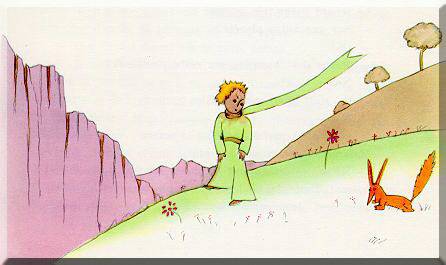
Le Petit Prince  by Antoine de Saint-Exupery  “Here is my secret.  It is very simple.  It is only with the heart that one can see rightly; What is essential is invisible to the eye…  It’s the time that you spent on your rose that makes your rose so important. . . . People have forgotten this truth,” the fox said, “But you mustn’t forget it. “You become responsible for what you’ve tamed.”

“You’re responsible for your rose. . . .”You risk tears if you let yourself be tamed.  But if you tame me, then we shall need each other. To me, you will be unique in all the world. To you, I shall be unique in all the world…” “If you tame me, it will be as if the sun came to shine on my life.”

Like a number of well written children’s books and fairy tales, this book offers supreme guidance on a major developmental task of life.  Faith and trust are the paramount components of loving.  Risking self and loss is required in love.

There are a lot of books that talk about how to calculate the risk and reduce the percentage of loss but as long as intimacy and self are involved in order to truly love and be seen one must step off the cliff like the fool card in the Tarot, Trusting one’s mindful heart.

Mindfulness is the key to reducing the risk while keeping the intimate connection – mindfulness and present moment focus.  These help to surround the risk with compassion, integrity, and character.

I hope you have a fantastic adventure in loving.

See you tomorrow.

Beth


Leave a comment

Lost and Found, The way

Hello

I remember when I began my search for self and the meaning of life in college.  I was intent on getting there fast.  I had a lot of ideas and a lot of energy.  I thought I could figure it all out pretty quickly and then just move on to being a great success.  Very puer, or rather the feminine puella, very dynamic, enchanting, and vulnerable; nothing could stop me.  I had a lot of success and innovative ideas that kept propelling me forward.

Then life happened, as it is known to do.  I got a little lost, and then I got a little found, then lost, then found, then lost… you get the idea.

I am pretty sure this describes most people walking around who have put energy into understanding the meaning of life and themselves.  The energy of existential angst and enlightenment can be so invigorating and frustrating.

Many of the therapeutic theories incorporate this winding, spiraling path inward and then outward through knowledge and confusion and integration of ones experiences.  The thing that is so useful about mindfulness is that it embraces the whole of things and accepts the dynamic quality of perspective such that being found and lost is, by its nature, transitory.

Very useful because it helps us from getting stuck in time and space, not caught in the past or the future, by placing us in the center of our life the present where actual change or action can take place.

Getting stuck happens when you define you have reached the pinnacle and now there is nowhere else to go; that kind of definition sets up a situation where one gets derailed off course.  The idea that something  is it, the answer, and now it must be repeated or held in place sets up a negative process where the energy degrades.  Holding something in place denies the ultimate truth of growth and change.  It creates a pull from the inside that pulls apart the thing held in place.  The cycle of life is change – it moves, shifts, grows, continues with the cycle or spiral in and then out and then in again, up and then down and then up again, onward and through.

Each answer is an ending but it is also a beginning and so is in the center of ongoing, dynamic, movement.  If you try to hold it still then the movement works against you and breaks it apart.

You can see this in relationship, your understanding of information, and existence.  The more you know, the more you see, the more there is to know.  It is ever-expansive incorporating and shifting.  The same is true for relationship – trying to hold someone to a way of being that defines them at one age disallows growth and change – yes their basic nature remains the same but what is attended to or experienced, how it is expressed, changes over time as humans are dynamic beings.

This brings me back to The Way, The Tao.  A larger more wholistic understanding of All that is,  is, and it is inside and around, and it is simple not complex.  Complexity is a trick that pulls you out of mindfulness.

Being mindful is a simple process.  Sit, breath open, allow, observe, accept, incorporate, shift.

Thus, the journey of being lost and found I suppose.

Quite a lovely journey if you are willing to lightly respond to each experience with a joyous interest – like the fool card in the Tarot.

Interest but not attachment.  Mindful, open, observation without good/bad judgement or interpretation.  Interest that sounds like this – hmm, I wonder where this will take me – perhaps down the rabbit hole to find  your way out by going within.

If you find yourself lost, fear not, a turn is soon coming that will set you again toward being found.  If you are found, take heed that holding too strongly to that knowing, may actually impede further movement until you are again lost.

Attachment is the thing to avoid or release.

Love, desire, interest, curiosity and mindfulness, these are all lovely and full of what brings you through the energy of The Way.

Lost or found you are on your path.  Follow your heart, and use your mindfulness, and joy will bring you home.

See you tomorrow.

Beth


2 Comments

En-joy now

Hello

Think of two defining moments in your life.

What is the basic emotion underlying each?

Things that stop us in our tracks and teach in this definitive way are either stern and painful or joyous.  Both are teachers but what they each teach shifts a person’s focus down different paths, one more limiting and one more expansive.

I encourage you to practice learning through joy.

When you feel joy your heart opens.  It is naturally expansive.  Joy unlocks your heart and guides you through your feelings to create more joy.

Singing can do this, especially if you are singing songs that bring you into a state of joy.  There is a softening, a slight sweetening of the experience.  It allows you to move into a neutral place or even to increase a fondness toward another or an event or a situation.

Mindful meditation has the same result.

Our emotions and senses are our guidance system.  They are navigators of our life experience.  We want to move away from negative feelings and move toward joyous ones.  This is an excellent guidance mechanism, however sometimes in youth or under defining circumstances this can result in a misinterpretation that creates a habit reaction pattern.

If you have a defining moment that sets into place a should or should not it creates a trigger that says if this, then that – so that a habit reaction is developed.  The habit reaction cannot be shifted without a re-set of the should or should not equation, if this, then that.

A trick to re-set it is to get into neutral or to get into joy. This is a trick because it is a way of getting under the habit reaction pattern to tip it on its head.

Think about driving your car.  You put it into Reverse to back up and into Drive to go forward.  In the middle is a gear called Neutral.  In neutral you cannot go forward or backward.  Getting into neutral allows for the space to decide which way you need/want to go.  It gives you space to evaluate the situation and then choose how to respond rather than just following the set pattern of one gear or another.

Mindfulness, just being with the situation, not allowing the should or should not equation to take hold, is very useful in releasing habit reaction patterns.  Mindfulness can allow for an acceptance and an observation of the situation and your emotions without a reaction to them – just taking note.  This allows for the space to decide, to allow, the next step to take place.

Mindfulness has a neutral intent to it, but it seems to open ones heart in a way that is similar to joy because it expands ones inner awareness and sense of connection.

Practicing mindful meditation increases your capacity for joy and shifts the energy of a situation as you practice paradigm shifting.  This disallows habit reaction pattern formation and dissolves habit reactions already in place.  It is a lovely practice to allow experiences to be joyous.

Learning through joy has this expansive quality such that growth is perceived as easy and enlightening.

This is most difficult to practice when the situation is loss, sadness, disappointing, fearful, or angry.  Practicing mindful meditation allows for space so that all aspects of the situation can be observed and evaluated and set in time in such a way that a positive joyous energy can be ascertained.  It incorporates a cycle of life and time that reinforces  a knowing that just as things desired are lost new opportunities are found.

This is acceptance of the way.  It centers you in your life.  Things past, the present, and things future.  As you move through your life each experience is centered in your life such that it is not an ending but in a cycle and continuing along a path.

Defining moments feel like endings, and may be completions but they are also beginnings into the next cycle, or centers of whole experiences.  When you choose to learn through mindful meditation and joy you can center yourself into the right perspective so that you can see the whole of the defining experience and its true place in your inner landscape.

Choosing to learn through joy allows for your heart to lead and guide you – not the heart meaning human love of another, but rather the compassionate, lovingkindness heart of your spirit.

Mindfulness meditation is a heart centered action.  It incorporates mind and spirit together.

Practice learning through joy.  Apply mindful meditation to your defining experiences.

En-joy now.

See you tomorrow.

Beth


Leave a comment

Thinking, Feeling, Being

Hello

What is instinctive is a natural state of understanding ones sensory guidance system information.  Your sensory guidance system is your 5 (+1) senses. Seeing, hearing, feeling, tasting and smelling are the 5 and the +1 is intuition.

Learned behavior is often not instinctive although it may be referred to as such or as a reaction.  This type of behavior takes us away from our center, by not allowing a direct connection to our sensory guidance system.

Sometimes one learns to deny what is instinctive due to circumstances and belief systems.  This is learned behavior that moves one away from his sensory guidance system.

To return to an instinctive way of being in the world one must understand his inner working belief systems and then shift away from those that are inaccurate or unhelpful.

It requires a natural and responsive relationship with ones sensory guidance system and ones inner landscape .  It’s thinking and feeling plus knowing that results in being.

The first step in developing this relationship has to do with trusting oneself and knowing oneself.  A knowing is something that is informed by your sensory guidance system and your intuition.  It is something more than book knowledge it has a connection to spirit.  In example, people who believe in god, do so through a knowing; they have a set of facts or information that give them a theory of a higher power and then they have an intuitive or spiritual or faithful experience they refer to as a knowing.  It is thinking plus feeling and intuition that results in a sense of knowing.

Think of what you know.  It is more than something you have read in a book and learned, it also has a component of reality through your own experience or inner feeling.  I know I love someone not just by my thoughts and mind but also my heart.  Careers are this way too – people know they are meant to do something by a connection to their sensory guidance information, book knowledge and something intangible that connects it to them – a knowing.

This is something that is important to develop early in life so that individuals can find where they are meant to be – whom they love and what they want to spend their life doing.  When I work with people who are unhappy or unsure of their choices, often it is a result of them having chosen career paths or life-paths to please someone outside of him/herself rather than from their own interior knowing.

Developing a knowing once you have disregarded it for a long time takes patience, understanding, compassion, listening, and development of attention to ones senses.  It is a process of opening or re-opening a portal to ones sensory guidance system.

One needs to increase ones awareness, perceptions, and connections to the environment around himself as well as the inner landscape of his being.  It requires a slowing down and evaluation of things that are accepted as truth but not really known.

This requires patience because it seems tedious to re-view aspects of our belief systems that seem obvious and true.  It’s an interpretation process.  Re-viewing what something means instinctively rather than interpreting different circumstances with the same reaction.

Integrating the knowing and the learning is a process of interpretation of paradigm and paradigm shifting as well as listening to our sense(s) of things.  We are spirit-human beings which is to say we have direct access to both the physical and the spiritual or intuitive.  If we choose to access and pay attention to both then we are being instinctive.

Breathing is a way of accessing and clearing out energy.  Meditation, both moving and sitting still, and yoga incorporate a stilling internally through breathing and focusing on ones center.  This helps us to gain access to ones sensory guidance system.

There is a tendency among energy workers to make an assertion that the ego or self is negative.  This is not my experience.  We are physical, psychological, and spiritual beings.  Our work is guided by both the ego and the spirit and each need, and are informed by, the other.

Historically in psychology, the ego mediates between the needs of the super-ego and the wants of the id. The super-ego is made up of introjects of the rules (belief systems that were swallowed whole without internal interpretation or evaluation – swallowed with an i-dent of truth) laid down by ones parents and society as well as ones stern experiences.  The id is pure desire.  It is like a young child – completely narcissistic and unfeeling toward others.  The ego mediates between these aspects to make choices that move the person forward in their goals as well as center them within the needs of a community.  The ego utilizes empathy and reasonableness.

Empathy is a necessary tool in developing ones connection to ones instinctive sensory guidance system.  Empathy places us in our center and in the center of our lives and relationships.  Empathy is not sympathy.  Empathy is having the ability to understand another’s perspective from their view; it is what assists us with paradigm shifting.

Often individuals will refer to the ego as power grabbing or wanting only to have power unto itself.  This is an uninformed understanding of the ego.  The role of the super-ego or id more accurately represent this kind of action.  Fear is often related to these roles and it causes an imbalance in how information is interpreted; it leads to reaction rather than instinctive action.

It is important to reorient yourself to the tool of using the ego as mediator to negotiate the space between physicality and spirituality.  If you are in a fear promoting situation and you have to trust your gut or spirit you need access to the ego to evaluate, using both your mind and your sensory guidance system, what aspects of the situation need your attention.  This is to say that fear presents itself sometimes as something that is an emotion not based in reality and sometimes as an emotion based on sensory information.  The ego in conjunction with intuition and spirit help you evaluate which is what.

The role of the ego is to move one to neutrality and then in that space be informed through ones spirituality, cognitions, and ones sensory guidance system.

The ego has a neutral feeling to it.  The id and the super-ego both have strong emotional attachments to them.  Super-ego feeling/thinking sense is stern and negative; it serves to keep you from changing or keep you in line.   Often the super-ego is Don’t or you must.  The id feeling/thinking sense is selfish and ownership; it serves to keep one connected to ones passions and desires but has no limits or boundaries.  Often the id is Mine.

Instinctive action is allowing your knowing to chart your course.  There is a natural sense of trust and peace that goes with this.  Navigating the environment of your inner landscape and the world around you requires a solid connection to your sensory guidance system as well as intuition and knowing, 5 (+1) senses, book knowledge, and an understanding of your self.

Instinctive knowing and being is thinking plus feeling and intuition. You will find more joy and success in your life if you allow yourself to be guided by your sensory guidance system.

Being is, I am, which centers you fully in yourself as a whole. Thinking and feeling are parts of the whole and more distant in their energy.  To test this say:   I am happy.  I think happy thoughts.  I feel happy.

Which of the three statements center you and are the fullest expression of your being?

See you tomorrow.

Beth