InstinctiveHealthParenting4U

Change your Attitude, Heal your Soul, Balance your Life. Uplevel YOUR consciousness. Find your way HOME through MAAPS.


Leave a comment

Interpretation and consolidation styles

Hello

Everyone has a personal style of being in the world and a personal style for communicating and learning.  From a solutions focused perspective in therapy, in order to help another I have to figure out those styles and match them in how I communicate and provide assistance toward solutions.  This takes a combination of focused listening skills,  intuition, quick thinking, and flexibility.

Using mindfulness when approaching interactions allows for more connecting space.

Each person relates on four intersecting levels.  They are a continua of abstract to concrete; sensing to intuitive;  thinking to feeling; planned to spontaneous.  Each end of these poles has trouble understanding or consolidating information from the other extreme end.

So individuals who tend to perceive the world in a more abstract fashion have difficulty with individuals who are concrete.  This is the same for individuals who tend to gather information in a sensing, fact observational (left-brained) way versus those who tend to gather information in a more intuitive fashion (right-brained).

The style in which one expresses information can also create misunderstanding if too far apart on the continuum of thinking and feeling.  Here the issue is more of a proactive versus a reactive perspective, using objective versus subjective information to both make decisions and express those decisions.

The final level of interaction has to do with planning and spontaneity.  This is somewhat obvious, if a person values planning then spontaneity is frustrating to them and visa versa.

For effective communication to occur one needs to assess his own position as well as that of the other on these four continua.  Some careers value different aspects of these four groups.  Most people are on a continuum of thinking and communicating skills from concrete to capacity to abstract.  Engineers tend to be at the concrete end of the continuum and artists tend to be at the abstracting end.  Most of us live somewhere in the middle.

This information is important in parenting especially if you and your child are at different places on a continuum.

Developmental stages can at times lead to a more concrete style of thinking and processing information for children.  But it is also a function of a child’s right-brained-ness or left-brained-ness.  Right-brained individuals are more on the abstracting end and left-brained people are more on the concrete end.

The more diverse or greater the crevasse between people, the less able they are to understand each other.  And a misunderstanding between them, can feel like an assault to a person’s character rather than a re-direction or teaching when it is related to a difference in information interpretation and consolidation style.

An example of this is the way in which a very left-brained person might interpret the information gathering style of a right-brained person; she might be seen as flighty or unable to substantiate her perceptions because they come from a more intuitive perspective.

A person who tended to be more feeling in their style of expressing information would be seen as subjective and not having an objective reason to feel the way they do.

For a child who tended toward this style of relating, she might have difficulty learning from a teacher she interpreted as not liking her, because the teacher might be more objective and less touchy feely and this might result in the child feeling like the teacher doesn’t like her.  A child who was more on the feeling aspect of the continuum might then have more difficulty learning from that teacher.

The work in parenting is to help the child manage her emotions and feelings and increase her understanding of her personal style in relating and interacting in the world.  This would need to be accomplished without deflating the child’s personal style but by developing the other aspect of the continuum.

The best way to do this is to help the child investigate whence their feelings come and to evaluate the objective aspect of their feelings.  This helps the child develop her thinking skills related to her feelings.  And develops both aspects of the continuum of thinking and feeling as well as both aspects of the sensing and intuition continuum.

Children who have strong intuition will often have information they have gathered from an observation perspective of subtle changes in behavior or facial cues from the other person whom they feel doesn’t like them.  So it might look like they are being subjective in their decision-making rather than objective, but there is an objective – observation of real information – in their decision-making process.   In these instances it is then useful to help them focus on learning for their own benefit rather than to appease or make happy their teacher – as they may be correct in their sense that the teacher doesn’t like them.

Individuals who have developed both their right-brained and left-brained style of gathering and expressing information are the most flexible and generally perceived of as affable, well-liked, and quite bright.

Myers and Briggs developed a test for preferred style of being in the world from Carl Jung’s work on this subject.  It has been used as a psychological test to help individuals understand their preferred style for years.  It is also used in business consultation to help build teams.

I prefer a book by Kiersey-Bates, called Please Understand Me, that is very comparable to the Myers-Briggs test.  The basic information is useful to help build teams but I tend to use it in couples counseling and parenting to help individuals see where they are mis-communicating and help develop an overall ability on both aspects of the four continua.

When interacting with someone you love, a team partner, or a child, it is useful to do some investigation about how each one of you got to specific information when you find you are in disagreement – it may be that you are perceiving different information or interpreting that information differently and you may be able to find agreement if you increase your understanding of each other.

This leads to paradigm shifting and an increase in one’s mindfulness in interaction.

See you tomorrow.

Beth

Leave a comment

Using dreams to develop mindfulness

Hello

Throughout my practice I have worked with dreams to help others develop an inner connection with their intuition.

Right-brained-ness is that part of your brain that knows things and makes connections but doesn’t have a connection to language because language is a left-brained thing.  Dreams are often right-brained in nature and so they seem inexplicable from a left-brained perspective.

Images in the dream are representations of holistic things and not just one-dimensional.

Smells and touch are right-brained – it’s part of what happens with babies they make connections to mom through their right brain capacity because they haven’t developed language yet.

Have you noticed how certain smells can evoke intense memories moving you precisely to the moment in time that connects with the smell?

Certain smells for me instantaneously evoke images of my childhood, my grandmother, and powerful experiences from my past.  This is a negative too for individuals who have experienced trauma – often the last image to be released is the smell of the persecutor or what smell was  around them when the trauma occurred.

My daughter, when reading will often stop and look at the illustration to assist her in consolidating the pictorial and written information presented.  She is, like her father and I, predominantly right-brained.  A gift and a curse really – it allows for an extraordinary style of gathering information but can be distracting and difficult to control as a young person, especially in our left-brained dominated world.

If not observing her closely, this stop-and-start style of reading could be misinterpreted as an inability on her part to read, when in reality it is a style through which she incorporates information.  She is strongly right-brained, and so utilizes illustration and holistic processing to fully incorporate information.

Dreams come to us through our unconscious to assist us in problems that are difficult to resolve or process.  Jung would use the process of dreaming to access what he called the collective unconscious by considering the problem on which he was working before going to sleep at night.

Many of us automatically use this same method to resolve our problems.  When we have something that is bothering us, that is nagging us in the back of our minds, we will find that we have strange dreams that will help us to resolve the conflict.  The problem is in the background of our thoughts.  In Dreamtime this becomes the focus of our unconscious so that we can gather information that is outside of our thinking style – this is where right-brained information can be utilized and provided.

Interpretation of the dream information can be problematic.  If we try to understand right-brained information, or holistic information, from a left-brained perspective then we will lose the illuminating information of the dream.

There are books written about the meanings of various images in dreams – but I find this is a left-brained approach to a holistic problem.  Yes, certain images are from the collective unconscious and therefore may be part of a list of meanings, but for the most part meaning is personal and individual.  Much like meaning of words in language, images take on specific meanings to specific people due to their life experiences and culture.

So how can dreams increase or develop our mindfulness?  By making connections about images in the dream that are holistic and personal in nature, as well as being open to the right-brained nature of information gathering.

Recently I had a very interesting dream that may be illustrative of this.

I cannot write out all of it here but will attempt to give the general information and how it pertained to the problem; there are many minor elements to how this dream was presented in my unconscious that are helpful and instructive to me, but to present the entire analysis would take too much room.

The dream is of me in a classroom in a large city with many professionals in the field.  I am the focus of a test.  Flowers are presented and I am to make comments, observations about them.  I do, including identifying changes in the smell of one of the flowers when presented with the other.  Additionally, I incorrectly name one of the flowers.  The incorrect name is a reference to a play I studied in college about a woman’s cleverness to change individuals’ belief systems and to develop an integrated union that results in peace.  The smell is of cloves and this has a number of important meanings with respect to the problem and chinese medicine.  The flowers are herbs that I use in chinese medicine to treat lung, heart and liver channel issues that might result in cardiovascular problems.  Although I originally mis-quote the name of one flower I later identify it correctly and win the prize.

The identified lesson, stated in the dream, had to do with perseverance in investigation, observation of the changes when the flowers were combined, and how it is important to know the effects of things individually and in combination.

Upon awakening my holistic analysis of the information allowed me to use the meaning of the flowers within the context of my chinese medicine training and the meaning of the play from my understanding of having studied it in school as well as my psych training.  The dream was answering a question I had been struggling with about an anomaly in my breathing – giving me information about how to address it from a chinese medicine perspective while simultaneously providing holistic information about other aspects of what was contributing to the identified problem.

Looking at the various paradigms of each part of the message – the meaning of the flower, the meaning of the flower within the context of both homeopathic and chinese medicine, as well as the meaning of the smell and of the mistaken name of the flower – and integrating these provided a multidimensional answer to the identified problem.

This integrative approach increases and develops mindfulness.

Not all dreams are this profound.  Many are just snippets of the day, but using your dreams to develop mindfulness is highly effective and will increase your understanding of yourself and how you are in the world.

One of my favorite sources for working with dreams is a book called Inner Work by Robert Johnson, an extraordinary Jungian therapist and writer.  His book discusses the general concept of lucid dreaming but focuses more on how to work with your own unconscious to understand the messages in your dreams.

Sweet and mindful dreams.

See you tomorrow.

Beth


2 Comments

Graciousness

Hello

Graciousness is doing the right thing under pressure – when you are most challenged to act without grace.  It is the embodiment of Grace.

From my perspective it is showing character and compassion when you are being attacked or threatened, rising above or transcending the conflict and acting from a centered, compassionate place.

Graciousness is a behavior that accompanies mindfulness.

I am using the term grace to refer to one’s beneficence, goodwill, kindness, and compassion.  Using mindfulness to analyze a situation, being mindful, results in gracious behavior.

This requires a change in consciousness.  It is a transcendent way of being in the world.  It requires moving out of a dualistic style of being in the world.

One has to move out of the dualistic of right/wrong, victim/persecutor perspective and into a transcendent consciousness of compassion and mindfulness.  Taking action to promote peace and grace rather than proving you are right or punishing another for their mistakes, shortcomings, or perspective.

True dialogue can only occur when people are interacting from this perspective.  Dialogue is a negotiation and discussion where there is a give-and-take through an attempt to understand each other.

In  my work providing business consultation and as a mediator, I use a book by Steven Covey called The Seven Habits of Highly Successful People. In it he prescribes a specific style of interaction for real negotiation to take place.  Each party must take the position to Seek First to Understand.

What this means is that one must use a mindful approach to understanding.  Not a litigator or debater approach wherein you are looking for the flaws in the position, but rather a mindful approach where you are attempting FIRST to understand whence the person is coming and then offering your own perspective.  Clarifying the position of the other fully before identifying what your own position is.

This action then allows for a paradigm shift – through mindfulness – so that a true negotiation and dialogue can follow, where each is attempting to resolve the situation or conflict to meet the needs of BOTH people, which he calls win-win.  Seeking to First understand leads to mindfulness, paradigm shifting and graciousness in behavior.

Often with conflicts in relationship both parties are right from their respective perspectives.

The conflict results as they are each looking at the situation in a limited, singular fashion, from only their own perspective, unable to communicate because they cannot hear or see each other’s distinct perspective.  Sometimes resulting in a digging in of their heels, each requiring the other to acquiesce to their position, and a stalemate ensues.  The conflict becomes solidified as each marshals forces to prove the rightness of their own position rather than moving to understand the position of the other.

This is problematic in relationship or dialogue where an understanding is sought rather than a winner or victor.  It would be easier to get to the middle way if both parties could see the other’s point of view but that is veiled by the emotion of proving the rightness of a perspective, a dualistic tendency.

This is most obvious when two religious or political perspectives are the focus of the negotiation but I see this in families, partners, business colleagues, and parents and children.  In these later groups it would seem obvious that a conflict could be avoided by simply acknowledging or remembering that the other would not be trying to or intending hurt, but trust is a core issue in many relationships so that people jump first to protect, defend, and into conflict rather than to understand.

Stress magnifies this reactive behavior and increases the difficulties in focusing mindfully and acting with proactive, compassionate behavior.

Graciousness as a behavior is to rise above or transcend that push or pull to conflict and be mindful, compassionate, and understanding.

Waiting to speak, seeking to understand, breathing, meditating, and praying all allow for the space and time for graciousness to be the chosen action in conflict.  Being right in relationship is often less important and less instructive than understanding or connecting.

Focus on connection and understanding.  I have found that graciousness is healing and instructive, especially under stress, in relationship and team-building.

May you be overcome with mindful, gracious behavior in all your interactions.

See you tomorrow.

Beth


1 Comment

embracing connections fully

Hello

Trisha Yearwood wrote and sang a song called I would have loved you anyway.  It touched me the first time I heard it.  The words communicate the willingness to take the pain that comes with loss because the fullness of the connection outweighs the loss.

This to me is the basis of truly living( and loving) mindfully, in the present moment.  We cannot control outcomes but we can control our actions and how we connect with others in the present moment.

The perspective of experiencing the whole of a relationship can allow for joy and sadness to be present at once and perhaps to allow for the joy to balance the sadness of the loss.

This can be loss, as in a death, but it is also the loss when a relationship dissolves for one reason or another.  The idea is that the outcome doesn’t diminish the importance of the connection while together.

I have had  important connections that had a finite timing.  For me the beauty and importance of what was shared outweighed the ending and dissolution.

Taking this attitude allows for time together to be powerful and honored rather than reduced in importance to the end result only, like a math equation.

Relationships are not linear:  this plus this equals that.  Relationships are not reductive, where the sum can be reduced into its various components.

There is something that is synergistic about the shared aspect of the relationship that stands alone as important.   That aspect is connected to the outcome but has importance at least as great as the outcome itself.

Each contact and connection in our lives has power.  Sometimes the information gathered is to redirect our focus (like I need to learn not to do that in relationship), other times it is a picture of a perfect moment of how to live.  Both matter.

This is where the concept of mindfulness and paradigm shifting help to bring balance to one’s focus and living experience.

In a dissolution of a relationship or loss through death one can be so caught in the sadness, or anger.  This disempowers a person, one cannot smoothly move through the loss as a transition into another path – or continued path in life.

This lodging in the emotion can cause a dam wherein one is caught and unable to move.   This can cause all sort of dis-ease resulting in  blockages in all aspects of one’s life – relationships, career, even health.

It is important to hold on to the beauty and comfort and positivity of each relationship while transforming the negative aspects that may have led to a dissolution, or in the circumstance of a death, flowing through the emotional aspects of loss.

This harkens back to the essential issue of holding on and letting go.  To what you hold and to which you release is the essential question in integrating loss in relationship into your general being and worldview.

Embracing connections fully brings the most joy, security and strength into your life experience.

Think of recent losses and what was truly beautiful about the connection.  Then do an inventory about what you may have difficulty releasing.  See if you can use a focused meditation to release that held sadness or anger.  Breathing out that which needs to be released so that you can be more free to bring the essential aspects of that relationship forward into your present moment and release that for which you have no control.

See you tomorrow.

Beth


Leave a comment

Transition into Joy

Hello

Many of us run around stressed most of our days – struggling to get from one commitment to the next, in the allotted time.  Little attention paid to the beautiful sky, the smell of the sweet roses, or the worry of a child.

We seem to be habituated to the stress of every day life, with cell phones that can get you at anytime of the day and email that can get through to you while you are on the phone.  Multitasking is the routine not the oddity, and single tasking is seen as something that is less than optimal behavior.

Sometimes the most difficult word is no and the most beneficial task accomplished is to stay still and not rush on.

Joy expands our time, our actual experience of life.  In a moment of bliss we experience eternity and the expanse of the galaxy, in that moment we can experience a oneness with the universe.

Being stressed and focusing on the minutia of things keeps us locked into time as a task master and we can feel stagnated or cramped.  It interferes with our opportunities to see moments of bliss.

Focusing on gratefulness for the simple sustaining aspects of life – dear friends, and family, health, interest in our work, beauty in our garden – can get us into the right perceptual state to experience joy.

That’s how using mindfulness and meditation can help us open up space to breathe and to transition into Joy.

By Joy I mean reveling in the mundane gratitude of a beautiful sunset or a child’s excitement at learning new things, a set of friends and family so wonderful they all want to see you now.  These are the kinds of mundane things or problems I think make life living – being grateful for these are transitions to joy.

One year I had volunteer pumpkins grow in my garden.  A wild weed of green that looked like something I might like, so I let it grow.  Sometimes what we think is a weed may actually be something that enriches our gardens.  Weeds are the plants we don’t plan on, but I like to think of them as volunteers.  Some may be bothersome, but others, like obstacles, may bring special gifts we need to unravel and revel in.

Growing up in the Southwest I had to discover a special kind of beauty in the plants around me filled with shades of grey, purple and sage.  They are unlike what we draw in our gardens as children but they have special properties.  That are imbued with a different hue of beauty, subtle and forgiving; many are quite healing actually.

Choosing to see the joy around me, to be grateful for that which I may take for granted but is great, is my best way to maintain a connection to that inner place of peace.

Mindfulness is a way of being in the world that fosters joyousness.

Using mindfulness as a guide, notice the weeds and mundane elements of life that make your life more positively full.  You may find that in breathing and focusing on the positive elements of these you find some transitions into Joy.

See you tomorrow.

Beth


2 Comments

Holding on and letting go

Hello

Holding on is necessary in life, it is how the baby gets her milk, how the two stay together, and how a tree survives a tornado.

It is also essential when in the middle of something that requires stick-to-it-ive-ness to complete.  Holding on to values, family, friends, and connections that serve us is fruitful.

Holding on can also stagnate Qi, block progress and impede smooth flow.

Letting go is necessary in life.  It is how the child is birthed, how the seed is set free to become anew, and how the adolescent grows into adulthood and leaves home.  The cycle of life.

It is necessary to let go of  ideas, beliefs, and structures that don’t serve us.

Letting go can also make it so that one is unable to finish projects, can’t stay focused or creates chaos.

So how do you know when to do which?

That takes wisdom and grace.

It is a dynamic process of give and take, ebb and flow.  It has to do with intuition, mindfulness, paradigm shifting, strength and flexibility.

Holding on when it is the right time is necessary.   Holding on beyond time hinders.

Letting go when it is the right time is necessary for transformation.  Letting go before it is time is traumatic.

Being in sync with the ebb and flow in your environment, actions, relationships, and structures within time and space allows you to know whether to hold on or let go.

Practice your mindfulness, and meditation skills so that you can feel and know what action is best for your optimal growth and development.

There is a timing to things.  You may notice that something bothers you now that has not previously, this may be a clue to a need for a shift in your holding on/letting go process.

The more we attend to the whole of our feelings, and inner responses the more we can live in sync with our needs.  This is one of the best uses of mindfulness to engage the bigger picture allowing for the incorporation of all the information that is present in each of our internal sensory systems.

See you tomorrow.

Beth


Leave a comment

Creating a blueprint

Hello

Having worked with lots of adolescents I developed some techniques for getting to that hidden information so I could help.  The best tool is some form of art.

You don’t have to have artistic skills, because it’s the content and process that matters.

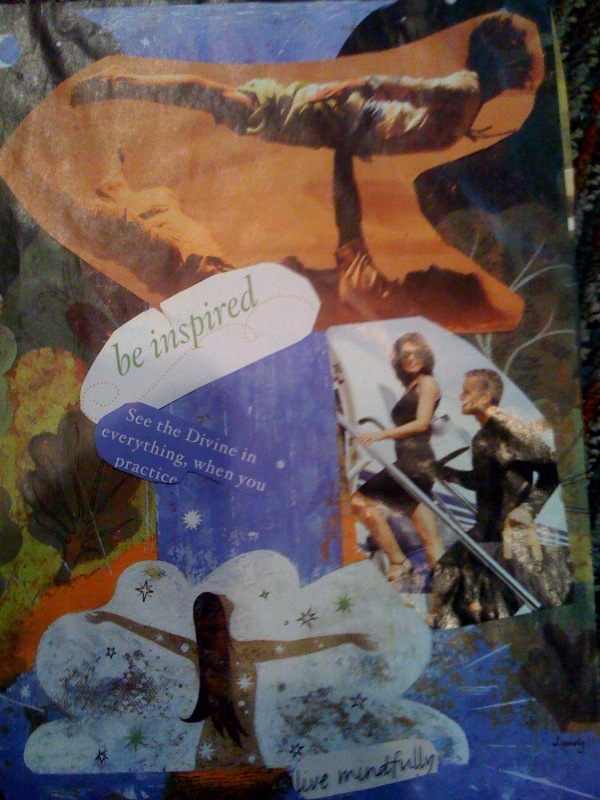
I find that you can pull together a cohesive picture of your passions, hopes, dreams, and your focus if you simply allow yourself to respond to the material.

I use magazines and a simple collage technique.

Choosing which pictures that attract you and then arranging them in a way on the paper, that is pleasing to you, can allow you to create a snapshot of what is going on in your unconscious and to what you are attending.  If you put intent into the picture then you can also create a tool that allows you to be reminded of your goals and current focus.

It’s like a pictorial affirmation or mantra that you can look at and incorporate into your daily actions.

Place the collage in a space where you can view it easily and be reminded by its images.

In this one I have used a background onto which I have placed various images – this is an example of an intentional blueprint.

When you are simply working with your unconscious you may find you are attracted to many disparate images and then you can use the piece of paper as the structure onto which you place the images together in a pleasing manner.

In this second kind of collage you  will find that it is slightly less consolidated but still feels complete.  You may not know why an image is attractive but if it is, cut it out.

Once you have all the pieces then place them on the page so they fit in some way.  You may cover aspects of the images and find that only a slight amount of an image is in the finished product.

Try to let yourself be guided by an intuitive and meditative process while incorporating all the images that seem to go together.  Once you feel finished, glue the pieces together onto the page.  Sit back and view what you have done and see if you cannot identify different issues that you are dealing with on an internal level.

It’s a lot of fun and if you allow yourself to be relaxed you can access parts of your unconscious that are sometimes hidden.

Then place the collage in a place where you will view it often and automatically, like a refrigerator door, a bathroom mirror, above your kitchen sink, your work desk, or a closet dresser.  Each time you look at it stop and breath in the different images and be with the collage for a few seconds.  This allows your right brain to continue to work with the images to guide your actions.

I have used this also in my own personal development.  Many years ago before I even considered going back to school for my Oriental Medicine degree, I found that I kept being attracted to statues of the buddha and lotus flowers and various chinese and eastern tradition symbols – I kept putting these into my collage not with any intent, simply because I was attracted to them.  Within a year of this, I awoke one morning with a strong pull to go to get an Acupuncture and Oriental Medicine degree.

I had been developing my concept of the connection of spirit, mind, and body and felt that I needed another education degree to develop my understanding and my skills in integrating this.  Could that have been my unconscious speaking to me about this through the collages – I think yes.

I hope you get the opportunity to create some space in your day to play with this and see what information your unconscious has for you that will guide you to your new world.

See you tomorrow.

Beth


1 Comment

Myth and Wisdom

Hello

Myths are stories that hold a sense of truth and history in them and provide an explanation of a world-view of a group of people.  These may include parables or moral stories about how to act in the world.

Wisdom is that information, accumulated knowledge, or enlightenment that gives us insight, strength and assistance in moving through difficult decisions and adversity.

Myths can hold wisdom.

Seeing through false myths – whose information is not true, or wise, is part and parcel to the work in parenting and our own psychosocial development.

Challenging the myths that are second nature to you, that you have swallowed whole from your own childhood or upbringing is the hardest part of adulthood.

These are often wrapped in little phrases that you say absent-mindedly.

Here is an example:  No good deed goes unpunished.

The myth is that if you do something kind then you will pay a price for your kindness. How do you think this came to be and what is it trying to teach?  Does this result in a person feeling more connected to a group or separate from one and which is more useful?

Myths and wisdom provide us with tools to help us navigate life effectively and with a sense of strength.  But they also have a sociological connection.

You see this with how people view political parties.  Myth can be see as fact rather than a story, just like prejudice – pre-judging.

There is an element of prejudice in each action we take.  For those of us who strive to live our lives without prejudice this is a difficult thing to accept.

Many years ago, in an art support group, I heard a fellow colleague discuss this.  I was astonished by the concept – I am not prejudiced – look at the array of friends I have from different races, countries, religious backgrounds – I am not prejudiced I reacted vehemently – she calmly responded that we all are – we have to be to make decisions in the world.

The work is not to relieve your self of every prejudice – it is to understand and own those you have, so that you can mindfully make a choice about how you want to be in the here and now, in each present, unique situation.

It took me years to understand her point, years of maturing and practicing mindfulness; years of accepting real responsibility for my choices, actions and beliefs; years of focusing my energy on acting in a congruent way in the world.

She is an extraordinary woman – she knew this 25 years ago as a young person, many do not understand themselves even now and so act in abhorrent ways while calling themselves righteous.

Acting congruently means that if you want the world to be tolerant you cannot respond to intolerance with hate  – Being congruent is acting in ways that are consistent with what you espouse as your beliefs.

Understanding the wisdom that is held in the myths we hold true is a dynamic and ongoing process.

The more we can listen to the words we use, and act in a congruent way, the more we can act in a way that uses the wisdom of our myths.

See you tomorrow.

Beth


2 Comments

Being in one’s center

Hello

The Chinese philosophical text the Tao Te Ching, attributed to Lao-tzu, has extraordinary passages about mindfulness (and emptying the mind).

Te meaning  Virtue, and Tao meaning the Way. These texts were found with one of the earliest forms of the I Ching, The Book of Changes and are written in a similar style.

For me,  I find these texts helpful to elucidate the need to be in the middle – in one’s center –  seeing both figure and ground, diminishing the need to control or push the river, and increasing the philosophy that going with the flow while remaining connected to virtue and one’s center, is of the utmost importance in creating success in life – the Way – or what I call The Path to Grace.

To understand others is to be knowledgeable;

To understand yourself is to be wise.

To conquer others is to have strength;

To conquer yourself is to be strong.

To know when you have enough is to be rich.

To go forward with strength is to have ambition.

To not lose your place is to last long.

To die but not forgotten – that’s true long life.

Chapter 33 Lao-tzu, Te-Tao Ching from the Ma-wang-tui-Texts

I think of standing in the middle of the river, fly-fishing, the water as it rushes by me drowns out all other sound so that it is like a deep and true silence; the water ripple ahead looks like white birds flying off the water.  It is a moment of now.  Me in my center, the world around me without meaning.   I experience the deafening sound of the water as the beauty of the white water transforms me into a middle place where two pictures of the world can be seen simultaneously:  the water flowing by me and over the rocks  in white rapids and the vision of the white birds flying off the water toward the sky.  I feel my heart pounding in my chest, my breathing, and a true sense of peace.

This is the picture of a meditative state for me, where true clarity is at my mind’s fingertips and I am in complete connection with spirit, nature, and my authentic self.  In that moment I notice that I am in joy and that my natural state is joy.

Being in one’s center allows a peaceful joy to take center stage and all decisions and actions from that place are in one’s best interest.

May you find your picture of being in your center so that you may access it easily, and completely –  at will –  so that joy is ever-present in your daily going and coming.

See you tomorrow.

Beth


1 Comment

Developing your Moral Compass

Hello

Ever used a compass?  It’s really cool!

No matter where you are you can open a compass and see where north is.  It gives you a focus and a center so that you have information to help you decide where you are going and where you want to go.

Early in my practice I used to give out a compass to individuals who were graduating from therapy.  The best lesson to gain from therapy is to have a sense of who you are, what has happened to you, what that means, and where you want to go.  It gives you the tools to find your way in the world.  It develops your internal compass.

I think an important part of parenting is to develop within your child an internal moral compass.  A sensing system that assists an individual in determining where he is and where he wants to go, and how to get there.

An internal moral compass evolves out of one’s value system and character.  It’s markers are through one’s senses, intuition, and mindfulness.

It’s the aspect within yourself that guides you in making decisions about your actions.  It helps to define not to steal or cheat, but also it’s the aspect in you that says don’t say that mean thing just because you can – don’t be a bully, be strong through your internal sense of self rather than through pushing another around.

It’s the aspect that guides you to do your heart’s desire rather than the thing that might fit another’s picture of you but pulls you away from yourself.

We develop our intelligence and our picture of how to be in the world through observation and experience, mostly.  That means for the most part our children’s connection to values and character come from how we act, behave, and communicate in, and about, the world.

If we say have character but we don’t actually act with character our children will learn to speak one way and behave another.  We will not be passing on a sense of security and confidence but rather a dissonant insecurity.

What matters is what we do when we are in a conflict, challenged or faced with a dilemma.  If our actions are not congruent with what we have been trying to teach verbally our children will incorporate the action as a way of being in the world.  This means it is important to be present and act mindfully in your everyday life.

If you say don’t use curse words then of course don’t use them yourself.  If you say have patience then of course have patience with your child.  If you say have perseverance and don’t give up – then of course that is how you need to behave yourself.  If you say don’t react to your friend’s mean statements on the playground have compassion or remove yourself from the situation then that’s what we have to do with our bosses, and colleagues, and friends too.

Children and adolescents are watching all the time, even when it looks like they are engaged in their books, TV, and music… they’re watching, observing, taking notes, and incorporating our behavior into theirs.  If we drink alcohol excessively, use drugs, deny our issues, and check-out on life, lose our temper over minor things – even if we think we have good reason to do so – they will develop those behaviors.

It’s embedded in our DNA to learn in this way.

They also learn from our change in behavior and our owning up to how we make mistakes.  So, if we do all of the above and then realize that wasn’t okay, talk about it, and change – really change – that gets incorporated too.  Sometimes it takes time for the new data to get incorporated but if we remain consistent in the change then it will have a positive effect.

Developing a moral compass comes from using the everyday experiences in life to show the best way to be in the world.  Choosing compassion over reactive anger, patience over reactive frustration, passion over apathy, belief over denial and fear, tenacity and confidence over insecurity.  It’s mindfulness, and paradigm shifting, and being balanced in our responses by incorporating a fluency with figure and ground.

I came from a family where perfectionism was highly rated.  The problem with this is that it is also somewhat impossible to attain, the result for me was a number of positive character traits and one negative one.  Over time I had to learn that perfectionism while great as a goal, was not always feasible and when not met I had to develop a sense of realistic compassion toward myself.

It took me a long time to see that while not perfect I was strong, tenacious, ambitious, talented, and inventive, and that more than anything my anxiety about wanting to do it perfectly the first time was more debilitating than anything else.  I had to learn that in some situations I simply could not control the outcome because events would occur that would interfere with my success.

I have had to develop a mindful, loving, and neutral approach to obstacles and a compassionate connection to my self.

Recently, I found myself having to deal with these issues in a very stressful situation with my beloved daughter observing.  I was astounded at the immediacy in how she incorporated what she observed.

I was at the end of writing a seminar that I was going to have to facilitate in two days hence.  I had been working steadily for 5 hours and had written over 50 slides.  I had been saving in my program and was just about to do a save as when the computer did a glitch and all the work was lost.  I didn’t panic I went to find what had been saved but all I could find was the first 19 or so of the total 65.  It was my first time working in the program and hadn’t realized that it required a save as for a permanent save.  All my work for the last 5 hours was gone.  The slides were due the next morning.

I could feel the anger and frustration rising in my being but I realized this reaction would not really benefit me and I made a choice to just begin again.  I calmly went back to the beginning and began to re-write the slides.  I worked steadily using the save as, and five hours later had a great product.

A few weeks later my daughter was working on her computer making a card for her friend Jessie.  She put a great deal of effort into the card creating special drawings and additions through her computer drafting.  When she was ready to print she hit the wrong key and the picture was lost.

Now my daughter is somewhat sensitive and gets frustrated when things do not work out as she had planned.  But to my amazement, instead of throwing a tantrum, or getting upset I watched her as she calmly went into her room and picked up a piece of paper to re-start her card for her friend.  I asked her if she was disappointed about losing her work and she said.  Yes, but I remembered your slides and what you did so I’m just going to start over, because I don’t have much time and I really want to give this to Jessie.

We really are models for them about how to live in the world.  We can help them to thrive or we can help them to feel insecure.  We can offer them the skill of patience or reactive action.

Developing our own moral compass and helping them to develop theirs is an important task in parenting.  It isn’t perfect, because children come in with their own personal styles of being in the world, their own temperaments, but what we do, our actions and behavior, can either help to extinguish negative aspects or increase positive aspects of their temperament.

Developing your mindfulness and balance in the world will help you to develop your, and your child’s, moral compass.  So that you, each, can feel you always have a sense of which way is north and which way you want to go on your path.  Mindfulness and congruence are the keys.

See you tomorrow.

Beth