InstinctiveHealthParenting4U

Change your Attitude, Heal your Soul, Balance your Life. Uplevel YOUR consciousness. Find your way HOME through MAAPS.


1 Comment

Change as catalyst

Hello

Change creation is the main focus of my career.

Being in the business of change is challenging and rewarding.  The most important part is identifying what you want to change.  This sounds obvious but it isn’t really.

As a rule identifying that things aren’t working is much easier than identifying the cause.  It’s a little bit like an archeological dig through a person’s belief systems, internal paradigms, and accepted misperceptions.  Even language is laden with personal meaning.  Dissecting that meaning can provide invaluable insight into the etiology of a problem.

People tend to feel discomfort or a lack of happiness but for the most part this doesn’t move them to change.  Usually they ignore it or misapply the reason behind their discomfort.  After a while that uncomfortable feeling or lack of happiness causes the person to do something that really shakes up their system.  If it shakes it up enough then things can fall away and change is possible.

When a person gets to change in this way it is generally very painful.

I encourage a more peaceful, compassionate way to change.  This requires an active relationship with your sense of comfort, similar to responding to cues that you are hungry, tired, or in need of exercise.

There are cues that can direct your response efficiently.  When you are hungry your first cue may be a loss of energy or focus, or it may be irritability (hypoglycemia).  Then if you ignore this you may get a stomach ache, increased confusion or irritability.  You can follow this trajectory for other physical needs like sleep deprivation or exercise.  The earlier you pay attention to the clues the earlier you can right the course.

Things that need changing in your personality, work, or relationship follow the same course.  Developing mindfulness and compassion as a style of being in the world will provide opportunities for the cues to present you the necessary information and to

Sometimes what obstructs our change is exactly what needs our attention.  It’s often the thing you want to hold on to that is the thing you need to let go.  This is not an absolute rule, but rather a guideline.  When you want to hold onto a situation or relationship because you interpret it defines you in a positive way, but to keep it you have to deny your authentic self, then this becomes an obstruction rather than an asset.  This kind of equation results in negative habit reaction patterns, self sabotage or destructive behavior.

This is actually the kind of change needed that brings a person into a counselor or psychotherapy office, a personal growth seminar, or groups like EST, Landmark Forum or Avatar.  The person feels very uncomfortable, has a general sense of what she feels is wrong, feels powerless to change her situation and is at the end of her rope.  She is desperate to find the answer and seeks guidance.

The process through this is sometimes bumpy.  Often the best guidance is within yourself.  Paying attention to those cues, listening to your quiet inner voice, and allowing your instinctive knowing to lead the way will get you to the necessary information more quickly and with less drama.  It is the most efficient way to allow a peaceful and compassionate change to present itself to you.  With this you can shift you perception, paradigm or habit to fully meet you true need.

Facing your fears is the often the fastest way to bring about change.

The issue that what you are afraid to change may well be what needs to be changed is a bit counter-intuitive and it is hard to look at or face.  Our knee-jerk reaction is to run in the opposite direction of our fear, to avoid what we fear, but turning to face your fears is the most healing prescription and often results in lasting, healing change.

Talking to friends or a counselor can help you to clarify what you need.  Seminars and groups can open a pathway.

It’s important that in these conversations you take the lead in the course of the discussion.  Sometimes others mean well but they are projecting, seeing through their paradigm rather than yours; it is important to go through the discussion thoroughly and with a sense of reverence toward your inner feelings, fears and personal meanings to things.  Through this process you will be able to decipher the clues so that you may let go of that which doesn’t serve you and hold onto that which defines you in an authentic way.

You hear the words catalyst for change to describe an event that shifts you so that you can change.  The generally accepted definition of catalyst  is a substance that increases the rate of a chemical reaction without itself undergoing any permanent chemical change ; or a person or thing that precipitates an event.   Change  in your environment or thinking is a catalyst for redefining yourself in a more authentic and true way.  So that you can be your true self.

If you are struggling with something that just doesn’t feel right but you aren’t sure what the real problem is, see if there is something that you could change that brings you complete peace.  If it is related to a change in definition then you may be on the right track for responding to the cues that are available.  Face your fear and shift that definition.  See what develops as a result of that change, that shift in perception.

See you tomorrow.

Beth


Leave a comment

identity creation and trauma

Hello

I have been working on a seminar about healing trauma and so it got me thinking about creating an identity and how that relates to traumatic experiences.

Identity formation begins in early childhood.  It has to do with the psycho-social stages identified by Erik Erikson.  How one resolves the conflicts of each of these stages imparts a special and unique spin on how one see himself.  This is very important and much has been written about these stages.

The use of mindfulness as a parent is very useful in assisting your child work-through these stages to a confident and positive conclusion or resolution.  (Read more about this in  every twelve years, and book Turning No to ON: The Art of Parenting with Mindfulness.)

This is further developed in adolescence where it has a crystallization effect until middle adulthood.  The crystallization process is confronted by different components for different people based on how each resolved the early stages of social-psychological development.  Mistakes or missed interpretations can become hardened in adolescence such that an individual has an inaccurate picture of self onto which she places her identity.

When a person is traumatized while in the process of working-through these stages, the trauma affects how she perceives herself.  This may be something that she inputs into the core of her identity.   This can have a strengthening or debilitating effect on the child depending on what message is imprinted from the trauma. If the child feels she has successfully dealt with the event and perceives the event has made her stronger, then she will be able to incorporate that into her identity.  If however the opposite is true she will incorporate a sense of insecurity.

Sometimes these misinterpretations are the basic foundation onto which the adolescent places her desires, goals, and personal expectations.  If these misinterpretations do not get corrected they can negatively affect what path the individual chooses and how she goes about completing goals and aspirations.  A person with excellent artistic skills may not go into an artistic field because he believes he has no talent.  Or a person with a high IQ may not attempt to go into college because she feels stupid.  Sometimes the resolution to the trauma leaves the person feeling as if he has no power; in this instance he may have difficulty consolidating his inner sense of self to make any attempt to participate in social, academic, and athletic ventures, and as a result his environment mirrors his inner sense of discouragement.

Specific interpretations developed in early childhood are required to help children work through trauma in a successful and affirming way.  Children need to feel that somebody cares about them, that they are significant or important to someone, that they are connected to a family that provides stability and belonging.  They need to  have a belief  in their innate, inner goodness, and to experience feelings of mastery and personal power and control.  These are all part of the early stages of Erik Erikson’s model of social-psychological developmental stages.

To assist your child through a trauma you want to align with him and create a loving, safe, and stable environment.  Many times a traumatized child will regress or lose skills previously developed.  Responding to this with understanding and providing opportunities to redevelop those skills offers an opportunity to increase a sense of caring, significance, connection, stability, and creation of feelings of mastery and personal control.

If your child tends to be more of a doer – offering projects to physically work on puzzles and build things will assist in the healing process.  If your child is a talker – offering projects to write, report, act-out or play-out puzzles and process the situation will assist in the process of healing.

If your child tends to integrate information in both ways allowing a choice and options to work-through redevelopment of skills and integration of the trauma into his inner landscape is most healing.

Having this information can help you feel prepared.  Knowing you can provide an avenue for your child to increase his sense of self and authentic identify when affected by a trauma can increase your sense of security.

This information is also applicable as we age.

Take the time to evaluate if you have built your identity onto a false foundation, a misinterpretation due to an early trauma.  Sometimes the way you suspect this is true is through an inner sense of emptiness or loss.  If you find that you have a false foundation use some of these techniques to see if you can discover a new sense of self and  a new perspective of your talents and skills.   It may open an avenue of work or enjoyment that you had closed long ago.

See you tomorrow.

Beth


1 Comment

Mindful Speech

Hello

When we are speaking we are creating.

The words have energy.  This is written in a number of the spiritual and religious texts.  Many philosophers have written about the power and energy behind words and anyone who has been involved in a persuasive argument can agree.

I have a favorite book that talks about the power and life of words called Words as Eggs, by Russell Lockhart.  The idea behind this title is how we speak our images into words and they, then mold our perceptions.  Words are symbols, and they have both universal and personal meanings which is to say they are multi-level in their meaning causing both clarity and confusion in their use.

I find this is a useful concept when speaking to oneself or thinking about one’s circumstances as much as a useful concept in communication.  When speaking to oneself often the style is to get down on oneself, to say negative definitive things that create a negative internal sense of oneself.  An example of this is to say things never go my way or I am going to do a bad job at my presentation or I can’t do anything.  These statements send out a negative energy vibration.  They shift ones internal position from neutral to negative thereby giving power to the words to create the negative expectation.

A better more mindful way to deal with fears and anxieties is to say I am afraid that I will not perform well but I am going to do my best and believe in myself.  This allows for the fear to be acknowledged and the negative power of creating that which is feared to be neutralized.  This speech when combined with specific examples when you have been successful in the past allows for the negative energy to be dissipated.

A word may have the meaning attached to it from the accepted dictionary as well as charge from ones own experience with the word.  This can create a dissonance in communication if one assumes that all others fully understand the word choice.

This is important from the perspective of mindful speech.  Especially when in a position of leadership, parenting, and relationship.  I like to look for feedback from the person with whom I am communicating to determine if my communication has gone in the way I intended.  If it has they will be on the same page with me, if it has not their response will seem to be out of sync with my intended communication.  I can then retrace with them what word or thing I said (or did) that caused them to go in a different direction than my intended communication.

The best way to remain in mindful speech is to be both descriptive and empathic when speaking.  To pause and consider how you are presenting the information.  From a parenting perspective it is helpful to consider setting boundaries by saying what you want to see from a positive perspective for example:  To a young child in a store full of breakables you might say Be gentle rather than don’t touch.  The first identifies a way in which to be that sets a careful boundary but allows the child to develop her skills at touching and not breaking.  The second sets a boundary but gives the child nothing to do but stay still.  This may be what you want under certain circumstances but as a rule it doesn’t provide guidance to developing an internal boundary and skill at touching without breaking.

In relationship mindful speech allows for the continued development and negotiation of the relationship without  blaming or divisiveness.  Again providing information in a positive and inviting way is better than a negative and blocking style.  Unless the goal is to end the relationship, at which point clarity in the boundary and concern is best still with description and specificity.

An example of positive collaborative mindful speech is to say I am having difficulty with something about how we are interacting.  I would like for us to work on this together to resolve the problem rather than take opposite positions that push us further apart.  Following this it is best to describe with non-charged words what you experience as a problem in the relationship.  Using description and inviting collaboration to create a mutually positive resolution is best.

Mindful speech is an attitude and communication style that you can develop over time.  As you become more acquainted with how you bring yourself out of a mindful speaking place you will be able to easily move yourself back to neutral.  This will also assist you in moving those you care about to neutral as you are interacting.

Keeping your attention on mindful speech will help you to focus your energies to create exactly what you want with the least amount of strife and the most ease.

Once you are doing this in a natural fashion then you will be role-modeling this behavior for your child.  This will become an easy way to re-focus the situation when things go awry.

See you tomorrow.

Beth


2 Comments

Turning NO to ON; shifting paradigms in parenting

Hello

Turning NO to ON isn’t just a trick of shifting the placement of letters, it’s a paradigm shift.  Responding and focusing with mindfulness in parenting can shift a child from NO to Yes and from Off to ON so that using mindfulness in interacting with your child can move your child from NO to ON.

Mindfulness integrates these two processes such that a quantum shift can occur moving the child out of obstructive, negative, stopped interactions into opportunities of Yes, an openness to learn, and being turned ON to the experience and thread of life.  It creates a path to move-through in an easy positive way.

Turning NO to ON through the perspective and action of mindfulness, to shift the child’s perspective, attitude and energy.  You are shifting the paradigms that organize how to act in a given situation.  The concept is about weaving and connecting in a new and upleveled way to shift the perspective and energy.

This is a whole new concept of how to BE with your child while guiding his behavior to create patterns that move him forward and upward toward his goals in a secure and empowering way.  It’s an evolution in consciousness.

If you think about how and where you get stuck in your own fears, blocked patterns, and limitations you can see how to shift your perspective and attitude.  This shift opens up a hidden path or way through your circumstance to a successful resolution.

This is what Turning NO to ON is about, using mindfulness and paradigm shifting as a way to navigate the sometimes stormy waters of parenting.

My new book Turning NO to ON:  The Art of Parenting with Mindfulness is a rich resource for developing your own skills at employing mindfulness in your personal development.  Then  through role-modeling you will be applying your new skills to your circumstances and parenting and guiding your child down a new internalized path of health and empowerment toward success.

I hope you get a chance to buy it and use it – and that it becomes your go-to resource for guiding your personal and parenting growth and success.

Let me know what you think, once you get a chance to read it.

See you tomorrow.

Beth


1 Comment

Figure-ground perception: paradigm shifting

Hello

The thing that is so fascinating about figure ground perception is the fluidity in which our senses differentiate between figure and ground.  If you are watching TV and there are men working outside on the street – your hearing differentiates between the sound attributed to the work outside (background noise) and the TV audio of the storyline of the program you are watching.  Visually our eyes determine figure and background to make sense of portraits or any visual field.  For wine tasting, individuals distinguish between the background of the wine – dry or sweet, while identifying specific flavors attached to various herbs and fruits – clove, blueberries, or citrus.  This is built into our very complicated sensory system to assist us in negotiating life.

From a psychological perceptual perspective, figure-ground perception applies to paradigm shifting; the figure or foreground of something to which we pay attention or are bothered by and the ground or background of our own values paradigm or belief system.  Fluid shifting between figure and ground is required for negotiation, relationship and communication processing, and working-through in the therapeutic environment.

This concept was first applied with these terms to psychotherapy and health promotion by Fritz Perls in his book Gestalt therapy verbatim.  It has since been applied to business communication development in negotiation and communication in leadership training programs.  The common visual example of this is the vase (figure) and the two profiles surrounding the vase (background).  Escher drew many optical illusion pictures that show the transition from figure to ground.

When we understand that our style of being in the world is the background that moves us to act and believe in specific ways, we can then be open to shifting our perceptions such that we may have a flexible style of perceiving.  This keeps us open to new information as it presents itself.

The figure of our attention – the thing that pushes us forward or stops us in our tracks – is what causes us to shift our perception from ground to figure and allows for paradigm shifting.  The reason to develop the skill of paradigm shifting is to increase your capacity to respond in a full and present moment way to the events in your life to create your most successful path.

Attention, intention, perspective, and attitude all affect how we interpret the information stimuli that cross our path.

This idea of figure and ground and paradigm shifting offers a way in to the rich experience of perception available to human beings.  Perspective in relationship, interaction, development, and philosophy allows for the same degree of richness found with lens modification in photography.  There is so much more to really see, know, and understand.

Opening the lens opens your perspective in the richness of relationship, development, and understanding.  This style of being in the world allows for interaction across fields, innovation, collaboration, and true understanding.

To begin the process of paradigm identification and paradigm shifting you can begin by identifying figure and ground in your sensory environment.  Then you can apply the process to your interactions and your value and belief perceptions.

By doing this you can see there are many more places where you may agree with another than originally thought and you can have an increased understanding of another’s perspective.

See you tomorow.

Beth


1 Comment

Daytime sleep-walking

Hello

Sleep-walking is an activity where an individual, usually in the middle of the night, gets up, walks around, talks, even interacts while seemingly awake but actually is asleep.  It is a strange experience for both the sleep-walker and the observer.

Incidents of sleep-walking may be described by the observer but  tend to not be available in the memory or wakeful experience of the sleep-walker.  It’s a bit scary, but for the most part harmless. It is understood that the sleep-walking individual is in a “hypnotic-like state”.  If fully awakened he will be surprised by his circumstance and deny the activities ascribed to him, as he has no memory of them.

I think the style in which people move through their lives, automatic and without conscious attention is quite similar.  People are pulled along by an habitual system and a lack of questioning acceptance.

It is as if they are sleep-walking through their lives.  In this way they are not wholly conscious of their behaviors, the effect of their behaviors and actions, or the foundation of their habitual reactions.  When they are questioned they respond similarly to the sleep-walking person in the middle of the night, denying they did the event ascribed to them.

In order to awake from this daytime sleep-walking state, a person needs to increase his awareness and attention to all situations in a mindful present moment fashion.

You cannot change your behavior until you are conscious of it.  First there needs to be an understanding that you are indeed sleep-walking.  This requires a detached perspective and a willingness to observe the whole of the situation.

Consider how you may not be fully conscious of your actions, and what you may need to do to wake up and fully respond in the moment to your life and situation.

The best way to see  if you may be in this kind of state is to notice the responses and behavior of those around you with whom you feel close, whom you trust.  If there is a bit of information or a snag between what you think and what you hear them saying, try to see if you can get into the present moment to get a full picture of what they are trying to communicate.  This can be painful.  This can be enlightening.

The idea is to awake to the full experience of living responsibly and ethically.

One of the things that impedes this is a group-mind.  This is the experience that you need to agree with the group perspective and not question whether it is a full and true representation of what is happening.  Often the group-mind has a set of true or real experiences that are interpreted in a way such that it supports a paradigm of thought but not necessarily a true representation of the situation or problem.

Group-mind requires agreement.  But mindfulness allows for understanding of the group-mind perspective while perceiving all the elements in the situation, so that a true understanding can result.

Group-mind requires daytime sleep-walking.

Mindfulness, perceiving fully in the present moment and then acting from that perspective is a way of staying awake and living in a responsive, mindful, ethical, fully connecting, and joyous way.

It reminds me of the line in the movie  Moonstrucksnap out of it! 

Life is full of so much stimuli and so many different paradigms that are inconsistent with each other, it seems like an onerous task to remain mindful – but in reality it is less difficult to simply be open to all the possibilities and calmly, with neutrality, lovingkindness, and compassion be open to perceiving the paradigms and shifting your perspective.

This mindfulness in the present moment is rejuvenating, freeing, and  empowering.  Holding on to past habitual reaction patterns is limiting, stagnating, and constricting, and a bit like sleep-walking through life – which feels better to you?

See you tomorrow.

Beth


Leave a comment

Pushing the river

Hello

In Buddhist thought there is something called pushing the river.

It relates to going with the flow.  When  a flowing river moves rapidly and with force, going against the flow, is not suggested; you use up all your energy fighting the force of the current and don’t get very far.  That is pushing the river, it brings discontent and is an unproductive use of energy.

Going with the flow allows for ease in movement, the river current glides you down without much effort on your part except to perhaps guide your way and avoid obstacles.

Flow and movement through life follows the same course.

An example of pushing the river in the flow of life occurs when the difficulty in flow is through delays or difficulties, and you get angry, anxious, and try to push through the problem.  Often the outcome is a complete block and non-movement with feelings of anxiety and frustration (inner feeling of being blocked).

Not pushing the river means accepting the delay and allowing the flow of the situation to Flow.  So if you are speeding in traffic and you keep getting red lights rather than speeding up to try to get to the green light, you slow to the pace of the cars, the flow, and through this you will begin to get the green lights.  It’s getting into sync.

Sometimes the delay is because of an attachment or an unmet expectation in that case communicating about what you want may result in you getting in sync, and that is like allowing the current to take you down the river while you guide your course and avoid obstacles.

Other times, no matter what you do the Flow is delay and interruption, in that case it is a mindset of pushing, that may need to shift to get into the flow.  This happens when you keep getting red lights and to get into the flow you relax and look for hawks in the sky or listen to music you like and trust that the situation is going to turn out ok.

To assess whether you are pushing the river, notice your attitude, feelings inside, and the energy around you.  Pushing the river is stifling, and generally carries a pushing and irritable or frustrated feeling.

Allowing, going with the flow, and getting in sync have in common the feeling of ease, comfort, and relaxation.

Being mindful, focusing on perception, and shifting paradigms as well as applying a compassionate lens are useful ways of being in the world to remain in the flow.

See you tomorrow.

Beth


2 Comments

Using humor to shift paradigms

Hello

Humor is the most useful tool in your bag of tricks when it comes to paradigm shifting.  It allows for the shift to be non-threatening.  It has the same energy as an epiphany but less drama.

Humor creates a conduit for the perception to be seen and released simultaneously.  This is especially true if you are attempting to assist someone, or yourself, in seeing an over-reaction.  Humor can help you see silliness in your thinking or behaving, without negative judgment.

I use humor all the time to shift energy.  It is the perfect response when I want to  lighten a situation that is getting too serious.  The seriousness can create a block to the needed shift.  It’s really helpful with children when you want to side-step a negative interaction that is steamrolling down a course to opposition and  a flat-out stalemate.  Using humor can result in an instantaneous shift in energy, especially if you choose just the right maneuver.

Laughing at ourselves when we need to lighten up is an important part of de-stressing, and it helps us get into a mindful state; it’s like a mini-paradigm shift into the humorous nature of events, that opens the doorway into real insight and epiphany.

The mindfulness component to humor is especially evident when used to deal with resistance.  Resistance can look like a NO or just a distraction; it can be really strong and obvious or just dawdling and delaying.  All of these actions can be a form of resistance and can interfere with the smooth flow of events.  Often resistance is actually a cover for something else that is underlying the situation.  This could be a way of dealing with unwanted pressure, or expectation, or structure that feels stifling, like our time schedules or an event we are required to attend.  By bringing humor into the equation you can uncover the cause of the resistance without getting into a power struggle with your child or the other person.  If it is your own resistance with which you are dealing than humor makes it more tolerable to look at yourself and your actions.

Humor lightens.  It makes the change feel less heavy or more obvious and it allows the shift to be embraced without negativity.  Lightening both the weighty-ness of making choices, decisions, and change as well as lightening with respect to increasing the degree of mirth, spirit, and luminosity involved in living and evaluating.

When my daughter was just working on moving from pre-team to team in gymnastics her energy changed.  Rather than being relaxed, attentive, self-confident, and strong, her intensity shifted; she started to be a little uptight and anxious about who was going to move up and where she was in the line-up of her peers in skill and talent.  She began to get discouraged and this affected her capacity to do the work.  She tried harder but it had the effect of making her too conscious so that she was pushing rather than allowing her skill to shine through. It resulted in her getting stuck.

I tried having a serious, mindful discussion about how her attitude was getting in the way, but she became adamant that she just couldn’t do it; “I can’t” she said.  I calmly and lovingly talked with her about how she needed to say “I can” because her words had power.  She said they only had power in one way if she said I can’t then she couldn’t but when she said I can it didn’t change the outcome.  She was trying to tell me how discouraged she was, but I wasn’t listening with my third ear (my inner mindfulness and attention), I just  kept on with my efforts to shift her perspective, describing how the “I can” made it a neutral space so her mind/body could work together to go through the motion of the skill with ease that she had been practicing.  I was talking to her rather than listening to her and responding, even though I thought I was being reasonable my efforts helped to create a block and she dug in her heels because she felt unheard and invalidated.  The more I tried to be calm, and mindful, and clarifying the more adamant, angry, and resistant she became, until we were at a block, a NO, a lost opportunity for learning.

Then I decided to explain how it worked by acting as her confused muscle that she was sending two messages to, one message of I want to do it, and the other message of I can’t. The result was a jerkiness that depicted her muscle trying to respond to both an action of follow through on the skill and an action of miss the skill.  When there are two opposing messages the wires get crossed and there isn’t any clarity about what action to take.  The inner confusion would assuredly result in a mis-step and diluted action/skill.   As I was describing this, in simpler terms, I acted it out,  with silly facial gestures and a crazy looking jerkiness of my arm.  It was so silly she spontaneously laughed out loud; I looked so silly that her first most natural reaction was to laugh and that broke up the energy so that she could both feel heard and listen to my explanation.

Through the use of humor, the words got in, then she had an opportunity to integrate the concepts.   The humorous picture also became a visual mantra/or visual imprint she could use to re-focus herself in the future, so that she could find her own neutral place and shift the energy when she felt discouraged.

It lightened everything.  It allowed for a paradigm shift, and it was a strong image that was beneficial in the future.  The next practice she moved with ease and self-confidence, she got her skill; and in her being was the memory of how funny her mom looked and the information behind the humorous action connected to it that you have to give one clear message and allow you natural ease to flow through.

So mindfulness needs a little mirth sometimes to get the job done.

Humor is a little tricky, it can really backfire when used incorrectly or at the wrong time.  This is especially true with certain ages that have a hypersensitivity to being laughed at.  In these circumstances it’s most useful to allow yourself to be the canvas or conduit for looking silly, allowing your child to laugh at you and through that, to see their own silliness, on their own and in their own time.  If you make the connection too quickly and they are not ready then you may find that you worsen the situation.

It takes a feel to know when to use humor and how, that ability to listen with your third (inner paying mindful attention) ear, in conjunction with knowing your child and what actions are covered messages.  When used efficiently humor is the most effective tool in your toolbox for shifting paradigms and getting to aha experiences.

Next time you feel your blood pressure beginning to rise, or you feel stuck in your interactions, apply a funny, humorous face to the situation.  See if you can create your own paradigm shift with humor.  The lightening up of the situation goes far to instill the needed information, and it does so with fun, ease, and efficiency.

See you tomorrow.

Beth


1 Comment

Thriver vs Survivor attitude

Hello

Habit reaction patterns define how we relate in the world.  They do so without our attention to them.  They pull us into ways of behaving like a rut pulls us around a circle.  The groove, furrow, or automatic routine of it takes us out into the behavior Habit like any reaction in an automatic, non-present-moment-thinking-way (unconscious).

This is not intuition.  This is the opposite of mindfulness behavior, which requires a present moment centeredness where information is experienced and processed in a thorough centered and multi-dimensional fashion.

Survivor scenarios are habit reaction patterns.  They are ways of being in the world where a trigger acts like the groove that pulls a person into a set of interpretations and actions (reactions) to survive.

This mechanism built into our style of being in the world is highly efficient in a dangerous environment; having the ability to automatically react in a split second fashion could save your life.  However, when these are applied to everyday choices in relationships and interactions that are perceived by way of the trigger as dangerous but are indeed not life-threatening, they form a set of behaviors that actually serve to negatively affect the individual engaging in them.

Survivor scenarios actually take on a number of forms depending on the function that set up the original scenario, the how mechanism to survive or what style developed to survive.  Protector, survivor, victim, persecutor are all forms of survivor scenarios.  They share the need for the other to define the self.  In order for an individual to define herself as a survivor she must continually create (by way of interpretation and attribution of specific intent) situations she must survive.  Thereby actually keeping herself caught in the web of the scenario.  This is true for each form of the scenarios.

In order to get out of the rut, groove, automatic routine, or habit reaction one has to invoke two things, a sense of present moment empowerment and mindfulness.  This is an attitude of a Thriver.

Thriving is doing more than surviving.  Surviving is good, as the alternative is not surviving, which is bad.  Thriving is even better – it is developing and focusing your life, actions, interactions, creations, and living toward your best potential and capabilities.

Where surviving is a function of creating the best situation possible out of a negative set of circumstances, thriving is a function of creating what you want.  Creating what you want out of all the possibilities in the universe, not just your current circumstances.

Being a survivor may be the best thing you ever did, and so it may be difficult for you to let it go.  You may feel like it is the thing that sets you apart from your peers.  The problem is it sets up an attachment to that style of being in the world, such that situations to which you are drawn will be primarily difficult and challenging, allowing you to continually, automatically, invoke the survivor mechanism to make lemonade out of lemons.

Being a thriver increases your actual responsibility to create what you want.  In order to do so you have to be willing to risk defining what you want and then creating the avenue to make that happen.  It sets you into an active rather than reactive mode.  Saying I want to make this happen in my life, rather than I can make this situation work to the best form.

Certainly having the skill to make a bad situation work until you can create a better one is laudable and to be maintained as a positive skill; however, it is not proactive unless connected with an attitude of focusing your efforts on creating a life that is thriving and reaching your best potential.

Here’s how to decipher if you are in a habit reaction pattern or survivor scenario.

Check in with your senses and intuition.  If you feel that the experience is familiar or a pattern then you may be participating in  a habit reaction scenario.  If you feel that you have trouble trusting that things can/will go well for you, then you may have a history of having to survive that is coloring your current day choices/actions.

If you have an immediate feeling of anger, like someone has crossed a boundary and your feeling is charged in that the level of emotion (intensity) doesn’t match the situation or boundary crossing, this is a sign that you have been triggered.

In this instance, proceed in your actions (re-action) with caution and by caution I am suggesting to invoke mindfulness and centered, present moment attention to the situation, to literally work against the pull of the groove into the habit reaction pattern.

This is how you can engage the thriver attitude.

Focus is the key.  If you are in danger, utilizing your survivor skills to get out of the situation is paramount.  If you are not in danger but rather caught in a survivor scenario then focusing your attention on what you want rather than what you fear is the best response.

Using mindfulness to re-view the circumstances in relation to your emotion will help you identify whether this is danger or not.  In example, if a stranger is doing something that feels dangerous allow your survivor reactions to move at lightning pace.  If however, the situation is with a loving partner, or friend – you need to view your emotion within the context of the relationship in present-time and with clarity and genuineness.

Here’s how you can develop a thriver attitude.

It requires a focus on what you want.

It requires a re-view of yourself through a centered, mindful attention to yourself, your skills and limitations, what brings you joy and centers you in your best self.

This focus allows the possibility of creating what you want from all the possible choices available to you.  This is a difficult concept to grock for a person who has defined herself as a survivor.

This paradigm shift allows for a relaxation of the struggle to survive or fight and a gentle movement into the mindful, balanced living of life.

May you Thrive!

See you tomorrow.

Beth


Leave a comment

Balance of spirit, mind, and body – the Tree of Life

Hello

Instinctive knowing incorporates spirit, mind, and body awareness and experiences, with attention centered along the space-time continuum, in the present moment; Intuition and sensing, together in balance, centered in time.

In studying the  Kabbala I have found something congruent with this idea and clarifying the issue of knowledge and instinctive knowing as integrated and guided by spirit at it’s core.

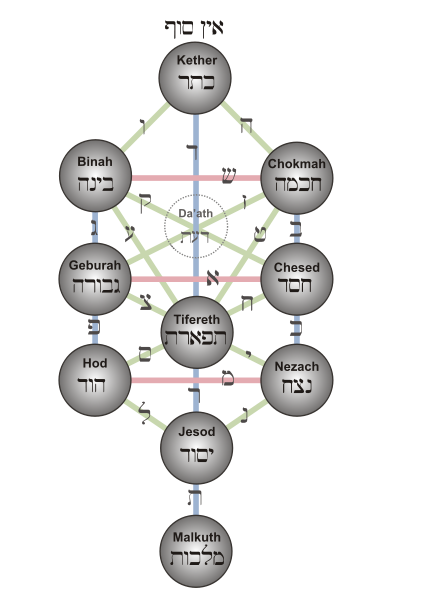
The Kabbala (Kabbalah, Qabbalah, Qabala) is a set of esoteric teachings.  It is a set of writings and texts that exist outside the traditional Jewish scriptures, but it is attributed to be a part of the Jewish religious tradition.  The Kabbala is represented by a set of branches sephirot, drawn as circles connected by lines in a specific order. This symbol is referred to as The Tree of Life.  

The texts seek to define the nature of the universe and the human being, the nature and purpose of existence, and various other ontological questions. It also presents methods to aid understanding of these concepts and to thereby attain spiritual realization.

Altogether 11 sephirot are named. However Keter and Da’at are unconscious and conscious dimensions of one principle, conserving 10 forces. Presented here are the names of the Sephirot in descending order:

(Think of these as going from most insubstantial in energy to most substantial.)

  • Keter (crown, representing above-conscious will)
  • Chochmah (The highest potential of thought – intuition)
  • Binah (the understanding of the potential – knowledge)
  • Da’at (intellect  or cystalization of knowledge – instinctive knowing)
  • Chesed (sometimes referred to as Gedolah-greatness) (loving-kindness)
  • Gevruah (sometimes referred to as Din-justice or Pachad-fear) (severity/strength)
  • Rachamim or Tiphareth (Mercy – Love, acceptance)
  • Netzach (victory/eternity)
  • Hod (glory/splendour)
  • Yesod (foundation)
  • Malkuth (kingdom)

These ten (11) sephirot can be viewed as a process of ethics.  Studying the sephirot will allow the individual to increase BOTH his spiritual consciousness and his spiritually ethical action in the physical plane.

It is viewed that Divine creation by means of the Ten Sefirot is an ethical process. The sephirot represent the different aspects of Morality and they hold within them the opportunity for both the virtue as well as the vice attributed to each branch.

Balance is the key.  Utilizing intuition and sensation knowledge, and centered in time, one can develop a balanced experience and knowledge of these branches.

In example, Loving-Kindness is a possible moral justification found in Chesed, and Gevurah is the Moral Justification of Justice and both are mediated by Mercy which is Rachamim. However, these pillars of morality become immoral once they become extremes. Lovingkindness is the Virtue.  When Loving-Kindness become extreme it can lead to sexual depravity and lack of Justice to the wicked, the vice.  When Justice becomes extreme, it can lead to torture and the murder of innocents and unfair punishment.

In the Kabbalistic view, “Righteous” humans (Tzadikim) ascend these ethical qualities of the Ten Sefirot by doing righteous actions. If there were no “Righteous” humans, the blessings of God would become completely hidden, and creation would cease to exist. While real human actions are the Foundation (Yesod) of this universe – kingdom (Malhut), these actions must accompany the conscious intention of compassion.

Compassionate actions are often impossible without Faith (Emunah), meaning to trust  that Source always supports compassionate actions. Ultimately, it is necessary to show compassion toward oneself too in order to share compassion toward others. When one empowers oneself through this development to assist others, one is following an important aspect of Restriction, and this is considered a kind of Golden Mean in Kabbala, corresponding to the Sefirah of Adornment (Tiferet) and being part of the Middle Column.

In the Kabbala there are different branches for understanding, knowledge, awareness, and knowing.  These culminate in the explanation of the sefirah of Da’at. Da’at can be viewed as the crystallization of awareness.

In the Kabbalistic Tree of Life, when counting the 10 sefirot, Da’at is the tangible form of Keter,and so can be counted with Keter.

Keter is the crown, knowledge as an emanation from Source, and Da’at is the experience of man – specifically experienced knowledge – knowledge from the point of view of the human being and his or her accumulated experiences.

Chochmah is intuition and Binah is understanding or the ability to grasp concepts, and Da’at is knowledge, the accumulation of experience.  In other words there are three ways in which a person knows the function of the mind or of consciousness:  1/through the intuitive grasp of Chochmah, through, 2/ through the analytical powers of Binah, and 3/through the accumulation of ones experiences, known as ones Da’at.

Da’at is sometimes drawn with a dotted-line underneath the crown Keter, somewhat in between Chochmah and Binah.  Keter, as the emanation of knowing, is the most insubstantial.  For our purposes, Chochmah – intuition, Binah – 5 senses, body and mind, and Da’at – the accumulation of experiences – time, offer together an experience of instinctive knowing, balancing spirit, mind, and body.

How these are translated into our ethical actions in the physical plane is how we enact our spiritual consciousness balancing spirit, mind, and body knowing and awareness.  It can be a product of studying and understanding the various consciousness of the sephirot of the Kabbalistic Tree of Life.  However this is not the only Way.

Living mindfully is a great resevoir for development of your higher consciousness, your true self and The Way.

May you find your Way and be in Joy.

See you tomorrow.

Beth