InstinctiveHealthParenting4U

Change your Attitude, Heal your Soul, Balance your Life. Uplevel YOUR consciousness. Find your way HOME through MAAPS.


1 Comment

Character building in everyday interactions

Hello

I wanted to write about character building from the perspective of victim versus thriving.

I have been thinking about this for many years now, ever since people started to talk about being a survivor.  At first, I loved the term a survivor because it was not feeling like a victim.  But then after a while I started to notice that people who defined themselves as survivors kept having to survive.  What I mean is they seemed to keep finding themselves in situations that required they stand up for themselves and survive.  It was as if they could only feel strong in this specific equation of surviving.

Then I started to look at various terms that were used in this way and I noticed there were six Victim Scenarios:  Protector, Survivor, Martyr, Victim, Perpetrator, and my personal favorite Savior.  Some of these have more negative connotations, but the thing they have in common is to exist they require a victim for definition.  These scenarios of being in the world require victimization  in order to be defined.

Can you see how that works?  Let’s look at the more positive scenarios:  protector, survivor, savior – in order to be these there has to be a victim in the picture either to save or protect or the situation has to be negative and you have to survive it.  So although these are focusing the energy in the correct direction away from the negative and with an increased sense of self-esteem – the scenario is still one of victimhood.

I think the thing that we need to be developing is a thriving mentality.

If we could avoid the feeling of victimization through this increased understanding that I’ve been writing about we could sidestep these victim scenarios and move straight to thriving.

Victim versus thriving:  feeling like a victim decreases strength and self-esteem and yes feeling like a survivor can increase strength and self-esteem but only for that situation.  What seems to happen is that it has to be re-done over and over to continue to feel strong.  The strength and self-esteem are tied to the action of surviving rather than as part of the person.

However as a thriver the sense that whatever comes your way you will learn, grow, and build on it, is a sense of thriving in life  – it is connected directly to the person as a generalized, increased self-esteem.

Moving from a victim scenario to a thriver is a paradigm shift.  You can learn to not react to things that don’t matter, and know what to get angry about and what isn’t an injury.  And you can teach this to your children.  Spend a few minutes if you can, thinking about how you define yourself, what victim scenario you may be using, and what you may want to do to change that perspective of yourself into a thriver.

I’ve been writing about how to do this and I have more to say on this in future blogs.  Stay tuned.

See you tomorrow,

Beth


4 Comments

Increasing Understanding through Communication

Hello

The biggest single issue that I see in my practice is ineffective communication.  Families, couples, small groups, teams, and individuals all struggle with conflicts resulting from ineffective communication.

In my undergraduate program I focused my work on sociology and the interface of sociology, literature, history, and developmental psychology.  I read dozens of books on existentialism and paradigm shifting.  These books had a profound effect on formalizing my attitude toward communication and interaction between people.

One book in particular was transforming in how it addressed the process of attitude and belief change:  Thomas Kuhn’s The Structure of Scientific Revolutions.  In my Master’s in Counseling Program I was trained as a Gestalt therapist and wrote an independent study thesis on Phenomenology.  In my Master’s in Business Administration Program and later in my Master’s in Oriental Medicine program I continued to focus on how to view various paradigms from within their own structure as well as in relation to other structures.

My focus in training has honed my ability to view situations from both a figure and a ground perspective.  Allowing me to view the conflicts and miscommunications in relationships and interactions as just that misunderstandings and disconnects.  Often when I have a couple,  or parent and child, in front of me in my office I find that each is telling the truth about the problems in the situation even though neither is able to see the other’s point of view.  The issue is from what paradigm or perspective they are arguing.  If they are each focusing on different things they feel very assured they are right while unable to understand the other person’s point or communication.

That’s why my first goal in communication skills training is connecting not assessing right/wrong.  Since both are right from their own perspective and wrong from the other perspective the latter focus doesn’t allow for resolution.  Only through a focus on increasing connection or understanding will the two individuals or group find resolution and solutions to their conflicts.

A foundational component to paradigm shifting and Gestalt therapy is the concept of figure/groundFigure focuses on the specific issue, situation, and ground focuses on the background information.  In example, figure is the words and ground is the tone, tenor, and unspoken information.

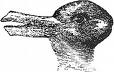
(I’m going to upload a couple of pictures and talk about how to see the figure and ground in the picture as well as what it may mean about you.  If you are looking at this on your phone you may not be able to see the images.  These are worth viewing.)

Figure ground illusion images:

Figure A.  The ground in Black – two faces

and the figure in white – a wine glass.

In Figure B Is a right/left paradigm shift; right facing  – bunny, left pointing – duck.      

There is a tendency to see either one or the other consistently when you first see the picture then after you learn about the other image in most situations you can go back and forth between the figure and ground.

I recently found a very cool way of looking at the concept of paradigm shifting by looking at a set of words and grouping them.

Let’s do that with this group of words:

axe,        log,        shovel,        saw

Group them into the three words that go together and the one that doesn’t.

If you chose log that doesn’t belong then you are looking at grouping them into tools and non-tool.

If you chose shovel as the one that doesn’t belong then you are looking at the log, saw and axe as connected by their function to each other – the log can be cut by the axe and saw but what can you do to it with the shovel?

It turns out that industrialized country citizens tend to see the first paradigm and individuals from countries like China and Russia tend to group them in the latter fashion.  If you saw that there were two answers right away before I gave you the information you have an affinity for seeing both points of view and are probably great at mediating and conflict resolution.  Seeing the relationships among these words is a paradigm affected by your environment, upbringing,  and your basic nature.

Paradigm shifting, and Gestalt figure/ground as applied to communication, team building and parenting is a way of increasing understanding between and among individuals to increase creativity, connection, and conflict resolution.  Think about how often in a close relationship you or the other person feels misheard or misunderstood because of the part of the communication you or they are focused – figure or ground.

That’s why it’s always so important to question what was heard when you feel you are in a conflict that you didn’t intend.

Hope you had fun with this.

See you tomorrow.

Beth


Leave a comment

Resilience

Hello

What is resilience?

It has to do with elasticity, rebounding or springing back.

Resilience is important to character and self-esteem.  It is the basic element in surviving the ups and downs of life.

The thing is that we can’t actually make sure nothing bad happens.  All we can do is teach our children, and ourselves, how to bounce back from the bad things that inevitably do happen.

From an emotional perspective resilience is the behavior that pushes us forward through our fear, anger, pain, frustration, or sadness/depression 

When thinking about the important things we want to encourage in our children, resilience is high on the list.  It’s the ability to take things in stride, to get back on the horse after you’ve been thrown, and to keep trying when you feel you’ve failed. 

An important component of resilience is to not be immobilized by a failure, loss, or mistake.  It’s being able to push on in the face of something fearful or difficult, as well as remembering when you were successful in a similar activity and generalizing  that success to the task at hand. 

An example of using past successes to create a new success is to link learning a new skill with the success of having already learned a skill.  Remind your child when he or she previously was able to go through a set of events that were difficult at first and then became easier.  This is especially helpful with new motor and developmental skills like reading, writing, starting a new school, or a new physical activity – “remember when you started gymnastics you were afraid of the balance beam but now after practice you’re very good at it – it will be the same with skiing, you may fall a lot but after practice you will fall less and feel more confident.”  You’re linking the success of the other activity to the new activity and providing the path to success – reminding them they already have the tools to do the task at hand because they have already successfully used those tools.

Having compassion toward yourself and your own mistakes, role modeling how to rebound is the most effective way to teach resilience.  Because children incorporate into their set of behaviors what we say and do, the more we can model resiliency the better their chances are of developing that characteristic in themselves. 

For the next few days observe what you are modeling to your children.  Is it perseverance and resilience or is it something different?  You can use the same technique to remind yourself that you have the tools to get through whatever activity or task that is difficult for you right now.  And if what you are facing is something that you have never faced before, try to break down the components of the task to see if you can make connections to other successes in your life.

See you tomorrow.

Beth


Leave a comment

Compassion toward yourself

Hello

Having compassion toward yourself is a good thing to keep in mind when trying to get congruent and/or deal with angry feelings.

This is especially applicable for individuals who are perfectionists or insecure and can get immobilized by their own mistakes.

Compassion is a sense of understanding.  Here I am using it as a mindful compassion; seeing the bigger picture of why, how and where things may have gone awry.

Applying compassion in a situation helps the anger or insecurity become less palpable and more easily assuaged.

The stop, look and listen blog  talked about a process to get into the moment and become mindful about what has happened (or is happening) and question whether the feeling of anger fits with the situation.  Using the same process of mindfulness toward yourself can increase your degree of personal compassion.  This doesn’t mean you aren’t going to be accountable for your actions; you are in fact more able to take responsibility for your actions, by having a better understanding of what occurred.

Consider the last time you had a negative interaction with your child or partner.  Just as you might ask what stress process your child might be dealing with consider your own stress level.  Perhaps you’re sleep deprived or overly worried about something or in pain from an injury – you have a lower threshold at which you will feel frustrated or lose your patience.

If you can feel yourself losing a sense of control, compassion toward yourself would allow you to not push yourself beyond your means.  Give yourself permission to be more flexible – perhaps this is not the time to strictly hold the line on a rule that you know you will not be able to enforce.  This is even better if you know in advance that you are going to be stressed; having compassion for yourself is when you say no I can’t do that rather than pushing yourself beyond your means.  And if things have gone awry having compassion toward yourself allows you to recover quickly with renewed strength and resilience.

Knowing when to hold the line and when to be flexible, understanding the positive power of habits and the need for mindfulness, and having compassion toward yourself, these are all forms of balance in action and thought.  Being balanced is a natural state.  The more we practice using the tools of mindfulness the more we can feel when we are out of balance and act to return to balance.

See you tomorrow.

Beth


Leave a comment

Building trust

Hi

Being mindful allows for congruence in our thinking and actions.

Congruence is something that most people don’t even think about.  However, most of us hold conflicting beliefs.  We just keep moving along in away that is not congruent because it’s a habit.  Mindfulness action causes us to look at these conflicting beliefs and actions and make decisions in the present moment in order to be more congruent.  Congruence is the quality of agreeing or being in harmony, corresponding in character and kind.  Using this concept as a guide to our behavior allows for unified action and thinking.  In other words, as an example of congruent thinking and action, if you say :  we should be fiscally responsible then if you are congruent in your actions and thinking (or saying) then you would not spend money beyond your current means, and you would probably save a large portion of your income.  But that is not what most people do they say one thing and they do another incongruent thing.  Sure we can say it’s because of the culture or other pressures but that doesn’t solve the incongurence issue.

What I’ve noticed is that as adults we repeat verbally what we heard and we repeat actions that we saw.  So when our caregivers’ were incongruent that got passed on.  Often we don’t even see how our actions and beliefs are not congruent.  In review of our actions we can see the inconsistencies.  This is one of the things I have been writing about when I encourage you to question what your emotions are.  I am attempting to get you to look at your own internal inconsistencies in thinking and action and give you an opportunity to evaluate what you think now and what action you want to take in harmony with that thinking in the present moment/situation.

The goal of such investigation is not to blame the original situation but rather to increase your own mindfulness action.

So why am I calling this article building trust?  Because in order to build trust we need to act in ways that are consistent with what we say.  And what we say needs to be congruent with what we think and do.  That’s the definition of being trustworthy.

This is a foundational concept in parenting; it’s paramount for relationship building and building character and self-esteem.

Simple idea that’s actually very challenging to incorporate into your being without a focus on mindfulness.  At first, try to do this with something simple.  Listen to what you say and look at what you do and evaluate whether it seems to be consistent.  If it isn’t then figure out what belief and action together are more descriptive of who you are.

Have fun with it!  Use humor/laughter and be kind to yourself as you go through this process.  This is serious but humor makes the learning process more joyful.  In my experience, being able to laugh at yourself is a sign of good self- esteem.

See you tomorrow.

Beth


1 Comment

Befriending anger to increase happiness

Hi

If you think of anger as the emotional/sensing alarm system it’s important to assess what boundary is being breached.

It goes off when someone crosses a boundary.  Think of boundaries as falling into three main groups:  physical, emotional and spiritual.  Physical boundaries seem to be the simplest to understand; someone touches you in a way that is inappropriate or hurtful and you get angry.  Emotional boundaries have triggering signals – someone says something that is offensive or hurtful and you get angry.  Spiritual is much less tangible than the other two, often it’s about something that you hold dear to you or a type of energy attack.  Sounds esoteric but it is one of the most common boundary breaches.  All of these breaches lead to anger.

The key to addressing anger in an effective way is to manage the control switch with mindfulness.

The stop, look, and listen process is useful to understand the underlying emotion of your anger – usually it’s hurt or a fear of injury.  Mindfulness is paramount in this process to turn off the anger and take the appropriate action.  Anger by its nature feels instinctive however, in my observations anger is actually a path to action that is often an habitual reaction pattern.  If we feel hurt we have less of the adrenaline and inner strength to take action.  However, by accessing anger we incorporate the fight or flight adrenaline system – now we have all the energy we need to take action.  Brilliant strategy.  Think how this works in divorce cases and in the survivor scenario – being angry rather than hurt creates fighting energy.  That’s great when you need it, very efficient.  The basic underlying emotion is hurt or victim and then the action is to survive.

The problem with this strategy is when it is an habitual reaction pattern of victim to survivor as a mode of action for all injuries.  It’s inappropriate if someone cuts you off in traffic for example; you don’t actually need to survive that but you do need to be able to avoid hitting them or another car.  You need the energy to take action but you don’t need the anger.

Befriending anger to increase happiness means to see the angry emotion as a teacher and an opportunity to strengthen your relationship or situation.

A boundary betrayal in close relationships is the biggest area where this is a malfunctioning use of the adrenaline fight or flight system.  Unless one is in a dangerous relationship in which case then you need to take permanent action to get out of that relationship.  In general it is more common that what is required is an increased understanding of the emotion underlying the anger and the boundary breach.  The stop, look, and listen mindful attention to the situation allows for an understanding of  the miscommunication rather than an exacerbation of the conflict.

You can use the stop, look, and listen exercise whenever you feel a boundary breach or anger.  Try to really question those habitual reaction patterns – does it make sense that someone you love is trying to hurt you?  Probably not so what is really going on?  And what part of it is something that isn’t a part of the current moment interaction.  Unlink the connection so that the past injury remains in the past and the current situation is free to develop along its true path.

More on this and how it helps to engender positive character and self-esteem in future blogs…. stay tuned.

See you tomorrow.

Beth


3 Comments

stop, look, listen

Hello

My favorite phrase to help me get into the moment is Stop, Look, and Listen.

It’s simple, directive, and unambiguous. Perfect.  When you want to get into the moment to increase mindfulness this phrase works like a charm.  Stop –  multitasking, Look – pay attention, Listen – to your inner voice and what’s happening.  Focusing in on the situation in this way allows for the process of interchange to slow down so that you can make a choice about the best action.  It increases your chance to get into a mindful frame of mind.

This is especially helpful with anger.  Anger has the ability to really take us out of our body, mind, spirit connection and move us into a fight or flight reactive position.  Anger is like our emotional/sensing alarm system.  A distinctive element to surviving dangerous situations is to have an early warning system that allows you more time to respond.  This is built in to our instinctive patterns of survival.

Like an alarm system in a home that gets triggered and sets off blaring, the human early warning system is loud and gets the individual’s attention.  That’s the purpose of intense fear/anger reaction, the adrenaline mediated fight, flight, or freeze system.  It works well.  It helps us avoid car accidents, catch our child as she falls out of a high chair, and determine our best defense when attacked.  The problem happens when it gets stuck on.  This can occur due to the type of danger or the time it first gets tripped in our lives, or some combination.

Fear is the original driver, and anger is the secondary maintenance.  These get intermixed and hypervigilance, wariness, or increased awareness develop, almost as a second nature in the individual.  And over time this increased awareness may lead to increased subjectivity and increased personalization.  This keeps the warning system going.  Much like the blaring alarm of a home intrusion when no one is there to turn off the alarm, the noise and hyperawareness of the intrusion heightens the response so the police have to come and check on the home to determine safety issues.  At some point someone determines the home is again safe and turns off the alarm.

The way that triggers affect the human psyche is that the alarm doesn’t really get turned off, so the individual is charged to react to attack.  We get angry when we feel some boundary has been crossed, spiritual, physical and/or emotional.  This is what our emotional/sensing alarm system is supposed to be responding to – a breach in our boundary system.  But triggers are not always actual breaches but left over from an original breach that was never cleared on our software.

Anger is like fire, fast and intense.  A way to turn off that alarm is to use stop, look, and listen – much like checking our a house alarm.  First stop, stop going on with the fight, or the situation as it is; then Look at the situation to assess what is causing the alarm – the anger – did that person mean to do/say that….is my child acting like this on purpose to get back at me…really look at the situation to see the focus of the anger.  Then listen – what could be going on here, this is where you might assess some of the basic needs issues – am I, or my child, hungry/sleep deprived…. and listen to your own voice – often we don’t know when we’re yelling just when the other person is.  We can use this technique to get into the moment to assess the situation and manage the control system to our emotional/sensing alarm system.

Stop, look and listen brings one right into the moment; better for parenting, negotiating, communicating, creating goals, and addressing our habitual reaction patterns.  Try using this over the next week whenever you feel anger come up or frustration and see what you learn.

See you tomorrow.

Beth


1 Comment

Finding Balance Within

Hello

Mindfulness, being present, letting go of habitual reaction patterns, and reframing – all concepts that are meant to get you on a path of Instinctive Health.  And along with flexibility, these tools help to keep you remaining in or returning to balance within – so that your actions can be balanced.

In my blog Create Balance Now I wrote about paying attention to the experience of intuition versus fear or habit reactions and how those experiences sound and feel different in your mind and body.  If you remember, fear or habit reactions are loud and push to the forefront of your brain and feel instantaneous, and intuition is quiet, sort of in the background of your brain and you can easily ignore these latter physical and cognitive experiences.

I suggested that you pay attention to the quiet intuitive experiences making real efforts to focus on these and follow through with them.  And I also suggested that you question the fearful, strong, loud, habit reactions – to try to get yourself into a more balanced perspective of yourself or of a specific situation.

Focusing on these quiet impulses and ignoring the loud habitual reaction patterns opens the possibility of finding balance within.

Balance is a spirit, mind, and body thing.  It’s an intra-relational experience.  I’m using intra – not inter because it’s happening within, not outside of you.  In Chinese Medicine energy follows in a certain way from the most insubstantial to the least insubstantial.  The most insubstantial is Shen or spirit, next is Qi – energy, then Xue or blood.

For our purposes, there is a relationship between spirit, mind, and body that is similar.  It is also intra-relational, there’s a  kind of feedback loop – and they can affect each other.  To find balance or return to balance you can go at this structure in a number of ways.

Medicine in general attends to imbalance predominantly from a physical point of view.  Psychology goes at it from a cognitive, belief system, mind point of view; and religion focuses on spiritual systems and imbalances.  I think they are all important.  Addressing any one of these alone, while useful will not bring about balance within the system.

In order to effect balance within all these must be addressed.

Using mindfulness, being present, flexibility, and letting go of the habitual reaction patterns we can review how we spend our days.  Then we can connect with our instinctive knowing and attraction to health and focus on renewing our physical, cognitive, and spiritual instincts, creating balance within our eating, sleeping, exercising, thinking, relating, working, and rejuvenating, patterns.

To begin to find the balance within, or return to balance, do a review of your own internal systems:  sleep/wake cycles,  nutrition, breath, exercise/rest, work/learn/rejuvenation, prayer/meditation, group/individual time, and creative endeavors.

What are your patterns in each of these areas?  Where do you put most of your energy?  Where is your passion and your responsibilities? Where are you overbundled and where do you feel deficient?   Where do you feel angry, sad, and happy?  Are you expecting of yourself actions that are out of balance or out of sync with your internal character needs?

You can even think to earlier times in your life when you felt more in balance  – what things are different now?  Perhaps you were an athlete but you aren’t allowing that to have a place in your life now – perhaps you were an artist but now you have to focus on making money, so you don’t have time to draw or paint.

Think of it like a treasure hunt – you’re going to get clues that you’ll have to interpret and these will help you move along the path until you find the treasure of balance within.

See you tomorrow.

Beth


Leave a comment

the art of living mindfully

Hello

I first started to use mindfulness in a purposeful way in the early 90s when I was facilitating two hospital outpatient, day treatment programs for individuals with eating disorders.  It was the best antidote to the automatic quality of the eating disorder process.  If a person could get into the present moment in their relationship with food then she could have more control over what action she took.  She could engage her own inner strength to see herself with fuller clarity, and make present moment-to moment choices about the feelings and habitual reaction patterns underlying her disordered eating.

My favorite author on this subject is a Vietnamese Zen master named Thich Nhat Hanh.  He has written and spoken about “the art of living mindfully” since the 60s.  My favorite book of his, Peace is Every Step, talks about how to live mindfully in everyday life.  I often suggest it for couples to read when they are attempting to increase their positive communication skills.  Each of his vignettes offer new perspectives on how to interact in the everyday world.

Mindfulness can have the enlightening effect of shifting one’s perspective.  Often by reframing how your look at a situation you can then change your action in the situaiton.  Re-framing is a great term to describe the process of paradigm shifting.  A paradigm is a frame, a way in which information is inputted or interpreted.  When one re-frames then the information is inputted or interpreted differently – that allows for a change in action in relation to a situation, and in my experience an increase in a compassionate interpretation and action.

As an example, Thich Nhat Hanh’s vignette about “Hope” .  He writes that hope is important, because it can make the present moment less difficult to bear.  If we believe that tomorrow will be better, we can bear a hardship today.  But that is the most that hope can do for us- to make some hardship lighter……he goes on to discuss the tragic nature of hope…..since we cling to our hope in the future, we do not focus our energies and capabilities on the present moment.  We use hope to believe something better will happen in the future…..Hope becomes a kind of obstacle. (pg 41 in Peace is every step).  He reframes the concept of hope so that rather than helping to create the change, hope becomes an obstacle to our actual opportunities, capacities and actions for change in the present moment.

The thing is that we can only change what we can identify; and we can only use the tools presently available to us.  By taking ourselves out of the present moment (hoping) we put ourselves into the future (hope for something better to come) where we have no actual power.  Our only power over the future is in the present and what we do in the present.  How we act in the present can change the future but waiting for change (living in the future) puts us into a passive, unempowered role.

Living mindfully is the most empowering tool available to us for actual change.  Seeing our world for what it is and taking action with the strengths we actually have increase our empowerment.

So try this.  Try to figure out what thinking, or doing you currently accept as “truth” (a belief system – Like:  I am not smart, or I need this person to survive) that doesn’t actually describe you or your situation- and see if you can reframe how you look at that “truth” so that it allows present moment information, for real empowerment in your life.  Hint: it will be something that’s been around a long time, it may be something that you feel defines you, and you will be surprised.

See you tomorrow.

Beth


Leave a comment

Getting on the path of mindfulness

Hello

So lets look at this idea of mindfulness.

Being present and the release of habitual reaction patterns focuses us on being our best self by utilizing our 6 senses.  Have any of you picked up on the fact I keep saying 6 senses?  We have hearing, seeing, touching, tasting, and smelling.  I am suggesting that we come into being with a sixth sense of intuition similar to what Malcolm Gladwell tried to illustrate in his book Blink. We get gut feelings, hunches and intuitions about people, places, and even goals.

Hunches can actually begin to move us out of stuck working and living routines or situations.  They may at first seem like daydreams or fantasies.   Follow the information and a clarity appears that we need to change paths.  When something doesn’t feel right that’s a type of intuition – it is a sense, a feeling similar to the information gathered from our other senses.  This information is less available to us for analysis because of it’s right-brained nature.  It’s like a knowing but it doesn’t have the left- brained concreteness, language, and proof.  So much of the time most people ignore these feelings, until later when the “proof” presents itself, like the unexpected cold-front that requires a sweater left at home.

Being present and focusing on releasing habitual reaction patterns are ways to increase clarity.  To access the information coming in from our senses.  This information directs us.  In some ways we recognize this – if we touch something hot that sense directs us to remove our hand from that hot space.  When we sense that something isn’t right in our lives or in a specific situation that sense also can direct our action.  These are the nagging feelings that we are not happy at work or in a relationship or that something isn’t right with our child.  These nagging feelings, and inner knowings, when ignored can develop into depression, a sense of disconnect, and lack of focus.  In fact the lack of attention to the intuitive sense can at times force the development of the very habitual reaction patterns that we need to dissolve.

Getting on the path of mindfulness, of paying attention to and also acting on all your sense related information including your intuitive information requires a relaxed focus.  An increase in one’s awareness is necessary.  Just listening to the intuitive voice, the quiet voice in the background of your mind and then taking action that is a beginning.  I talked about the difference in the intuitive voice and the voice of fear a few days ago in the January 9th blog, Create Balance Now.

Sometimes the sense needs to be fine tuned or trained.   A great way to do just that is to get a magazine or several.  Browse through them.  As you are browsing notice what draws your attention.  Cut out the pictures that are attractive, and try to not put a lot of thought into the exercise – be open, and allow the different feelings.  Cut these out and create a collage.  Leave the completed collage in  a space where you can look at it each day and jot down in a journal feelings and thoughts that develop in relation to it.  This can give you a picture of what is going on in your unconscious.  It’s a conversation with yourself about yourself.  If you choose to do this with a focus in mind, a problem that you may want to resolve,  then it can be a way of clarifying a problem, and a solution will present itself in the collage.  This can be a fun way to access more tangible information.

Talk to you tomorrow.

Beth